Tropicalities
pp. 21-23 · Read in the full issue
The stuff of
PNG history
According to calculations by Can >erra’s Pacific Manuscripts Bureau for details of what the bureau is loing see p 71) something like 3,000 o 3,500 patrols were carried out in he Australian Mandated Territory of 4ew Guinea between 1915 and 1941.
These patrols varied from short likes of two or three days to arduous ixploratory treks of five or six nonths. Some were so full of idventure that the officers involved :ould have pretty well filled a book vith the details had they been so ninded.
Indeed, whether the officers were iterary-minded or not, it was their luty to write a report on what they lad done when they returned to home >ase, and to submit one copy to the :entral administration in Rabaul and mother to the local district office.
The pre-war patrol reports that lave been preserved in public institu ions constitute valuable source naterial for a wide range of present lay research. However, most of the eports that were once on file in the ormer Mandated Territory were lost luring World War 11. In fact, only ibout 230 are now positively known o exist.
Of those, about 50 are in the National Archives of Papua New Guinea in Port Moresby; seven are n the Dixson Library, Sydney; 13 n the National Library of Australia, Canberra; and 47 in the Australian Archives (formerly Commonwealth Archives), Canberra.
The remainder have been located n private hands by Mr Kevin Green, lirector of the PMB’s Papua New Guinea Records Project. These are low on microfilm in the 19 sponsor ng libraries of that project.
Mr Green’s success in uncovering ipproximately half of the present otal of known reports has encouraged lim to hope that further reports will :ventually be forthcoming.
More than 160 district officers, issistant district officers and patrol )fficers are known to have served in he Mandated Territory between the vars.
Reports (not necessarily all they
wrote) have been located for only
26 of the officers —apart from those filed in Port Moresby. So it is to be hoped that others may yet be forth
coming. The list is printed below.
Bob Langdon, executive officer of
the Bureau, tells us that anyone
knowing the whereabouts of any of
the officers in the list, or of relatives or descendants of them, is invited to get in touch with Mr Green, C/- the
Pacific Manuscripts Bureau, Austra
lian National University, Canberra.
Where reports by an officer have
been located, his name is preceded
by an asterisk. The names are part
of history.
T. G. Aitchison, J. Appleby, G. Austin, W. B.
Ball, E. M. Bastard, *C. D. Bates, J. W. Bell, G. W. Benham, *J. R. Black, A. A. Bloxham, H. A. Booth, R. H. Boyan, S. W. Brearley, *K. W. T. Bridge, A. W. Cains, *B. Calcutt, H. C. Cardew, E. K. Carlile, D. G. N. Chambers, S. J. Chapman, C. G. Clifton, R. R. Cole, H. F.
Cook, J. A. Costelloe, W. I. Crichton, H. G.
Cunningham, D. W. Dally-Watkins, *J. E.
Daymond, N. J. Dillane, N. Douglas, H. L.
Downing, *l. F. G. Downs, M. S. Edwards, W. M. Edwards, D. S. Elliott, G. M. R. Elliott, G. Ellis, W. M. English, C. Falkner, R. M.
Farlow, E. A. Feldt, D. M. Fienberg (Fenbury), H. L, Fletcher, A. C. Forte, H. S. Foulkes, G. K.
Freeman, W. B. Giles, E. R. Gittoes, J. A.
Grant, G. Greathead, H. A. Gregory, N. S.
Griffiths, H. Hamilton, G. C. Harris, *H. W.
Hartley, D. Heaton-Brown, H. B. Hempsted, *G.
Hickley, J. W. Hodgekiss, W. J. Hook, L. F. S.
Hore, L. F. Hewlett, A. J. Hunter, *E. E.
Jones, J. H. Jones, N. Judd, J. I. Kenny, *G.
Keogh, *A. F. Kyle, L. G. R. Kyngdon, W. N.
Leach, C. J. Levien, N. C. Lineham, J. H.
Lukin, I. D. Lyon, J. Kyng, I. M. Mack, T. L.
McAdam, *J. K. McCarthy, E. C. McDonald, J. H.
McDonald, F. Macdonnell, *J. B. Mackay, R. K. C. McMullen, N. D. McWilliam, R. G. G.
Mader, F. W. Mantle, J. W. Mason, R. Melrose, J. I. Merrylees, C. J. Millar, P. J. Miller, *J. S.
Milligan, E. H. F. Mitchell, P. J. Mollison, *L.
Morris, G. W. Mostyn, F. H. Moy, J. C. Mullaly, J. J. Murphy, G. Naess, M. Wilder Neligan, •C. T. H. Nelson, *H. L. R. Niall, H. M. Nickols, •A. Nurton, *E. W. Oakley, G. C. O'Donnell, H. L. S. B. Ogilvy, W. M. B. Ogilvy, R. G.
Ormsby, N. Penglase, P. M. Penhalluriack, V B.
Pennefather, E. F. Phibbs, M. J. P. A. Pitt, W. G. Pooley, L. Pursehouse, J. R. Rigby, A. A.
Roberts, A. L. Roberts, *E. D. Robinson, T, L.
Roper, A. H. Ross, A. J. Samson, W. E. Sanson, A. H. Scroggie, F. N. W. Shand, B. W. Sherman, G. E. Simcocks, S. S. Skeate, R. I. Skinner, H. G. F. Somerset, *C- W. Slattery, R. B.
Strudwick, E. Taylor, *J. L. Taylor, J. T.
Tennent, *K. H. Thomas, 0. J. Thompson, *G. W. L. Townsend, W. J. Townsend, N. R.
Tutton, D. H. Vertigan, L. G. Vial, P. Vivian, T. W. Walker, J. Walstab, C. F. Warde, J.
Waterhouse, D. Waugh, E. C. Webster, J. P.
White, H. Wickham, W. M. Wilkin, H. L.
Williams, A. H. Wilson, C. A. Wittkop, *H. E.
Woodman, R. A. Woodward, *Y. G. Yanner.
Details of all the patrol reports
whose existence is known—except
those in the National Archives, Port
Moresby—have been published over 14 pages of the latest issue of the Pacific Manuscripts’ news-sheet Pambu, No 35, April-June, 1974, which deserves to be a collector’s item. Don’t ask us, ask Bob Langdon for your copy.
A pilgrimage
by eanoe
A two weeks voyage in the open seas from Satawal to Saipan in May and June may become an annual pilgrimage for the people of Satawal to pay a tribute to their ancestors. As a side effect, the voyages would be used to train future navigators from among the young people of Satawal.
Two sailing canoes carrying 11 people set out on May 28. They stop ped at West Fayu, a turtle-breeding ground to capture six turtles for relatives on Saipan. The crews were greeted by cheering Carolinians. After reaching Saipan the men from Satawal made a pilgrimage to the Island of Managaha to pay homage to their ancestor King Aghrub, who was buried there after leading a mass migration from Satawal to Saipan when Satawal was devastated by a typhoon in the 19th century.
The canoes carried for part of the way a correspondent for the National Geographic Society Magazine who was gathering material about the trip, particularly the navigation techniques of the people of the area.
Volunteers for
Yap wanted!
There’ll be some funny goings on among the teenagers of Yap in the United States Trust Territory of the Pacific if the youngsters respond to an appeal by James Mangafel, a mem ber of the Yap District Legislature.
Alarmed at the smallness of Yap’s population in relation to those of the other five districts, Mr Mangafel introduced a resolution during the legislature’s July session.
He expressed concern over the small population, which, he said, “has rendered us somewhat politically im potent and ineffectual in relations with our sister districts especially with
respect to lobbying efforts in the Congress of Micronesia”.
Expressing the belief that a Yapese population boom would “enhance our political power and influence in Micronesia and increase the economic and social capacity of this district for growth and development”, Mr Manga fel called upon all “parents, boys and girls of child-bearing age to do every thing within their power and ability to increase the population of Yap.”
Andree Millar 9 *
ii m miracle Jealous members of other branches of the armed forces who, during World War 11, dubbed those in the Royal Australian Air Force “blue orchids” may be surprised to know that they exist. The orchid is called Dendrobium lasienthera, or more commonly, Sepik Blue, and comes from the upper reaches of New Guinea’s giant river and its tribut aries.
It is a species unlikely to survive the march of development but looks like being saved for posterity and the orchid lovers of the world by the efforts of the University of Papua New Guinea, or more particularly the efforts of UPNG’s indefatigable Mrs Andree Millar.
Mrs Millar worked wonders in Lae botanical gardens adjacent to the war cemetery and then trans ferred to the University in Port Moresby where miracles were called for. She performed them and now the brown scrub land of Waigani has been turned into the landscaped gardens surrounding the university.
In the last couple of years the orchids of the Sepik and Upper May Rivers have been her special care and in this she has been helped by grants from the American Orchid Council. It is believed that Sepik Blue has economic potentials and the stage has now been reached where flashed seedlings of this species will soon be available to orchid enthusiasts throughout the world.
Hose Atoll —Cor
seientists only
American Samoa’s Rose atoll, one of the world’s smallest and most remote, has been set aside as a National Wildlife Refuge. The an nouncement was made in May by the director of the US Fish and Wildlife Service who described the atoll as an 18 acres reef of pink coral with a 100 ft wide boat passage
linking its lagoon to the sea. A stand of 80 ft buka trees provide nests for red-faced boobies and fri gate birds in the top branches, and for fairy and Hawaiian noddy terns in the middle and lower branches.
There are two clumps of about 40 coconut trees and scrub over the rest of the islets. At least 16 species of birds live there including boobies, plovers, curlews, tattlers, herons and tropicbirds. The only mammals are rats but it is an important nesting area for the green sea turtle which is a rare reptile.
Public use of the atoll will now be restricted to scientists and edu cators on a permit basis,
Solomons 9 eonneil
goes bankrupt
The Mungava Mungiki local government council on Rennell and Bellona islands in the Solomons is bankrupt and out of action.
The council owes $1,500 dollars plus interest to several Honiara com panies; its tax collection operations have foundered and there’s no money in the kitty, not even to pay staff wages over the last six months. The registered nurse running clinics on both islands hasn’t seen a cent of her wages since the beginning of the year; yet she continues to work, with the hope that the council will be salvaged.
Which it will be when the councils
of Rennell/Bellona, Savo, Russells and Gela are merged into one council later this year.
The council’s financial troubles began with the building of the council rest house at White River in Honiara and a new clinic on Bellona.
Materials and labour for the rest house cost $3,700. To pay part of the bill the council hoped to collect $1,350 in taxes. To date, they’ve got a mere $648 and the people are refusing to pay more because they claim the council’s funds have been mismanaged. They are even demand ing punishment for whoever is guilty of mismanagement.
If the council hoped to make a profit out of its new rest house, it has been sadly disillusioned. Although the rest house has been well used since it was built, the revenue from it totalled only $5O, and there’s a care taker to pay.
Ilread cheaper
than newspapers
Bread still costs less than newspapers and cigarettes in Noumea, but all three items were on the tide of recent price rises hitting the Caledonian pocket.
Local daily papers went up to 30 francs CFP per copy (22 cents Aust), in July. This second rise has meant a total increase of 50 per cent on newspapers so far this year. If you happen to smoke as you read, you suffer a double price hike, since cigarettes in July went up 10 per cent for French brands, 15 per cent for others, with packets now costing from 31 to 80 francs each.
Even if they can go without news papers and cigarettes, the French can never be expected to cut down on their tasty, crisp bread —latest price rise here brings the 300 gramme “wife-beater” loaf to 23 francs (17 cents).
To help wage-earners cope with the situation, the Caledonian minimum wage (SMIG), which in fact applies to only a few workers such as low paid farm labourers, rose in June to 119 francs per hour (90 cents), enough to buy nearly four packets of French cigarettes or a packet and a half of the costliest foreign brands.
Election promise
eomes good
In October hopefully, Mr Ron Kermode, a former parliamentarian in Fiji, will see an old election pro mise come to fruition when the new Lautoka hospital is finished. The
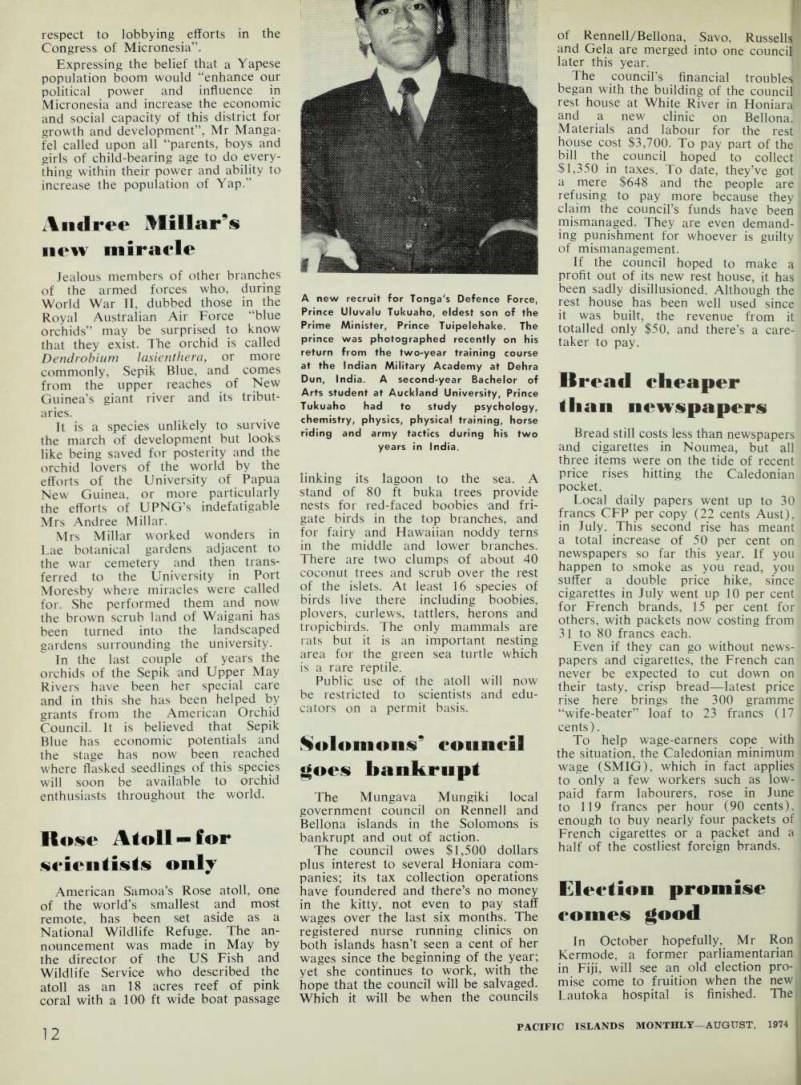
A new recruit for Tonga's Defence Force, Prince Uluvalu Tukuaho, eldest son of the Prime Minister, Prince Tuipelehake. The prince was photographed recently on his return from the two-year training course at the Indian Military Academy at Dehra Dun, India. A second-year Bachelor of Arts student at Auckland University, Prince Tukuaho had to study psychology, chemistry, physics, physical training, horse riding and army tactics during his two years in India.
hospital has been having labour troubles, plus other problems, which delayed the target date for opening by almost 18 months.
Mr Kermode, elected to the Fiji Legislative Council in 1958, repre senting what was then the North- West Division, made a new hospital for Lautoka one of his election tar gets, and he hammered that theme at every opportunity during council debates.
Project manager for the hospital, Mr G. S. Scotney, said recently that the builders had a lot of difficulty getting suitable labour because of many other development projects.
High rainfall, Hurricane Bebe and delay in getting materials from over seas, also held up the project.
The hospital, when finished, will cost about $8 million. The British Government is providing most of it; the Fiji Government will pay the rest.
The hospital will have a five storey ward block, a three-storey technical services block (including operating theatres, X-ray suite and central sterilising equipment) and three two-storey blocks for adminis tration, a pathology department, mortuary, laundry and boiler-house.
The old hospital will probably be turned into a hostel for medical students, nurses and interns. Some students will move from the Fiji School of Medicine at Suva to the new hospital.
French cargo cult
“See New Caledonia in 1974 — ■Captain Cook did it in 1774” is the message to be proclaimed on Cale donian tee-shirts when some 600 New Zealand travel industry representatives visit Noumea in October for the
annual conference of the Travel Agents Association of New Zealand
(Taanz).
The Caledonian Tourist Office is going all out to welcome the New Zealanders, with the locals being urged to make generous hand-outs of souvenir perfume, writing paper, pens, manous (colourful lap-laps) and lots of smiles. It is the smiles that could be hardest to dispense as the island continues clouded by an economic situation that is far from cheering.
But great importance is being placed upon the reception to be given to the TAANZ conference delegates.
Now that the nickel bubble has burst beyond foreseeable repair, the French are virtually invoking the help of Australian and New Zealand tourists to buoy up the territory’s sources of revenue. The big white nickel ships can no longer be counted on to sustain the islanders so Paris is intro ducing a new cargo cult—the glisten ing big jumbo jets flying in full of dollar-laden Anglo-Saxon tourists.
Meantime, tourist figures were soaring early this year as a result of the particularly low fares offered by UTA airlines to promote the new installations at the Chateau Royal Hotel.
And more help is on the way, from the north.
As New Caledonia awaits the open ing of the Noumea-Tokyo air link around November, various fore runners of the Japanese tourist cur rent are being welcomed in the ter ritory.
A TV film crew from the Tokyo Broadcasting System recently flew to the island, accompanied by young actress Reiko Ike. The group’s itinerary included the offshore Isle of Pines and Ouvea Is for TV filming.
Another visitor prompted by tourism was Mr Hisao Endo, who came from the large Fujita travel group.
Saipan's gamble
in tourism rare
“One-arm bandits” could give Saipan the edge over Guam in the race for tourists. Saipan has adopted an ordinance allowing slot machines in clubs and hotels at an annual tax of $l5O. In Guam, the Governor, Mr Carlos G. Camacho, has reso lutely refused to allow gambling.
The Mayor of Saipan, Mr Vincente Sablan, expects all hotels to install the machines. Three hotels already qualify for permits—the Royal Taga, the Hafa Adai and the Continental.
Most visitors to Guam and Saipan are Japanese. The average stay in Guam is 4i days as a package deal, which includes an overnight stay in Saipan. The “bandits” could reverse that trend. Guam in 1973, had about 200,000 visitors; Saipan had about 56,000.
A temple bell
goes home
A bell cast in 1690 for a temple in Japan, and which was in a temple in Saipan for about seven years, is now back with its owners, returned via Saipan and America. The temple in Tokyo housed the bell for 154 years, and was then burned down.
The new temple had no bell-tower, so the bell, the Genkakuji Bell, was kept in storage till 1937, when it was lent to the Nanyooji Temple in Saipan, where there was a small colony of Japanese.
When Saipan fell to the Americans during World War 11. the bell was scarred by shrapnel and holed by a bullet. It was “souvenired”, by a serviceman, and taken to America.
The Buddhist authorities searched for it, but no trace could be found till 1965, when a Japanese woman, married to an American, saw it in Texas.
It disappeared again, and was not found till 1973, when the temple authorities traced it to a collection belonging to an Oakland business man, Mr Donald V. Clair. Mr Clair, on learning the Buddhists wanted it back, gave it to the Buddhist Church of America for return to Japan. It was handed over to the traditional owners at a ceremony at Nihonmachi, the Japanese centre in San Francisco.
On the bell are engraved the names of the 300 people who gave the bell to the temple. Mr Clair’s name has now been added as a latter-day donor.
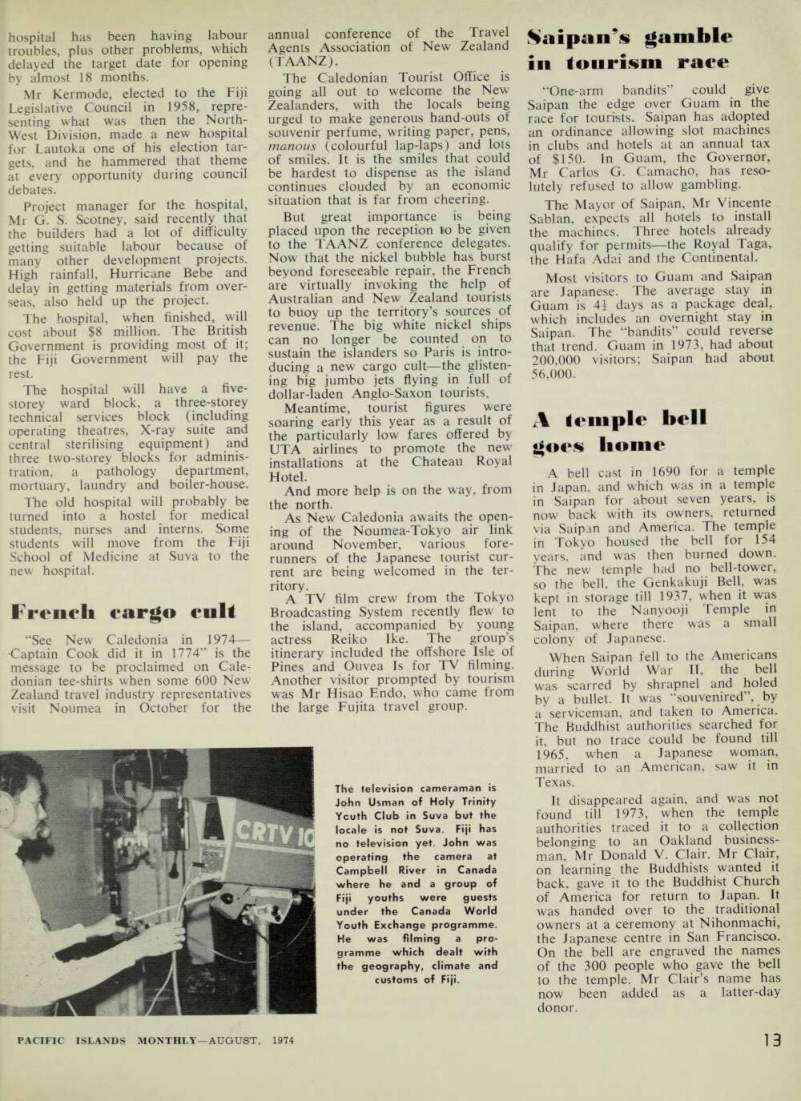
The television cameraman is John Usman of Holy Trinity Youth Club in Suva but the locale is not Suva. Fiji has no television yet. John was operating the camera at Campbell River in Canada where he and a group of Fiji youths were guests under the Canada World Youth Exchange programme.
He was filming a pro gramme which dealt with the geography, climate and customs of Fiji.