Wealth Appreciates
pp. 23-25 · Read in the full issue

Png's Other Great
In Value
From Kirsty Powell
in Port Moresby A popular stereotype of the New Guinean woman depicts her walking with a bilum or string bag on her head in which is a monstrous load of garden produce or firewood with a child or two on top, while her hus band walks unburdened, with a spear in his hand.
It is a picture from life, but it can easily be misused to suggest that relations between men and women in traditional New Guinean societies illustrate a uniform pattern of male dominance and female suppression.
Nothing in Papua New Guinea is as simple as that.
Such a stereotype does not take account of societies in which women are seen as dangerous rather than inferior; or in which women take the initiative in proposing marriage; or in which women become chiefs; or in which there was an expectation (destined to disillusionment) that some of the first white kiaps (government officers) might have been women. That all white kiaps were, in fact, men helped to strengthen male dominance.
At the beginning of the 20th century, there was a woman con stable in the Northern District. Her like has not been seen since the barbarism of traditional ways has been enlightened by colonial govern ment and education.
In the early days, the vernacular village primary schools of the missions served both boys and girls, in many cases almost equally, but as the stan dard of education offered improved, and it became necessary to set up more advanced schools to serve children from many villages, the pro portion of girls in school decreased.
Education for girls lagged behind, and although recently, the Education Department has expressed a desire to increase the number of girls in school, in fact education has become more and more a male preserve: not so much because of the educators’ in tentions as because of the villagers’ unwillingness to allow their girls to leave the village.
The boys were, among other things, more easily dispensable than their more hard-working sisters.
Moreover, as the aim of universal primary education came to be abandoned for that of the education of an elite, and as provision was made for tertiary and secondary education, the proportion of girls in the whole range of educational in stitutions has still further decreased.
It was not until 1961 that the first government girls’ secondary school was established. Figures for both primary and secondary schools show that although the total number of girls in school has increased in the last 10 years the proportion of girls to boys has decreased (although there has perhaps been a slight in crease in the proportion of girls in secondary schools).
Education, like government, looks like becoming a weapon for the en trenchment and extension of male dominance. In 1973, men out numbered women at the University of Papua New Guinea in the pro-
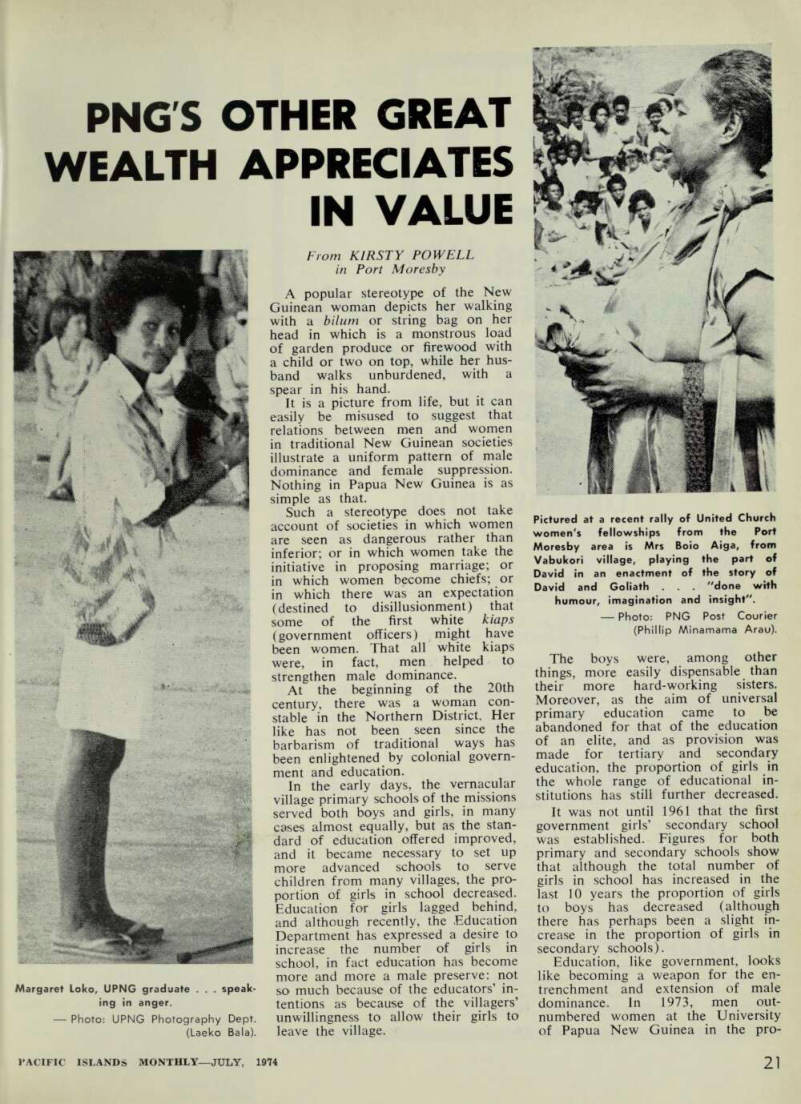
Margaret Loko, UPNG graduate . . . speak ing in anger. - Photo: UPNG Photography Dept. (Laeko Bala).
Pictured at a recent rally of United Church women's fellowships from the Port Moresby area is Mrs Boio Aiga, from Vabukori village, playing the part of David in an enactment of the story of David and Goliath "done with humour, imagination and insight". -Photo: PNG Post Courier (Phillip Minamama Arau).
portion of nine to one (in 1974, in the proportion of 11 to one); at the University of Technology in the proportion of 25 to one.
It is not surprising in such a con text that university women have often been timid in expressing them selves, and in assuming their rightful roles of leadership in campus life.
Nor is it surprising that they find themselves—when cast into such an abnormal society—the victims of male aggression, and frustration, and
possessiveness.
A favourite attitude of the male poets is that of righteous indignation at those black women who show so little sensitivity to the plight of their black brothers and to the needs of the nations as to cast their eyes at white men. The Constitutional Plan ning Committee has proposed that the children of black women who marry white men should not have the same rights to citizenship as the children of black men who marry white women. I am not unaware of the legal and socio-economic argu ments behind this proposal, but 1 wonder if such a proposal could have gone forward if there had been even a single woman on the Constitutional Planning Committee.
It is well known that there is one woman in the House of Assembly, Josephine Abaijah, She has thrown herself into other causes than that of improving the status of women, but her courage and strength in fighting for her own convictions have shown what women can do, and what power they can wield. A new assertiveness is emerging among women. They are no longer content to let the male dominance of post colonial society go unchallenged.
At a recent forum at the Univers
Sole woman member of the House of Assembly, Josephine Abaijah . . . personi fication of female courage and strength.
ity of Papua New Guinea, Josepha Namsu, a law student, accused New Guinean men of having an attitude towards women very much akin to racism. Men, she suggested, don’t want women to be equals: they are scared. Hiap Salaiau, a graduate of UPNG, elaborated a similar theme.
She pointed out that just as New Guinean men have long been under the domination of their European rulers, but are now standing up for their own rights, using the weapons of Western education in their fight, so New Guinean women are making use of their Western education, and are expressing their views to men.
Margaret Loko, another UPNG graduate, speaking in anger, but with strength and dignity, charged the men with irresponsibility: with leav ing their wives at home to shoulder all the burdens of family life, while they went “on the town”.
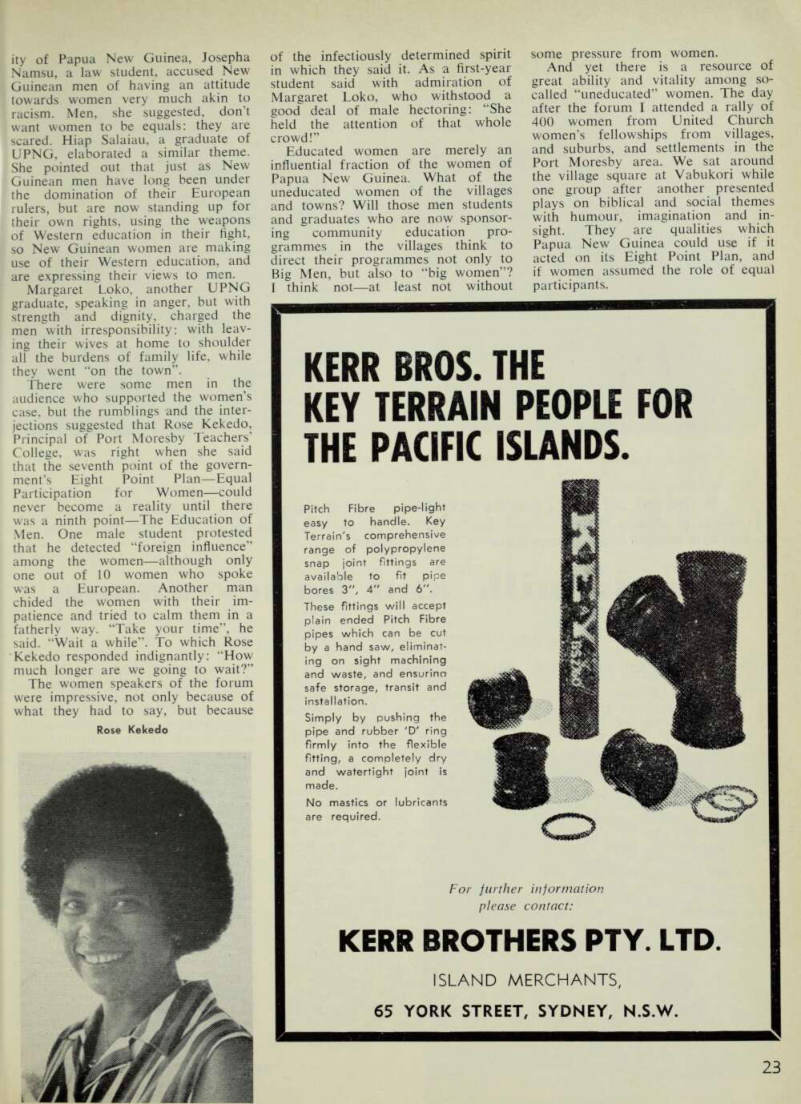
There were some men in the audience who supported the women’s case, but the rumblings and the inter jections suggested that Rose Kekedo, Principal of Port Moresby Teachers' College, was right when she said that the seventh point of the govern ment’s Eight Point Plan—Equal Participation for Women —could never become a reality until there was a ninth point—The Education of Men. One male student protested that he detected “foreign influence” among the women—although only one out of 10 women who spoke was a European. Another man chided the women with their im patience and tried to calm them in a fatherly way. “Take your time”, he said. “Wait a while”. To which Rose Kekedo responded indignantly: “How much longer are we going to wait?”
The women speakers of the forum were impressive, not only because of what they had to say, but because
of the infectiously determined spirit in which they said it. As a first-year student said with admiration of Margaret Loko, who withstood a good deal of male hectoring: “She held the attention of that whole crowd!”
Educated women are merely an influential fraction of the women of Papua New Guinea. What of the uneducated women of the villages and towns? Will those men students and graduates who are now sponsor ing community education pro grammes in the villages think to direct their programmes not only to Big Men, but also to “big women”?
I think not—at least not without
some pressure from women.
And yet there is a resource of great ability and vitality among so called “uneducated” women. The day after the forum I attended a rally of 400 women from United Church women’s fellowships from villages, and suburbs, and settlements in the Port Moresby area. We sat around the village square at Vabukori while one group after another presented plays on biblical and social themes with humour, imagination and in sight. They are qualities which Papua New Guinea could use if it acted on its Eight Point Plan, and if women assumed the role of equal participants.
Rose Kekedo