Tropicalities
pp. 16-18 · Read in the full issue
It's to be Port Moresby DC
Papua New Guinea is to have a new district—the 20th—to cover the capital city of Port Moresby which is to be excised from old Central District. In the tradition of Washing ton DC and Australian Capital Territory, it’s to be the National Capital District.
The decision was made by the cabinet, which “considered the mat ter carefully”, according to Chief Minister Somare. He thought that it would please the people who be lieved that money allocated to Central District was spent on Port Moresby city. Now they would see that Central District expenditure went to that district.
The decision didn’t please every one, including PNG’s opposition and the member for Tari-Komo, Mr Matiabe Yuwi. It was another example of cabinet disregarding the House of Assembly, he said. A de cision of this sort should involve the people of PNG as a whole, through their representatives.
He asked what had happened to the recommendations of a select committee set up during the second House of Assembly to investigate possible sites for a future capital city of PNG. That committee had re commended Arona, near Kainantu, as being climatically and geographic
ally suited but nothing more had been heard of it.
He said that it seemed that the government, having ignored the Papua Besena movement of Miss Abaijah initially, now saw it as a major threat and had proclaimed the new district as an attempt to ap pease the lady.
Despite the valid points, the mem ber for Tari-Komo is crying in the wilderness. Our Port Moresby man says that with all those large, ex pensive buildings rising among the scrub out at suburban Waigani it is impossible to believe that anyone ever expected that PNG’s capital would be anywhere but where it is.
And it’s $lO to a coconut that the new National Capital District will continue to get most of the cash and that Central District will continue to be overshadowed by the big voracious city in its midst.
Making
iioii-chizens
in Micronesia
When is a Micronesian born in Micronesia and living in Micronesia a “non-citizen” of Micronesia? The answer is set out in what is now known as Public Law 5-85 recently approved, rather against his judg ment, by the Trust Territory High Commissioner, Mr Edward E. John ston. He had previously disapproved the measure, but Congress passed it again and sent it back to him for reconsideration.
The measure Mr Johnston signed related to the definition of “non citizen” in the Foreign Investors Business Permit Act. It stated “a non-citizen is any person who is not a Trust Territory citizen, or a Micro nesian who is married to a non citizen, or is under the age of 18 and who is adopted by parents at least
one of whom is not a XT citizen; o any company, corporation or asso ciation in which a person who own any interest is not a Trust Territor; citizen as defined previously”.
The object of the measure is tew prevent people using a Micronesian! husband, wife or adopted child to get into business in the Trust Terri tory.
Mr Johnston, when he first re jected the measure, said it could well be set aside by the courts as illegal.
In a letter to the Congress leader ship after signing the measure he set out his doubts again: “We still feel that this act is discriminatory against Micronesians who have married or been adopted by non-Trust Territory citizens and are now being subjected to rules and regulations not in effect at the time of their marriage and/or adoption”.
The new law would be tested by some Micronesians now classified as non-citizens. However, in spite of his continuing objections he could not justify forwarding the legislation to the Secretary of the Interior, as would have been required had he disapproved the measure a second time.
lISIP's antidote
Ut inflation!
Under a recent order from the High Commissioner of the Solomons, local councils have regained power to organise village people to do com munal work . . . without pay.
It’s really a step back in time.
Years ago local people worked for nothing on special “council days”, cleaning villages and maintaining roads and footpaths. Then labour laws were introduced, pronouncing that work of this kind had to be paid for.
Under the new order, councils can pass by-laws requiring village people to do minor communal work, on anything but commercial ventures.
Any villager can be asked to work up to 26 days in any one year and if he doesn’t do his bit, he can be fined by a native court.
This arrangement doesn’t conform strictly to international agreements on communal work, but the government has been able to satisfy the Inter-
national Labour Organisation of the United Nations that the council by laws would not lead to exploitation of villagers.
This custom operates in several Island territories. In Fiji, for instance, under the Fijian administration—as distinct from the Fiji Government — villagers had work to do without pay, and villagers living away from their villages had to pay a tax in lieu of work. Norfolk islanders, too, have so many days a year compulsory unpaid work or pay a tax.
Big (leas have
little fleas...
Achatina Fulica, the fancy name the bug men have given to the Giant African Snail, is running (or crawl ing) riot in Vila. But not to worry.
The Agriculture Department has found an antidote, two much smaller snails which hail from Hawaii.
These smaller snails, Euqlandina and Gonaxis, eat the giant snails although you’d expect it would be the other way round. But, it’s not surprising; some of PlM’s staff, a little on the small side, believe a good little ’un is worth at least two mediocre big ’uns.
Well, 50 Euqlandinas and 50 Gonaxis (should the plural be Gonaxises?) have arrived in Vila and have been put to work in areas where old Achatina is thick on the ground, which is around the Number 2 and Star Wharf areas.
There’s just one snag. The Gonaxis
is a real little cannibal. He eats both the old Achatina and the Euqlandina, so they’ve had to separate the two little ’uns and put them to work in different areas. The Euqlandina is about two inches long (50.7998 mm in the French sector) while its hungry mate Gonaxis is much smaller and shaped like a normal snail At the time of writing, the Euqlan dina and Gonaxis were busy working their way through the Achatina population with Euqlandina looking over his shoulder in case the Gonaxis decided to try some Euqlandina as a change from Achatina.
Which brings us round to the old ditty—Big fleas have lesser fleas on their backs to bite ’em; little fleas have lesser fleas, and so ad infinitum.
8 nside, a
Safari of gold
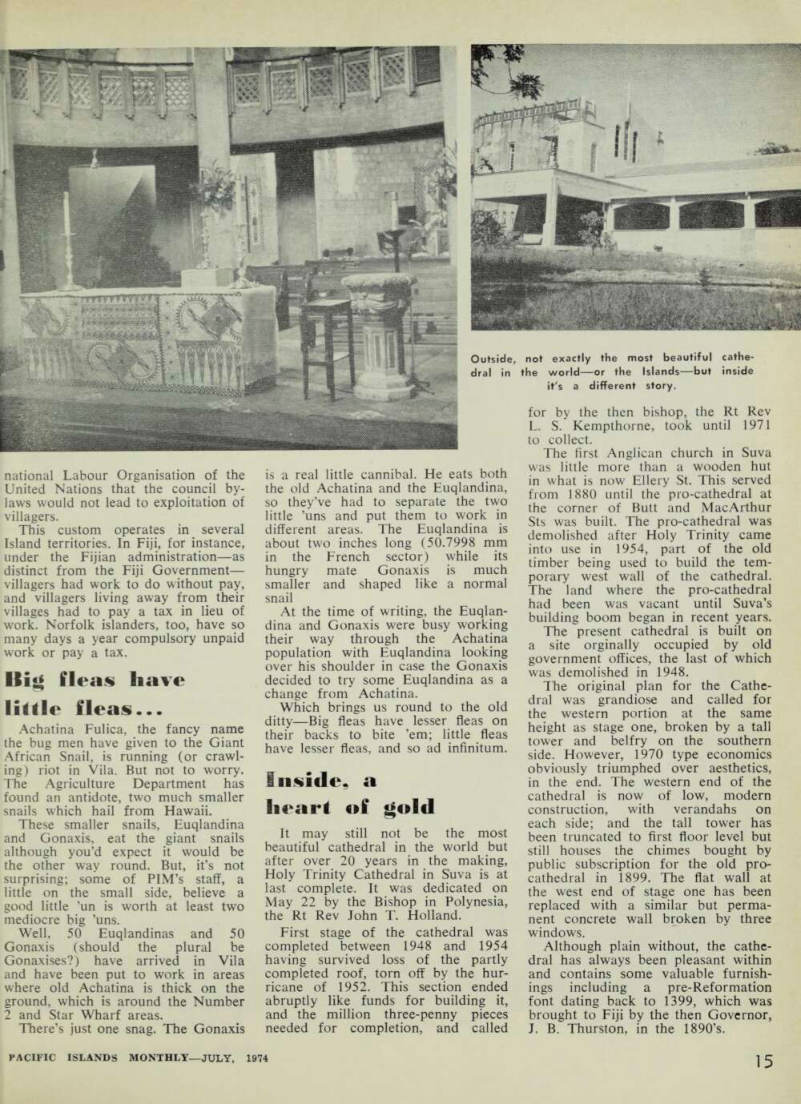
It may still not be the most beautiful cathedral in the world but after over 20 years in the making, Holy Trinity Cathedral in Suva is at last complete. It was dedicated on May 22 by the Bishop in Polynesia, the Rt Rev John T. Holland.
First stage of the cathedral was completed between 1948 and 1954 having survived loss of the partly completed roof, torn off by the hur ricane of 1952. This section ended abruptly like funds for building it, and the million three-penny pieces needed for completion, and called
for by the then bishop, the Rt Rev L. S. Kempthorne, took until 1971 to collect.
The first Anglican church in Suva was little more than a wooden hut in what is now Ellery St. This served from 1880 until the pro-cathedral at the corner of Butt and MacArthur Sts was built. The pro-cathedral was demolished after Holy Trinity came into use in 1954, part of the old timber being used to build the tem porary west wall of the cathedral.
The land where the pro-cathedral had been was vacant until Suva’s building boom began in recent years.
The present cathedral is built on a site orginally occupied by old government offices, the last of which was demolished in 1948.
The original plan for the Cathe dral was grandiose and called for the western portion at the same height as stage one, broken by a tall tower and belfry on the southern side. However, 1970 type economics obviously triumphed over aesthetics, in the end. The western end of the cathedral is now of low, modern construction, with verandahs on each side; and the tall tower has been truncated to first floor level but still houses the chimes bought by public subscription for the old pro cathedral in 1899. The flat wall at the west end of stage one has been replaced with a similar but perma nent concrete wall broken by three windows.
Although plain without, the cathe dral has always been pleasant within and contains some valuable furnish ings including a pre-Reformation font dating back to 1399, which was brought to Fiji by the then Governor, J. B. Thurston, in the 1890’s.
Outside, not exactly the most beautiful cathe dral in the world—or the Islands —but inside it's a different story.
No place like koine
—and $3 million
The Bikinians are prepared to re turn to their own atoll—at a price.
Several times in the last 12 months a date for their return has appeared imminent. There was even a pilot project arranged for some of them to go to the atoll to inspect the houses being built for them.
Late in 1973, there was every in dication they would be home by Christmas. Now with 1974 almost half over the date of their return has been postponed indefinitely. They now say they will not return till the United States agrees to make them an ex gratia payment of $3 million.
A delegation representing them went to Washington to ask for the money.
They went away with assurances ringing in their ears that the Defence and Interior departments would promptly and sympathetically con sider their request.
The islanders were evacuated to Kili Island in the Marshalls to make way for the US nuclear tests in the late 40s and early 50s. A programme to rehabilitate the island started several years ago.
1181 tourism a Bid
a dead duck
Two reports by independent bodies in the Solomons, each highly critical of government policy, have appeared in Honiara in the same month.
The annual report of the BSIP Tourist Authority pointed out that while more people than ever are visiting the Solomons (about 2,500 a year by air and another 7,000 from cruise ships), the government ap peared to have done little to en courage tourism. The report con cluded on a despondent note that there appeared to be little official interest in the future of the tourist industry.
The authority complained that despite representations on its part, the government had taken no action about restricting roadside advertising signs, preserving war relics, improv ing airport conditions, or smartening up the Botanical Gardens.
Official reaction to tourism in the Solomons has always been lukewarm, dating back to a radio programme several years ago when a secretariat spokesman declared that the authori ties were not really interested in the tourist industry, a remark which still rankles with a section of the com mercial population.
The second controversial report was that of the Public Service Ad
visory Board, which criticised the action of a number of elected mem bers who wanted to take a larger part in the BSIP localisation pro gramme. The PSAB, however, has long been regarded as a dead duck by most civil servants and Govern ing Council members alike, and a considerable restructuring in the near future is anticipated.
llasketball ilie
Erie* ib dir way
The Australian Amateur Basketball Association was recently given a les son in basketball—lsland style—by a group of Tongan players. The team, which was formed only a short time ago, was playing against an Australian team at the association’s headquarters in Sydney when punches, instead of the ball, were thrown within minutes of the start. One Tongan was sent off and a few moments later an all-in brawl was in full swing, resulting in the game’s suspension.
Police were called to the scene but the nimble-footed Tongans had already left. Among the debris were the two women referees nursing Tongan-inflicted bruises, and the den tures of one Australian player which required $2OO worth of repairs.
At a subsequent inquiry the Tongan team was banned for life and players received suspensions ranging up to 15 years. No tears were shed in Sydney as it is believed that most of the players were only on holiday visas anyway.
St Fieri re versus
i li< llKoibb
The St Pierre affair, that has kept charges and counter charges flying around the US Trust Territory for 14 months, dragged on into June.
Mr Roger St Pierre, who has been T.T. Chief Public Defender since 1962 was charged over a year ago with accepting a legal fee or a gift for services provided to a Marshal lese woman in a probate case. The official position was that this was a breach of regulations under which Federal civil service employees work and Mr St Pierre was first notified in April 1973 of the T.T.’s intention to remove him.
However, St Pierre fought success fully to retain his job. The matter was heard before a judge in Saipan who delivered his judgment in April 1974, upholding the government’s main charge against the public defender but suggesting that a 90 days suspension from duties rather than final dismissal would best suit the case.
High Commissioner Edward E.
Johnston chose, however, to ignore the recommendation and advised St Pierre that his duties would be terminated on May 31, 1974. Sub sequently the T.T. Chief Justice issued a restraining order preventing the T.T. government from carrying out the dismissal and set a date in June for an appeal to be heard. St Pierre’s contention is that he is an employee of the Trust Territory and not of the US Dept of the Interior and therefore is not subject to Federal public service regulations.
The public defender has received wide-spread public support in Saipan while the H.C. has been accused by some of conducting a personal vendetta against St Pierre.
H a ppy returns
Britain’s Prince of Wales, Prince Charles, so enjoyed his recent visit to Fiji aboard a Royal Navy ship that he has accepted the invitation to return in October for the big centenary celebrations of the signing of the deed of cession which gave Fiji to Britain.
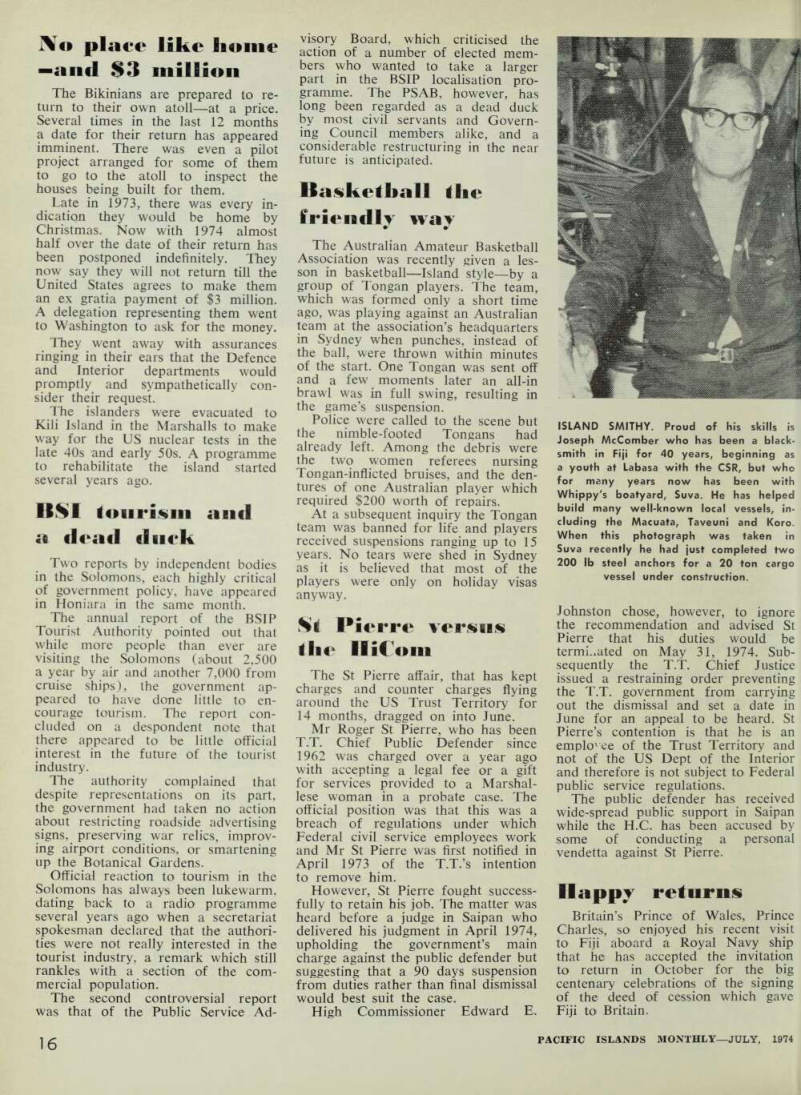
ISLAND SMITHY. Proud of his skills is Joseph McComber who has been a black smith in Fiji for 40 years, beginning as a youth at Labasa with the CSR, but who for many years now has been with Whippy's boatyard, Suva. He has helped build many well-known local vessels, in cluding the Macuata, Taveuni and Koro.
When this photograph was taken in Suva recently he had just completed two 200 lb steel anchors for a 20 ton cargo vessel under construction.