Magazine Section
pp. 61-63 · Read in the full issue
New Caledonia's Petit Train': The
Railway Which Went Nowhere
By H. B. Rennie
South Pacific islands are not a likely place for railways. Many know Fiji’s famous sugar trains, but few visitors realise that the traces of a metre-gauge public railway can still be seen in New Caledonia.
The casual traveller, disembarking at Tontouta airport, passes several clues on the trip to his hotel at Noumea. The telegraph lines plunge into the bush at Paita township and do not rejoin the road; at Dumbea River a second substantial bridge can be seen upriver from the road bridge; and a really sharp-eyed traveller may see the stone facade of Tonghoue tunnel.
But no local museum or book re cords the story of a railway which was perhaps the most improbable “railway to nowhere” ever built.
Even the menus of Noumea’s Le Petit Train restaurant lack any illus tration of the tiny railway after which it is named.
To understand its history one must go back to 1895 when New Caledonia, a long narrow mountain ous island surrounded by reefs, had no satisfactory transport. Noumea’s beautiful harbour had given it some prosperity, but many promising areas could not be reached by sea, while prospective mines were uneconomic because their output could not reach a port.
French Governor Paul Feillet could see that settlement would only follow transport. Long the dumping ground for French convicts, New Caledonia was about to end its role as a prison—without any other economic base to keep it viable.
In 1895 he presented a proposal, modest for its time, to borrow 10 million francs. With this he would dredge the harbour, build wharves and a graving dock, and a 152 km railway from Noumea to Bourail, the country’s second town and a farming and mining centre.
Three years later a reluctant French Government approved a loan of five million francs for a railway to reach Tontouta, 54 km from Noumea, Only in 1901 did the money come to hand. In June of that year the works were proclaimed; in August they started, and Feillet happily told the November budget session “at the end of this session we will be able to travel, in a train notable for its lack of luxury, four kilometres across the marshes and the Riviere Salee to the slopes of Koutio- Koueta”.
Such rapid progress did not con tinue. Indentured labourers had to be brought in to provide enough workers, and in 1902 Tonkinese workers arrived on labour contracts.
By 1903 the first section of line was
complete—l 3 kilometres from Nou
mea to Tonghoue. The line began at Noumea’s tiny station, half a mile from the docks, and ran straight inland across marshes to cross the Riviere Salee on a 47 metre steel
bridge. Passing Koutio station—
actually just a simple sign bearing its name—it stopped short of Tong houe summit, a 122 metre hill with a commanding view of Noumea.
Here the Tonkinese laboured to build a 203 metre tunnel, with a formal stone facade and lined throughout with concrete.
Already the line had its critics.
“It goes nowhere” snapped one; and indeed it had taken a formidable part of the first loan—nearly four million of the five million francs— to build these first 13 km and start the tunnel. During 1903 the tunnel was pierced but no train services operated and the railway, out of
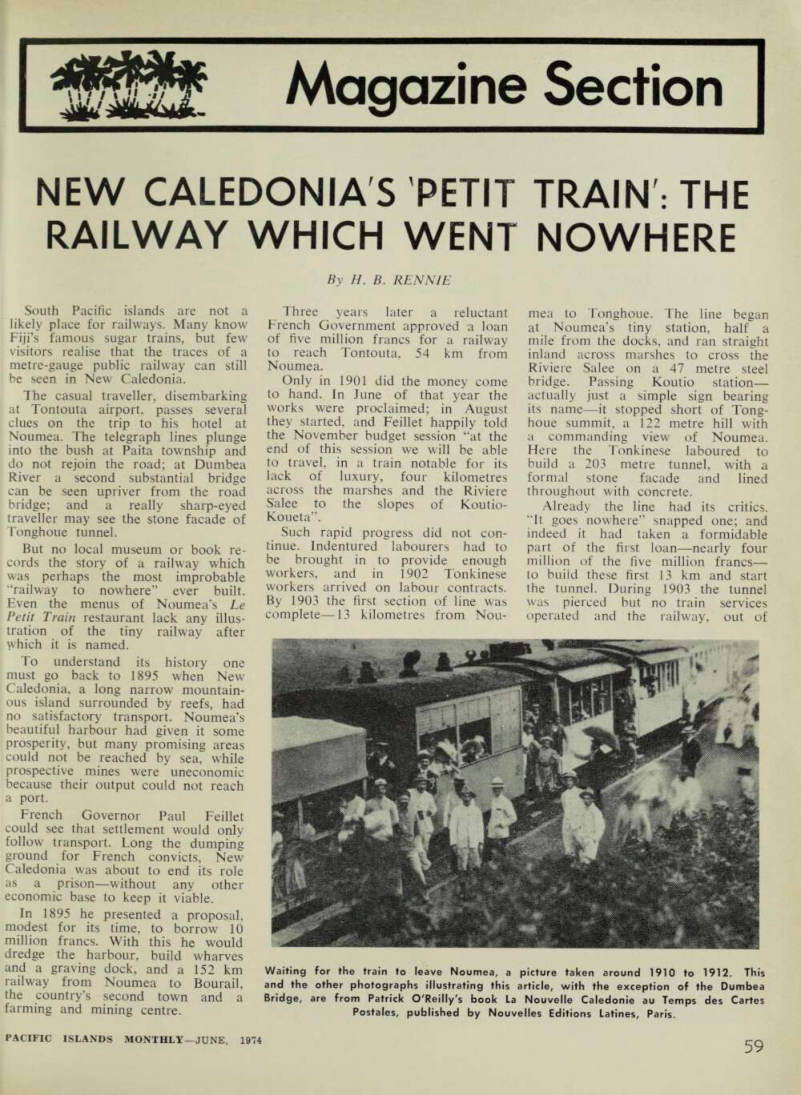
Waiting for the train to leave Noumea, a picture taken around 1910 to 1912. This and the other photographs illustrating this article, with the exception of the Dumbea Bridge, are from Patrick O'Reilly's book La Nouvelle Caledonie au Temps des Cartes Postales, published by Nouvelles Editions Latines, Paris.
Putting Away Their Little Toy
funds, suspended construction in January, 1904 at the 16 km point.
New Caledonia’s politicians de bated the debacle. “We will have to put away our little toy” said Marc le Goupils, a clever writer who had no time for Feillet’s larger flights of fancy.
Elaborate analyses were made.
The money in hand was sufficient for one of three choices, but not more. The railway station could be joined to the quay; or the Dumbea River could be bridged; or the river could be left unbridged and the line continued beyond the river to the mines.
Had the debaters spent their time working on the railway more might have been achieved, for by the time the money came to be spent interest costs had mounted even further and nothing was left for even one of the choices!
On January 1, 1905 the territory commenced railway operations on the Noumea/Dumbea section. Three locomotives, four carriages, and 24 assorted wagons provided the ser vices; the carriages proudly bearing on their sides the inscriptions “N-B”, for Noumea-Bourail. But of the 152 km between these centres, the trains ran for only 17 km.
Laid out as a narrow-gauge moun tain railway, the line had light track (about 40 lb rails), curves with a minimum radius of 100 metres, and a maximum grade of 25 mm per metre (1 in 40). Travelling downhill a train might reach a speed of 40 km an hour. But the simple fact was, that until the line crossed the Dumbea river and the range beyond, there would be little in the way of profitable rail traffic. Noumea is cut off from the mines and the farming plains to the north by some 20 miles
of steep hill country, difficult to traverse and with little cultivable land.
New Caledonia’s tiny population— -17,000 Frenchmen and 38,000 Mela nesians in 1904—needed transport, but they could not afford to take the line further. The government did what it could. Land concessions were offered along the line, with special freight rates for industry. Meanwhile hopes remained high. Across the Dumbea, in the valley of Nondoue, coal had been discovered. Here surely was the key to the railway’s extension —and its future profit ability.
So confident of its future was the Societe des Charbonnages that it proudly proclaimed it would extend the railway at its own expense —and turn Noumea into a great coaling port with coal said to be 25 per cent better than best Australian grades.
Reality was more brutal. By 1906 the mine so confidently begun in 1905 was closed, company operations had ceased, and people ceased to talk of a large freight traffic waiting only for a bridge across the Dumbea.
Change was beginning to overtake the little railway. On June 30, 1906 the first bus service from Noumea to Bourail began. The road had already achieved, for passengers at least, what the railway had failed to do.
The island’s economy improved a little in 1908, though the railway’s total of general goods carried —185 tonnes for the year—was pitiful.
Charges on the loan bore heavily on the territory’s finances. The only answer seemed to be to press on.
Feillet, in particular, never aban doned faith, and in 1909 a second loan of 2,360,000 francs was made.
This was expected to cover the cost
of the line to Paita (13 km), to gether with route surveys for Paita/ Tamoa (15 km 830 m) and Tamoa/ Tontouta (14 km 300 m). On May 1, 1910 the new works started.
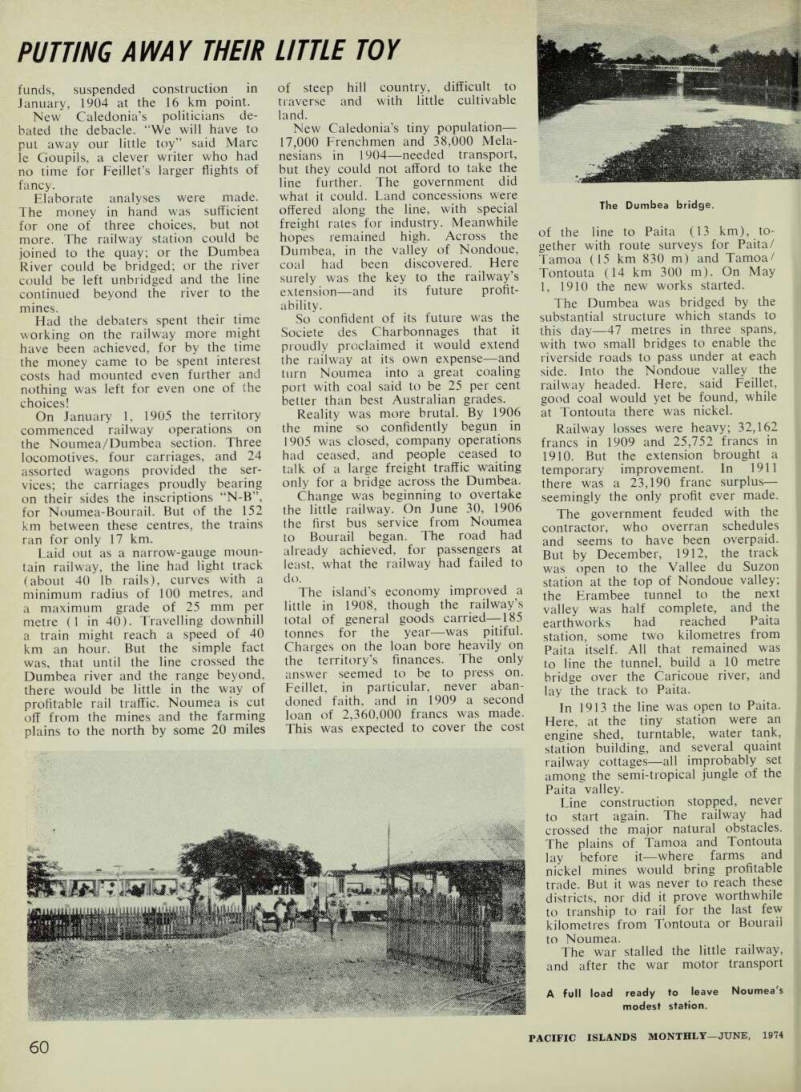
The Dumbea was bridged by the substantial structure which stands to this day—47 metres in three spans, with two small bridges to enable the riverside roads to pass under at each side. Into the Nondoue valley the railway headed. Here, said Feillet, good coal would yet be found, while at Tontouta there was nickel.
Railway losses were heavy; 32,162 francs in 1909 and 25,752 francs in 1910. But the extension brought a temporary improvement. In 1911 there was a 23,190 franc surplus— seemingly the only profit ever made.
The government feuded with the contractor, who overran schedules and seems to have been overpaid.
But by December, 1912, the track was open to the Vallee du Suzon station at the top of Nondoue valley; the Erambee tunnel to the next valley was half complete, and the earthworks had reached Paita station, some two kilometres from Paita itself. All that remained was to line the tunnel, build a 10 metre bridge over the Caricoue river, and lay the track to Paita.
In 1913 the line was open to Paita.
Here, at the tiny station were an engine shed, turntable, water tank, station building, and several quaint
railway cottages—all improbably set
among the semi-tropical jungle of the
Paita valley.
Line construction stopped, never to start again. The railway had crossed the major natural obstacles.
The plains of Tamoa and Tontouta lay before it—where farms and nickel mines would bring profitable trade. But it was never to reach these districts, nor did it prove worthwhile to tranship to rail for the last few kilometres from Tontouta or Bourail to Noumea.
The war stalled the little railway, and after the war motor transport
The Dumbea bridge.
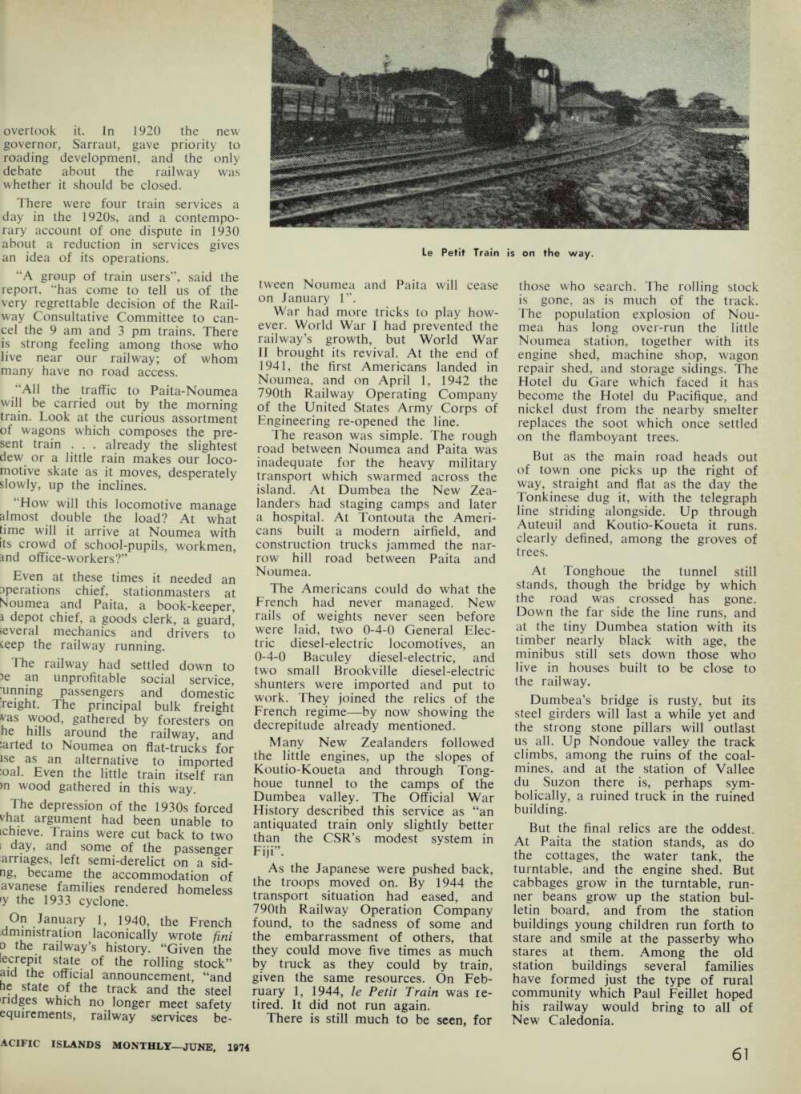
A full load ready to leave Noumea's modest station.
overtook it. In 1920 the new governor, S'arraut, gave priority to reading development, and the only debate about the railway was whether it should be closed.
There were four train services a day in the 19205, and a contempo rary account of one dispute in 1930 about a reduction in services gives an idea of its operations.
“A group of train users”, said the report, “has come to tell us of the very regrettable decision of the Rail way Consultative Committee to can cel the 9 am and 3 pm trains. There is strong feeling among those who live near our railway; of whom many have no road access.
“All the traffic to Paita-Noumea will be carried out by the morning train. Look at the curious assortment of wagons which composes the pre sent train . . . already the slightest dew or a little rain makes our loco motive skate as it moves, desperately slowly, up the inclines.
“How will this locomotive manage almost double the load? At what time will it arrive at Noumea with its crowd of school-pupils, workmen, and office-workers?”
Even at these times it needed an Dperations chief, stationmasters at Noumea and Paita, a book-keeper, a depot chief, a goods clerk, a guard, several mechanics and drivers to ceep the railway running.
The railway had settled down to ?e an unprofitable social service, 'unning passengers and domestic reight. The principal bulk freight vas wood, gathered by foresters on he hills around the railway, and :arted to Noumea on flat-trucks for ise as an alternative to imported :oal. Even the little train itself ran m wood gathered in this way.
The depression of the 1930 s forced vhat argument had been unable to ichieve. Trains were cut back to two i day, and some of the passenger arriages, left semi-derelict on a sid ng, became the accommodation of avanese families rendered homeless •y the 1933 cyclone.
On January 1, 1940, the French dministration laconically wrote fini o the railway’s history. “Given the lecrepit state of the rolling stock” aid the official announcement, “and be state of the track and the steel ridges which no longer meet safety equipments, railway services be-
tween Noumea and Paita will cease on January 1”.
War had more tricks to play how ever. World War I had prevented the railway’s growth, but World War II brought its revival. At the end of 1941, the first Americans landed in Noumea, and on April 1, 1942 the 790th Railway Operating Company of the United States Army Corps of Engineering re-opened the line.
The reason was simple. The rough road between Noumea and Paita was inadequate for the heavy military transport which swarmed across the island. At Dumbea the New Zea landers had staging camps and later a hospital. At Tontouta the Ameri cans built a modern airfield, and construction trucks jammed the nar row hill road between Paita and Noumea.
The Americans could do what the French had never managed. New rails of weights never seen before were laid, two 0-4-0 General Elec tric diesel-electric locomotives, an 0-4-0 Baculey diesel-electric, and two small Brookville diesel-electric shunters were imported and put to work. They joined the relics of the French regime—by now showing the decrepitude already mentioned.
Many New Zealanders followed the little engines, up the slopes of Koutio-Koueta and through Tong houe tunnel to the camps of the Dumbea valley. The Official War History described this service as “an antiquated train only slightly better than the GSR’s modest system in Fiji”.
As the Japanese were pushed back, the troops moved on. By 1944 the transport situation had eased, and 790th Railway Operation Company found, to the sadness of some and the embarrassment of others, that they could move five times as much by truck as they could by train, given the same resources. On Feb ruary 1, 1944, le Petit Train was re tired. It did not run again.
There is still much to be seen, for
those who search. The rolling stock is gone, as is much of the track.
The population explosion of Nou mea has long over-run the little Noumea station, together with its engine shed, machine shop, wagon repair shed, and storage sidings. The Hotel du Gare which faced it has become the Hotel du Pacifique, and nickel dust from the nearby smelter replaces the soot which once settled on the flamboyant trees.
But as the main road heads out of town one picks up the right of way, straight and flat as the day the Tonkinese dug it, with the telegraph line striding alongside. Up through Auteuil and Koutio-Koueta it runs, clearly defined, among the groves of trees.
At Tonghoue the tunnel still stands, though the bridge by which the road was crossed has gone.
Down the far side the line runs, and at the tiny Dumbea station with its timber nearly black with age, the minibus still sets down those who live in houses built to be close to the railway.
Dumbea’s bridge is rusty, but its steel girders will last a while yet and the strong stone pillars will outlast us all. Up Nondoue valley the track climbs, among the ruins of the coal mines, and at the station of Vallee du Suzon there is, perhaps sym bolically, a ruined truck in the ruined building.
But the final relics are the oddest.
At Paita the station stands, as do the cottages, the water tank, the turntable, and the engine shed. But cabbages grow in the turntable, run ner beans grow up the station bul letin board, and from the station buildings young children run forth to stare and smile at the passerby who stares at them. Among the old station buildings several families have formed just the type of rural community which Paul Feillet hoped his railway would bring to all of New Caledonia.
Le Petit Train is on the way.