Yesterday
p. 52 · Read in the full issue
Twenty years ago young American Samoans were keen to get into the US Navy. A selection team from the US interviewed 1,000 aspirants who underwent mental and physical tests.
Eighty-four were chosen for enlistment in the US Navy. They're still keen 20 years after, making successful protests to the US Defence Department when a ban was slapped on the recruitment of Samoans for the US Forces. Twenty-four American Samoans died in Vietnam.
A plea for more and better publicity in Australia for Papua New Guinea was made at the May, 1954, session of the Legislative Council by Mr Don Barrett, elected member for the New Guinea Islands. In Australia during the Royal visit, Mr Barrett evidently had a unhappy time permit-seeking down in the wilds of West Circular Quay where the Sydney branch of the Department of Territories had its being, PIM reported. He said that although the room he entered had about 14 people in it, none seemed at all anxious to come to the counter to find out what he wanted; and that when they did they obviously had little or no knowledge of Papua New Guinea and conditions there. Mr Barrett died suddenly in January, 1973.
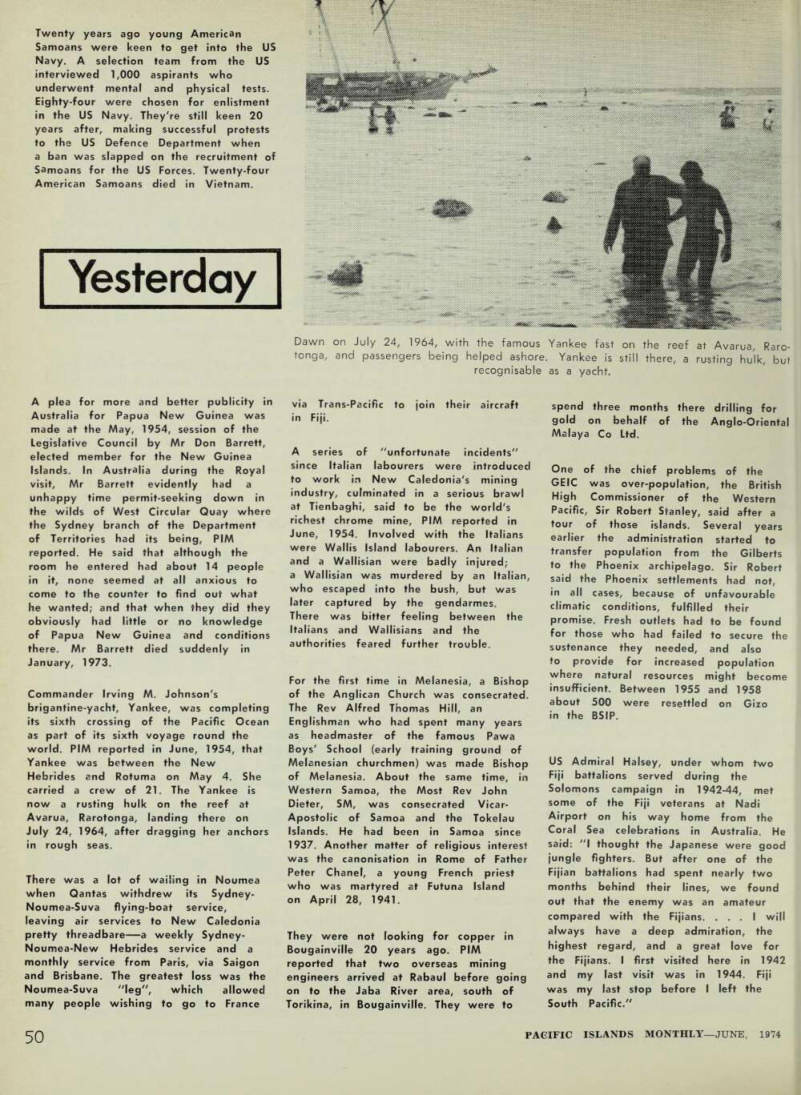
Commander Irving M. Johnson's brigantine-yacht, Yankee, was completing its sixth crossing of the Pacific Ocean as part of its sixth voyage round the world. PIM reported in June, 1954, that Yankee was between the New Hebrides and Rotuma on May 4. She carried a crew of 21. The Yankee is now a rusting hulk on the reef at Avarua, Rarotonga, landing there on July 24, 1964, after dragging her anchors in rough seas.
There was a lot of wailing in Noumea when Qantas withdrew its Sydney- Noumea-Suva flying-boat service, leaving air services to New Caledonia pretty threadbare —a weekly Sydney- Noumea-New Hebrides service and a monthly service from Paris, via Saigon and Brisbane. The greatest loss was the Noumea-Suva "leg", which allowed many people wishing to go to France
via Trans-Pacific to join their aircraft in Fiji.
A series of "unfortunate incidents" since Italian labourers were introduced to work in New Caledonia's mining industry, culminated in a serious brawl at Tienbaghi, said to be the world's richest chrome mine, PIM reported in June, 1954. Involved with the Italians were Wallis Island labourers. An Italian and a Wallisian were badly injured; a Wallisian was murdered by an Italian, who escaped into the bush, but was later captured by the gendarmes.
There was bitter feeling between the Italians and Wallisians and the authorities feared further trouble.
For the first time in Melanesia, a Bishop of the Anglican Church was consecrated.
The Rev Alfred Thomas Hill, an Englishman who had spent many years as headmaster of the famous Pawa Boys' School (early training ground of Melanesian churchmen) was made Bishop of Melanesia. About the same time, in Western Samoa, the Most Rev John Dieter, SM, was consecrated Vicar- Apostolic of Samoa and the Tokelau Islands. He had been in Samoa since 1937. Another matter of religious interest was the canonisation in Rome of Father Peter Chanel, a young French priest who was martyred at Futuna Island on April 28, 1941.
They were not looking for copper in Bougainville 20 years ago. PIM reported that two overseas mining engineers arrived at Rabaul before going on to the Jaba River area, south of Torikina, in Bougainville. They were to
spend three months there drilling for gold on behalf of the Anglo-Oriental Malaya Co Ltd.
One of the chief problems of the GEIC was over-population, the British High Commissioner of the Western Pacific, Sir Robert Stanley, said after a tour of those islands. Several years earlier the administration started to transfer population from the Gilberts to the Phoenix archipelago. Sir Robert said the Phoenix settlements had not, in all cases, because of unfavourable climatic conditions, fulfilled their promise. Fresh outlets had to be found for those who had failed to secure the sustenance they needed, and also to provide for increased population where natural resources might become insufficient. Between 1955 and 1958 about 500 were resettled on Gizo in the BSIP.
US Admiral Halsey, under whom two Fiji battalions served during the Solomons campaign in 1942-44, met some of the Fiji veterans at Nadi Airport on his way home from the Coral Sea celebrations in Australia. He said: "I thought the Japanese were good jungle fighters. But after one of the Fijian battalions had spent nearly two months behind their lines, we found out that the enemy was an amateur compared with the Fijians. ... I will always have a deep admiration, the highest regard, and a great love for the Fijians. I first visited here in 1942 and my last visit was in 1944. Fiji was my last stop before I left the South Pacific."
Dawn on July 24, 1964, with the famous Yankee fast on the reef at Avarua, Raro tonga, and passengers being helped ashore. Yankee is still there, a rusting hulk, but recognisable as a yacht.