Behind The Scenes As Guam Gets
pp. 14-15 · Read in the full issue
Unready For The 1975 Games
The Fifth South Pacific Games are slated for August 9-22 at Guam on the other side of the equator but M with the Games only 14 months away, the venue may be switched in the face of growing doubts that Guami has the ability or the facilities to host them. Alarmed at the absence of news of preparations being made by> ouam, which has failed to answer three requests for information, members of the Games Council have ca I led I a meeting for May 31 in Suva when a switch may be decided on. What has been happening behind the scenes; in Guam? Below, Joe Murphy, editor of Guam's Pacific Daily News, supplies the answers in a special report for PIM, sent before Games Council members decided to act.
From JOE MURPHY, on Guam
Despite Guam’s relatively high level of prosperity, potential visitors are cautioned that the 1975 Games facilities won’t be anywhere near the level of those seen last in 1971 at Tahiti. There are many reasons for this sad situation, but basically the problem stems from the fact that the Games got embroiled in a political controversy between the Democratic Party (which controls the Guam Legislature, and whose Speaker, Sen.
Larry Ramirez, issued the invitation to hold the Games in Guam), and the Republican administration headed by Governor Carlos Camacho.
Ramirez had assumed that the US Government would help pay the cost of the sports facilities needed for Guam, as a gesture to Pacific good will. Unfortunately, the violence at the 1972 Olympic Games, brought an adverse reaction throughout the US, and the federal government refused to guarantee aid to Denver or Salt Lake City, both of whom wanted to host the 1976 Winter Games. Having already refused two states, the US Government couldn’t bend the policy to help Guam.
It had been estimated that Guam’s sports complex would cost from SUSS to $6 million. More than a year ago, Governor Camacho insisted that Guam needed this money for high ways, telephones, power, sewerlines and schools, and announced that Guam would be unable to host the Games.
This unpopular announcement brought ringing editorials protesting at the inhospitality, the “slap in the face”, to Island neighbours. Under pressure, Governor Camacho re considered, deciding that he didn’t have the authority to call off the Games, because that decision had to be made by the South Pacific Games Committee. He did say that he expected help from the business community in building the sporting complex, and that the Guam Govern ment itself wouldn’t be able to give much financial support.
The matter has developed into such a local hassle that Ted Nelson, Guam Games chairman, has already tossed his hat in the ring as a candidate for lieut-governor in this November’s elections, as a Democrat.
And Republican Senator Pauli Calvo, head of the Guam Gamesi Committee, recently announced his; resignation from that post in order toi challenge Governor Camacho in the: September Republican primary, ad ding even more politics to the Guam scene.
But in the meantime some Guam facilities—tennis courts, pool, track, etc —are slowly being upgraded, and other improvements are planned, and still others are being studied by the experts. No central stadium, for instance, exists, and whether one could be completed, even if started im mediately, is questionable.
But there are other alternatives.
The large US military bases on Guam have ample sports facilities for their 30,000 men, and these could be made available for some, or all, of the Games with some give and take between the Guam Government and the military, although even here, too, a hassle has developed. When Rear- Adm. G, Steve Morrison was asked about the possibility of using his facilities, he said this would be perfectly acceptable—providing “his boys” got to participate. But this was out of the question, because the rules for participation had already been set down.
In addition, Guam politicians and the military establishment are in the midst of a battle royal themselves which could affect use of the military snorts facilities. The Navy wants lo move its ammunition wharf out of busy, heavily-populated Apra Harbour to a pristine, rugged, unpopulated area on Guam’s southwest coast. The move, at an estimated cost of SUS 120,000,000 would require the acquisition of some 4,000 Part of the land that would be accuired is owned by yet another Gu< i Senator, Paul Bordallo, who insists that the Navy already has enough Guam land. (Sen. Bordallo’s brother, Ricardo, is another announced Democratic can didate for governor.) Earlier, Governor Camacho signed an agree-
merit with the Navy on the land transfer, but failed to get approval by the Democratic legislature, putting the entire transaction in a state of limbo.
Thus, the spirit of co-operation doesn’t seem to be very high between the military and the local government.
To sum up, Guam, embroiled by a sometimes bitter battle with the military; facing a general election for all 21 of its legislative members and its governor and lieut-governor, plus its Washington Representative in the US Congress, doesn’t seem to be con centrating on the 1975 Games. That is not to say that the Games themselves are a political issue. It’s just that the politicians have other things on their minds.
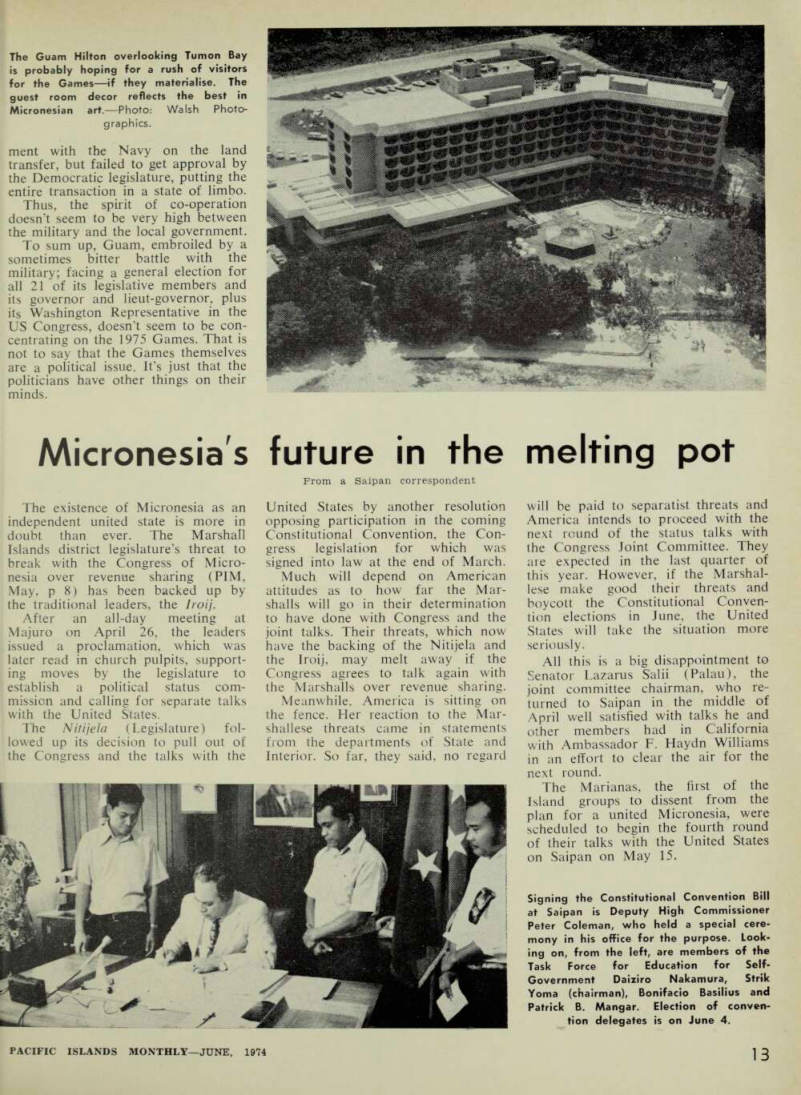
The Guam Hilton overlooking Tumon Bay is probably hoping for a rush of visitors for the Games —if they materialise. The guest room decor reflects the best in Micronesian art. Photo: Walsh Photo graphies.