NZ's welcome to immigrants
p. 13 · Read in the full issue
may be Fiji's skill drain'
By a staff writer
Fiji islanders reacted to New Zea land’s new immigration policy by queuing at the NZ High Commiss ion’s offices in Suva to apply for permanent entry to NZ. Australia, too, has adopted new guidelines which will make it easier for Islanders to migrate permanently to Australia. „ P ut there is no 'open door policy. In each case skill is a require ment, and in New Zealand the coun trVs capacity to absorb migrants from anywhere is a key factor. The ,f restricts the number of w y ho enter Nz as migrants f he New Zealand Prime Minister, M r N. H. Kirk, announcing his country’s new guidelines, said it was adopting a “non-discriminatory” ap proach. All would be selected ac cording to skill, age and family size.
Immigrants would be drawn from a wide range of countries in a gradual process, which would not involve an abrupt break with previous patterns of immigration.
Apart from skills, and humani tarian reasons such as allowing the reunion of families in NZ, migrants will have to be in good health and of good character, aged between 18 and 25, and have not more than four children.
Fiji’s Prime Minister, Ratu Sir
Kamisese Mara, was philosophical about the possible loss of skilled men to NZ, calling it a “skill drain”.
While Fiji would be sorry to lose such talent there was nothing she could do till the standard of living in Fiji was equal to that of NZ, Australia and Canada. However, NZ’s ability to absorb migrants, may restrict the numbers.
While both Australia and NZ have repeatedly stated their intention of doing as much as possible to help Pacific Islands groups in develop ment, and in fact, are doing a lot, the drain on skills could undo much of their good work. The Islands need all their skills in their race to catch up with the developed countries, and “skill drain” policies may have to be looked at closely in a few years.
No reference was made in the new policy guidelines for NZ about the “guest worker” scheme, which allows labourers to enter the country for limited terms for specific tasks. As this involves unskilled labour only, it will probably continue.
Australia has repeatedly refused to have anything to do with this system, and the Immigration Minister, Mr A 1 Grassby, reaffirmed the policy early in May. But he said then that an Australian Government trade skills mission would be seeking workers from South-East Asia, and the Pacific, with a special priority for Fiji.
Australia welcomed permanent settlers from more than 70 countries, including Fiji. She wanted the per manent settler with skills, and would not discriminate by allowing guest workers from one country. But he would fully support any scheme which allowed Fiji citizens to go to Australia for on-the-job training.
Ratu Sir Kamisese Mara, speaking in the Fiji Parliament recently said that Fiji people could not go to Australia for temporary work be cause of opposition from Australian trade unions. He was speaking on a motion to set up a select committee to examine Australian and NZ im migration policies.
He suggested that Mr Apisai Tora, Opposition spokesman on immigra tion matters, use his influence with trade unions in Australia to try to arrange a system under which Fiji people would be allowed in for temporary work.
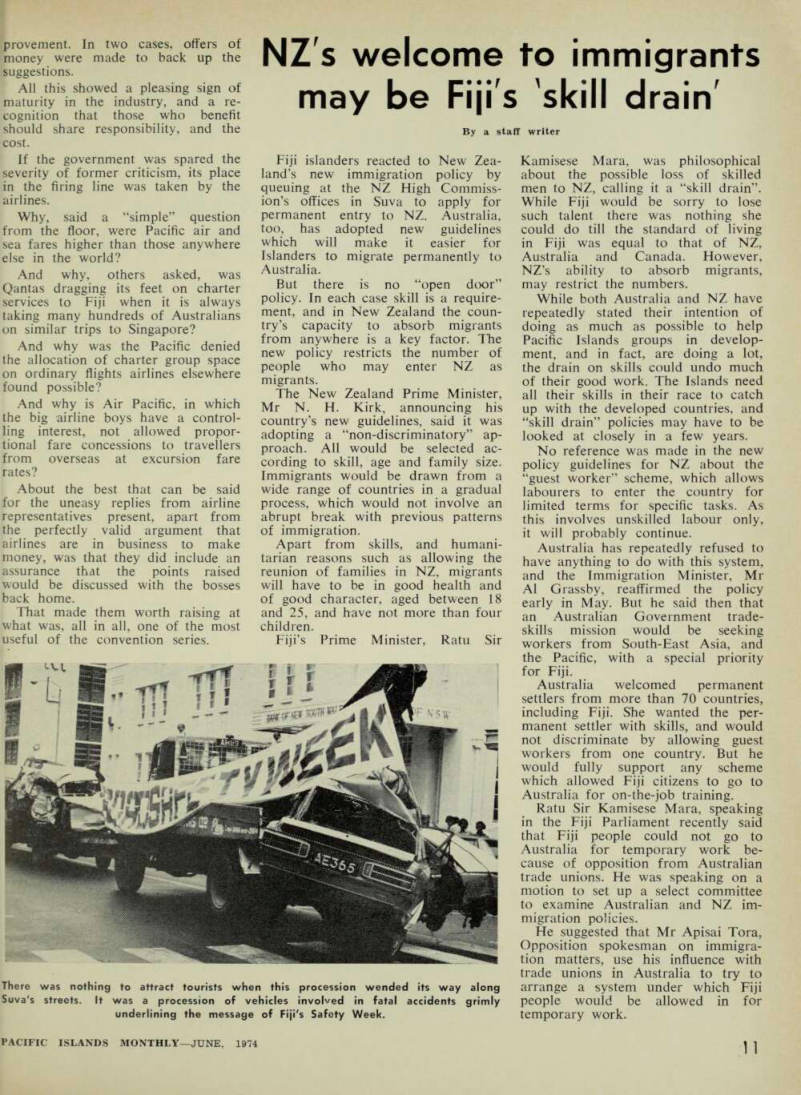
There was nothing to attract tourists when this procession wended its way along Suva's streets. It was a procession of vehicles involved in fatal accidents grimly underlining the message of Fiji's Safety Week.