Yesterday
p. 83 · Read in the full issue
Twenty years ago Fijian soldiers were stationed in Malaya rooting out communist terrorists. They had been there two years and PIM took the opportunity to remind its readers of that fact with a cover picture of a patrol just out of the jungle in the Yong Peng area of Jahore. Shown holding a tortoise, which was caught incidental to pursuing the terrorists was Warrant Officer Gukisuva. The warrant officer's family had just joined him in Malaya, along with the families of 17 other soldiers.
The first weekend of May, 1954, was a black one for the small ships which operated in New Britain. This was the "casualty" list: Matoko held up with engine trouble near Kavieng; Kokoda and Nusa in collision off Cape St George; Rulan sunk at Namatanai; Maiuma aground off San Remo; Two Brothers, holed below waterline in Rabaul Harbour; Channel Star aground at Drina and reported to be breaking up.
Tonga boxer, Kitione Lave made a good start to his overseas professional career when he knocked out Alan Williams in the eighth round in a Sydney bout.
One of the critics considered the fight could have ended much earlier if Lave had not been so casual. Lave later went to England to pursue his boxing career, and in the late 50s, went home for a trip. He did not receive the welcome he expected, and in Suva on his way back to England announced that from then on he was "Kitione Lave, of England", not "Kitione Lave, of Tonga".
The price of brides was a major topic for discussion 20 years ago, as it is now, when Central District Papuans met at Port Moresby to discuss native affairs.
There was an attendance of 108 village elders, headmen and others from 32 villages in the district. The conference passed a resolution asking the administra tion to limit the formal amount paid to a woman's relatives when her marriage had been arranged, and that the Court for Native Matters be given jurisdiction in disputes. It was suggested that the price be limited to £lOO at Koiari, £3OO at Hanuabada and £2OO at other places. PIM commented that the prices were large sums in a native community—and a great deal more than most young European men would
like to hand over to their pros pective in-laws.
People from the Cook Islands arriving in Auckland complained bitterly about a visit to Rarotonga of a taxation inspector from New Zealand. They said the Rarotonga Island Council had refused to accept taxation and had radioed to the NZ Prime Minister to that effect. Failing a satisfactory and prompt reply from Wellington, the Island Council would immediately put the case to the UN. Cook Islanders were not liable for the NZ social security tax of 1/ 6 in the £ on salary or wages, but were liable for income tax, even though they had no repre sentation in Wellington.
Pioneer Pacific aviator, Mr Harold Gatty, waxed critical of the South Pacific Commission at a meeting in Suva of the Fiji Society. He said much of the SPC's work could be done better by individual territories. The head quarters at Noumea were isolated.
Mr. Gatty's broadside at the SPC was the first to be made in public for some time.
The Pacific Islands was about to get a link with the Petrov affair. Vladimir Petrov had defected from the Soviet Embassy in Canberra, and Russia sent two couriers to take Mrs Petrov back to Russia. But at Darwin, she was given a chance to declare her wishes —no thanks to the couriers. In charge of rather a delicate situation was Mr. R. S.
Leydin, Acting Administrator of Aus tralia's Northern Territory, who was about to be transferred to Nauru as Administrator. Mr Leydin served from
1954 to 1958, and went back in 1962 for another four-year term.
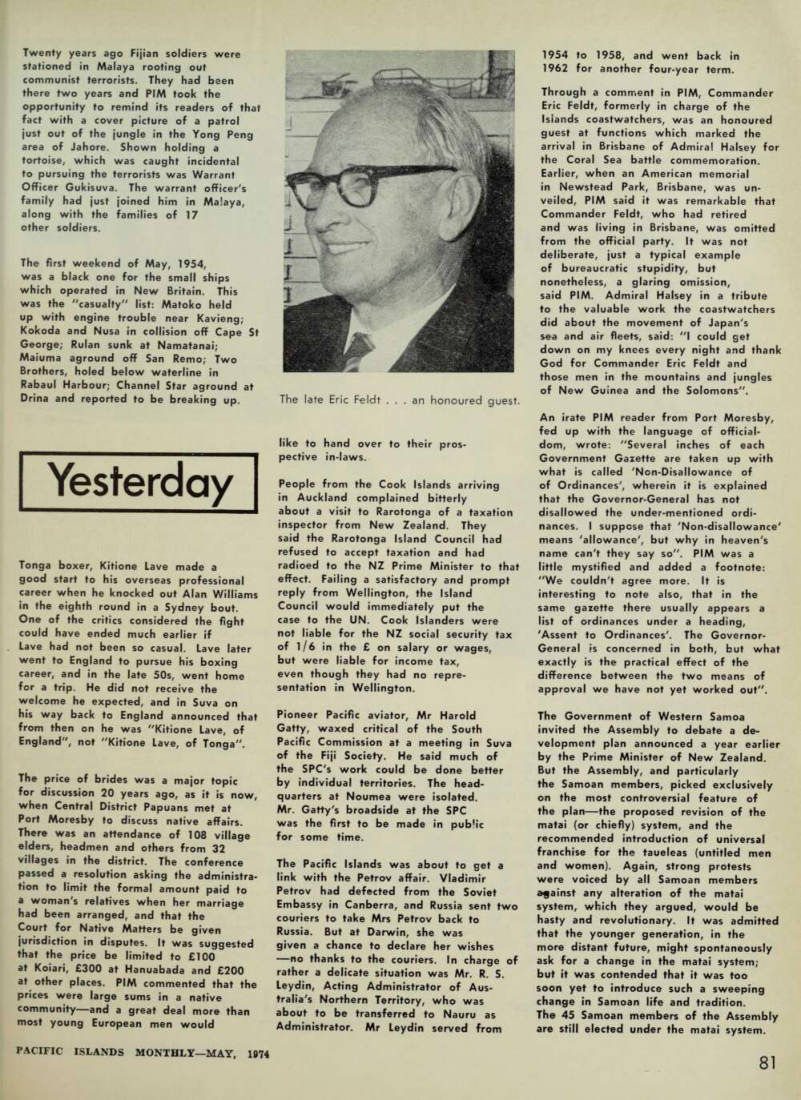
Through a comment in PIM, Commander Eric Feldt, formerly in charge of the Islands coastwatchers, was an honoured guest at functions which marked the arrival In Brisbane of Admiral Halsey for the Coral Sea battle commemoration.
Earlier, when an American memorial in Newstead Park, Brisbane, was un veiled, PIM said it was remarkable that Commander Feldt, who had retired and was living in Brisbane, was omitted from the official party. It was not deliberate, just a typical example of bureaucratic stupidity, but nonetheless, a glaring omission, said PIM. Admiral Halsey in a tribute to the valuable work the coastwatchers did about the movement of Japan's sea and air fleets, said: "I could get down on my knees every night and thank God for Commander Eric Feldt and those men in the mountains and jungles of New Guinea and the Solomons".
An irate PIM reader from Port Moresby, fed up with the language of official dom, wrote: "Several inches of each Government Gazette are taken up with what is called 'Non-Disallowance of of Ordinances', wherein it is explained that the Governor-General has not disallowed the under-mentioned ordi nances. I suppose that 'Non-disallowance' means 'allowance', but why in heaven's name can't they say so". PIM was a little mystified and added a footnote: "We couldn't agree more. It is interesting to note also, that in the same gazette there usually appears a list of ordinances under a heading, 'Assent to Ordinances'. The Governor- General is concerned in both, but what exactly is the practical effect of the difference between the two means of approval we have not yet worked out".
The Government of Western Samoa invited the Assembly to debate a de velopment plan announced a year earlier by the Prime Minister of New Zealand, But the Assembly, and particularly the Samoan members, picked exclusively on the most controversial feature of the plan—the proposed revision of the matai (or chiefly) system, and the recommended introduction of universal franchise for the taueleas (untitled men and women). Again, strong protests were voiced by all Samoan members against any alteration of the matai system, which they argued, would be hasty and revolutionary. It was admitted that the younger generation, in the more distant future, might spontaneously ask for a change in the matai system; but it was contended that it was too soon yet to introduce such a sweeping change in Samoan life and tradition.
The 45 Samoan members of the Assembly are still elected under the matai system.
The late Eric Feldt ... an honoured guest.