for fruit but
p. 78 · Read in the full issue
There's a market for fruit but it must be good
Japan in 1974 expects to import 924,000 tons of bananas. And on present indications there will be none from Fiji, Western Samoa or Tonga, which grow possibly the best bananas in the world. Yet Japan imports bananas from further afield than those three countries.
In 1971, when Japan imported bananas worth SUSIS9 million, 43 per cent came from Ecuador, 30 per cent from Taiwan, 19 per cent from the Philippines, 7 per cent from Costa Rica and 1 per cent from Panama. If bananas will carry all the way to Japan from the western coastal area of Central America, they should carry equally as well from the South Pacific.
All it needs are proper growing and packing techniques and transport, none an insurmountable difficulty.
There have been abortive attempts in the past to send bananas from that area to Japan. Fiji, about 12 years ago, without a proper research of a potential market, sent two trial ship ments. They were a failure.
Later, they found the bananas did not match the foibles of the Japan ese housewife. The skins were in clined to spot; the housewife wanted a banana with a clean skin, and Taiwan was able to supply that. It did not matter if the Fiji banana was a better quality product, in spite of the spots. Provided the banana is used quickly enough after it ripens a spotty skin does not impair the quality of a Fiji banana, but that is not good enough. The banana has to be offered for sale with a clean skin.
The importance Japan attaches to bananas is shown by long-term agree ments Japan has entered into with suppliers. Most of the supplying countries are in hurricane or typhoon belts. So if one country loses its crop another is able to fill the demand. It is a risky business, but profitable.
This is what the Japanese want in banana imports: Quality —There is not much dif ference in quality by producer countries at present supplying Japan.
But the Japanese prefer the taste of bananas from Taiwan, the Philippines
and Ecuador in that order. To get into the market a new supplier would obviously have to “sell” the taste of his bananas.
Packing —Except for Ecuador, card board boxes are used. Producer countries are now replacing bags made of bamboo, which have long been used. Cardboard boxes cause little damage to bananas and assure uniform quality. Ecuador uses polyethylene for vacuum packing.
An important factor in determining banana price is peel colour, which is closely related to peel thickness.
Most of the Taiwan, Ecuador and Philippines bananas belong to a species which has a thicker peel than any other species. It has the merit of a beautiful colour finish, and the dis advantage of being vulnerable to cold weather, which turns it brown.
It is also more perishable.
While bananas offer the best potential, the Pacific Islands could also grow a lot of other fruit, and vegetables, for Japan. Rising incomes have lifted the demand for fresh fruit.
It is regarded as an essential food item, rather than a luxury.
The Japanese will take all the citrus fruit they can get, and here is where the Cook Islands could come into the picture. Their main market, New Zealand, is limited. In Japan, with its 100 million plus population, they could probably sell all they could grow, provided they maintain quality.
Japan restricts canned pineapples, but import of fresh pineapples is unrestricted. There are times in the Pacific Islands when there are gluts of pineapples.
Pacific Islands, especially those of volcanic origin are natural vegetable bowls. The Japanese market for fresh vegetables might not be as lucrative as the banana market, but in 1971 vegetable imports were worth about SUSII.S million, and that is a fair sized market to share.
Onions are required more than anything else. The Japanese grow their own onions from April to October. Onions held in storage go on the market from November to April. The supply and demand situa tion is unsteady from February to April, and during those months Japan looks to Taiwan for onions. She also brings in onions from Australia, New Zealand and the US, and in one bad year when domestic prices rose very high, she took onions from wherever she could.
Fresh and frozen fruit and vege tables, sent by sea or air, offer a range of smaller specialties for seasonal markets. Many of the Pacific Islands are well able to meet such a demand, provided the people are prepared to work. The fruit juice markets are wide open to areas of the South Pacific suitable for citrus grow ing. Rotuma and the Cook Islands are two.
Papaws, avocado pears and guava grow wild in a number of groups.
Surely the potential of the Japanese market represents a challenge to develop methods of processing these delectable fruits which could become as popular in Japan as New Zealand apple juice.
A joint South Pacific Commission/ United Nations Development pro gramme research project is showing something of Island production and marketing prospects. Just as Aus tralian efforts in Tokyo have helped to put New Guinea tea and coffee before Japanese buyers, so could similar promotions on behalf of the Islanders.
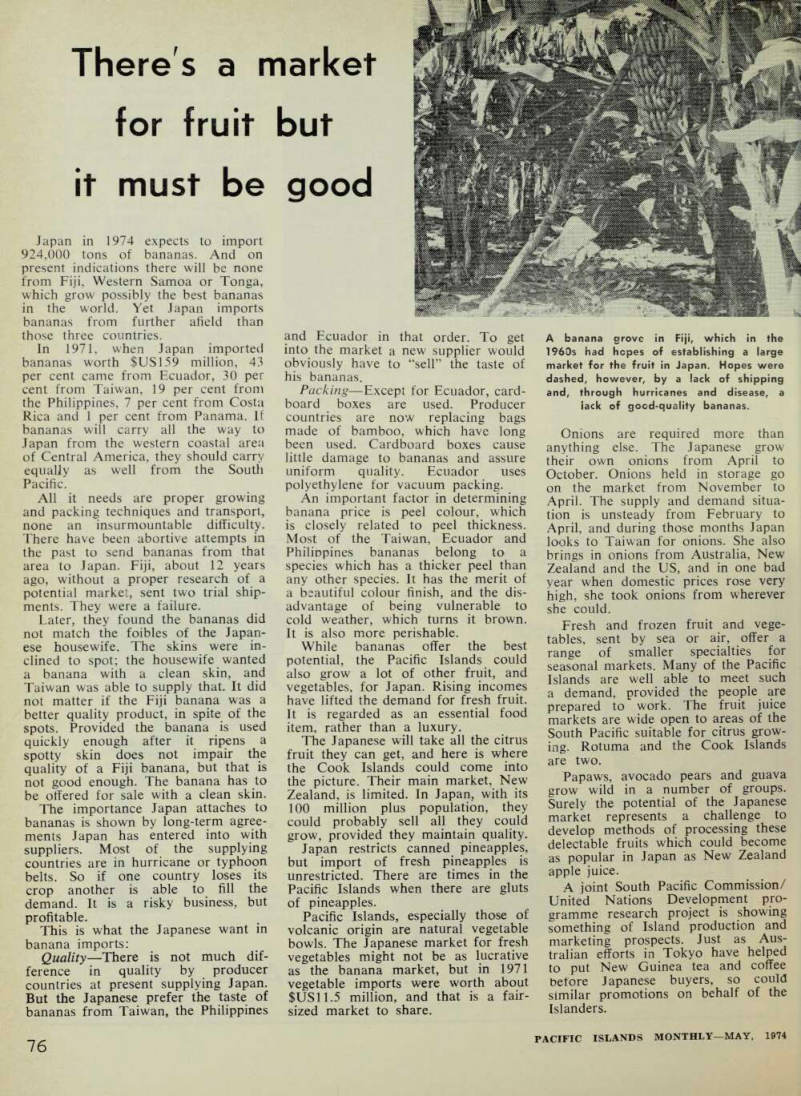
A banana grove in Fiji, which in the 1960s had hopes of establishing a large market for the fruit in Japan. Hopes were dashed, however, by a lack of shipping and, through hurricanes and disease, a lack of good-quality bananas.