my family'
pp. 76-77 · Read in the full issue
Life with my family' in Kobe
Visitors to Japan may take advantage of the home visit system, which has been officially adopted. They stay in a Japanese home, living Japanese style.
Most home visits are from one to three days. The following story is by an Aus tralian girl who made a home visit sponsored by Liens International.
By Kay Thomas, an 18-year-old student.
A long time ago an eminent author wrote: “East is East and West is West and never the twain shall meet”. When he wrote that, it was probably true. But today east and west are meeting—and with great pleasure on both sides, too, because both sides are trying.
The lowering of costs of travel to the Far East from Australia, and the growing desire of young Australians to travel abroad, have brought Japan within the grasp of large numbers of Australians.
Also, of course, Japanese people are visiting Australia. It is a big marketplace for Japanese goods. And to sell goods in a marketplace, one must have knowledge of the poten tial customers in that marketplace— and, more importantly, one must have the goodwill of those potential cus tomers.
So it is that a great change has come about in the attitudes of west erners (Australians) towards east erners (Japanese) and vice versa. In other words, the twain are meeting today—and they are meeting to their mutual advantage.
A number of social groups in Aus tralia with international affiliations have recognised the great need for people of east and west, the great need for people of vastly different social and economic outlooks, to get together to rationalise the differences that used to exist between east and west.
My participation in the process of east meeting west was made pos sible by the Lions International Youth Exchange Programme—YEP —and I can say that my recent five week visit to Japan under the auspices
of this programme has been the most educational and emotional experience I have ever had.
The keystone of this experience was that a Japanese member of Lions International took me into his family.
That family treated me as a mem ber of the family. That experience is one I shall treasure always.
I was one of a group of 161 young Australians sponsored by Lions Inter national who dropped down gently at Tokyo’s Haneda airport on New Year’s Day in a Qantas 707. A day in Tokyo, and then off to Kobe, a maritime city, where my Japanese family awaited me.
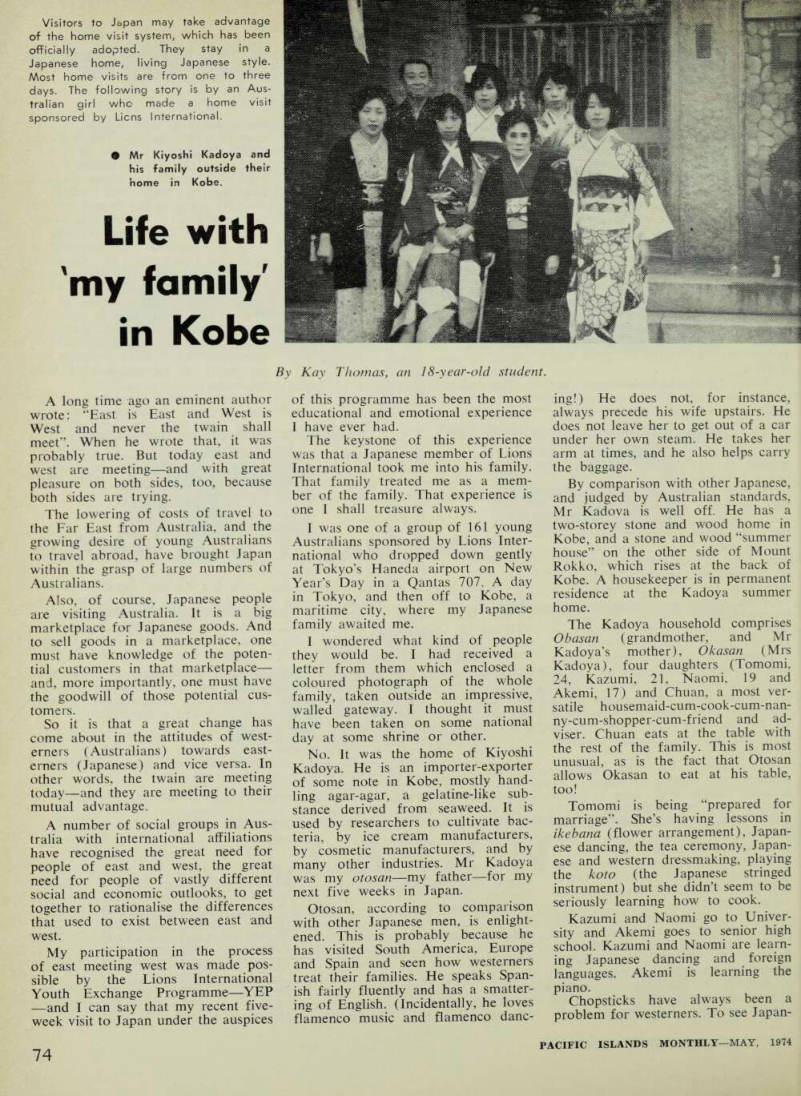
I wondered what kind of people they would be. I had received a letter from them which enclosed a coloured photograph of the whole family, taken outside an impressive, walled gateway. I thought it must have been taken on some national day at some shrine or other.
No. It was the home of Kiyoshi Kadoya. He is an importer-exporter of some note in Kobe, mostly hand ling agar-agar, a gelatine-like sub stance derived from seaweed. It is used by researchers to cultivate bac teria, by ice cream manufacturers, by cosmetic manufacturers, and by many other industries. Mr Kadoya was my otosan —my father —for my next five weeks in Japan.
Otosan, according to comparison with other Japanese men, is enlight ened. This is probably because he has visited South America, Europe and Spain and seen how westerners treat their families. He speaks Span ish fairly fluently and has a smatter ing of English. (Incidentally, he loves flamenco music and flamenco danc
ing!) He does not, for instance, always precede his wife upstairs. He does not leave her to get out of a car under her own steam. He takes her arm at times, and he also helps carry the baggage.
By comparison with other Japanese, and judged by Australian standards, Mr Kadova is well off. He has a two-storey stone and wood home in Kobe, and a stone and wood “summer house” on the other side of Mount Rokko, which rises at the back of Kobe. A housekeeper is in permanent residence at the Kadoya summer home.
The Kadoya household comprises Obasan (grandmother, and Mr Kadoya’s mother), Okasan (Mrs Kadoya), four daughters (Tomomi, 24, Kazumi, 21, Naomi, 19 and Akemi, 17) and Chuan, a most ver satile housemaid-cum-cook-cum-nan ny-cum-shopper-cum-friend and ad viser. Chuan eats at the table with the rest of the family. This is most unusual, as is the fact that Otosan allows Okasan to eat at his table, too!
Tomomi is being “prepared for marriage”. She’s having lessons in ikebana (flower arrangement), Japan ese dancing, the tea ceremony, Japan ese and western dressmaking, playing the koto (the Japanese stringed instrument) but she didn’t seem to be seriously learning how to cook.
Kazumi and Naomi go to Univer sity and Akemi goes to senior high school. Kazumi and Naomi are learn ing Japanese dancing and foreign languages. Akemi is learning the piano.
Chopsticks have always been a problem for westerners. To see Japan-
Mr Kiyoshi Kadoya and
his family outside their home in Kobe.
Polite Slurping
ese eating with chopsticks from a bowl is really an audio-visual ex perience, for apart from the speed with which they eat, and the way they get their mouths so close to the bowl, the polite slurping effects make it quite noisy, too.
A typical daily menu in my home was; BREAKFAST: Soft boiled egg, toast, salad, rice cake, hot milk or Japanese tea.
LUNCH: Boiled rice, curry, nood les, occasionally Kentucky Fried Chicken, or fried ham, or dry baked fish, Japanese tea.
DINNER: Boiled rice, fish (raw fish is a specialty), soup, pork cut lets are popular, Japanese cake or perhaps a sweetmeat from a temple, fruit cake, fruit and Japanese tea.
The traditional sukiyaki and tem pura bob up in the menu frequently, but mainly when Otosan directs!
When his favourite dishes were on, he would move from the head of the table to the centre so that he could be nearer to the bowl, and help him self more easily!
Most Japanese always sleep on the floor, on a thin mattress placed on a tatami mat. These mats are looked after very carefully, because they are both difficult and expensive to replace.
To enter any Japanese home one must take off one’s shoes and put on slippers. But to enter a room with
T*”? h f Ve •? T*
electrfc blanke'ts amT tot w™er boh
des - This, I gather, was unusual. . T , •
Occasionally Japanese sleep in
western-style beds. Obasan (grand mother) now sleeps m a bed because her back is troublesome. I was priv ileged. I slept in a bed every night except two, when I stayed in a Japan hotel in Yumiira and in a hotel nelr BiVa Lake "“r mwa Lake.
Japanese toilet facilities are mclm ed to rather horrifying to western ers, who should never use Japanese public toilets, and wtio should always carry toilet paper. The smell can be overpowering. Some streets have open sewer s ’ . , , . For a nation of people so fastid lous about personal cleanliness, I could not understand how they could put up with their toilets. I was for tunate. The Kadoya household has one western-style toilet and two Japan
ese style (one flushes and one doesn’t). The western one is upstairs.
All j apa nese families are very i nv inp families anH the Karlova family narticularlv so Japanese
'3L "oded hevond Telfef
Thev are eiven evervthinp thev ask m mats the ln ’ return, the Japanese child has f ° r ParentS Japanese hospitality is fabulous.
Even if being hospitable means ignor jn g tradition or custom, hospitality comes first.
L ° ve was paramount in my Japan ese hom e, and this was another m stance of Kiyoshi Kadoya s liber ationist” views" He showed his affec- Uon for his mother , wi ( e and daugh terSj even to pat ting the girls on the head if they pleased him. His girls cou ld playfully push or smack him. j was was most unusua f . ’ ] r east cant meet west poli tically, at the people level east and west can. This I found in my five weeks in Japan. I could not have (outside my own) a family that made me more welcome in their home, that was kind, considerate and above all, loving than my new, second family which lives in Kobe. ’