Magazine Section
pp. 85-87 · Read in the full issue
The Papuan Villager; A Milestone
And A Memorial To A Scientist
By W. G. Coppell
On May 12, 1943, a plane crashed into a mountainside in Papua’s Owen Stanley Range, killing all aboard.
Among those who died was Francis Edgar Williams, the government anthropologist, then a captain in the Australian New Guinea Administra tion Unit. At the time of his death Williams was engaged in the estab lishment of a school for the training of young officers in Papuan affairs.
F. E. Williams had a distinguished career as a scholar, anthropologist, author and journalist. Born on February 9, 1893, he had a brilliant career at the University of Adelaide, graduating with first-class honours and being elected as a Rhodes Scholar for 1915. He enlisted in the Australian Army in World War I, saw action in France and served in Persia with the rank of captain.
After the war’s end, Williams re turned to his studies at Balliol Col lege, Oxford, where he gained dis tinction for his Diploma of Anthro pology. In 1922 he was appointed assistant anthropologist in Papua and he became government anthropologist in 1928. Continued recognition was given to his academic work; in 1928 he was given an honours degree of Master of Arts by the University of Adelaide and at Oxford he gained a BSc in 1934 and Doctor of Science degree in 1942.
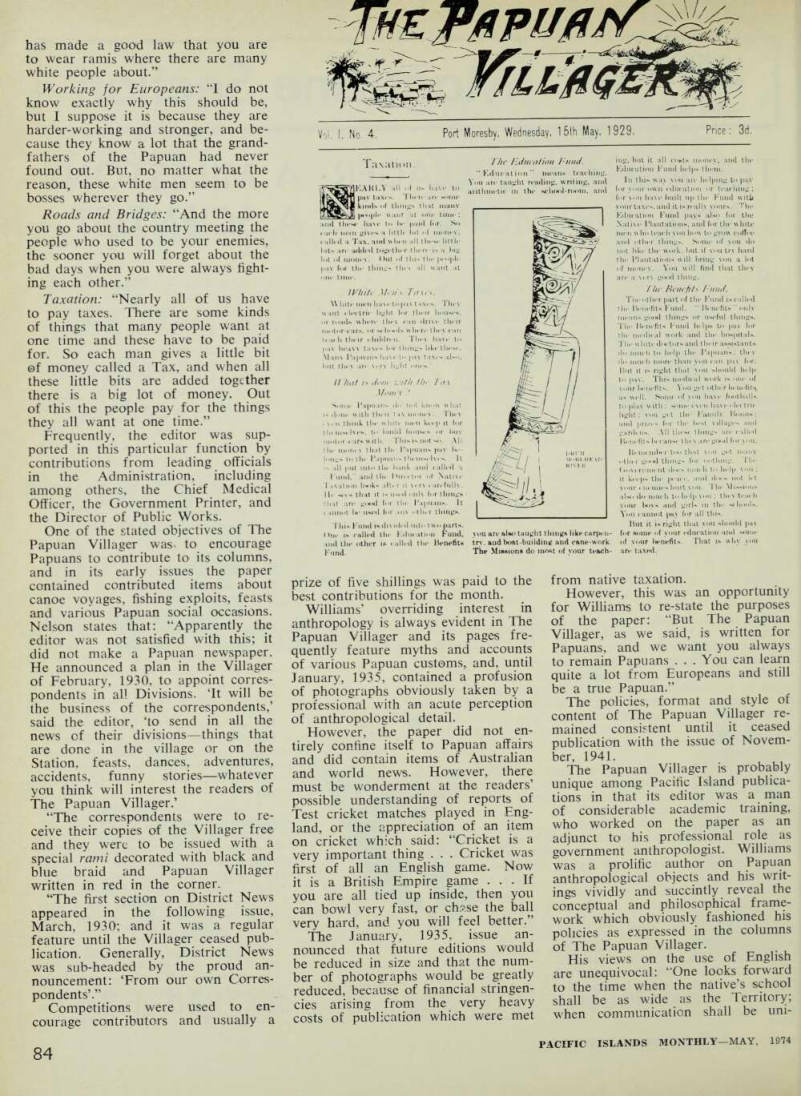
In journalism, Williams’ place in Papuan history is contained in the pages of The Papuan Villager, a monthly paper printed by the Gov ernment Printer, Port Moresby, which first appeared on February 15 1929.
Apart from a short period during 1933-34, when Williams had a fellowship at Oxford, he was always editor of the Villager.
The objectives of the paper were made evident in Williams’ first editorial: “This paper is for the people of Papua. It is not for the white man (they have a paper of their own). It is for the brown man and it will tell you about the things that belong to you.”
This is the third of an oc casional series of articles on newspapers in the Islands in the early days. Dr. W. G. Coppell, who is a lecturer in education at Macquarie University in Sydney, has made a special study of Island newspapers. This article is the story of a man, rather than a history of journalism in pre-war Papua, and his attempts to bridge the knowledge gap between the Papuan and the world outside.
H. Nelson, by reference to the report of the Lieutenant Governor of Papua in 1928-1929, has indicated how The Papuan Villager fitted into a larger vision—that of the fostering of a sense of national unity among the Papuans: “Sir Hubert Murray wrote: ‘I have often looked for something like national or racial pride in Papua, and until this year, I have never found
anything beyond tribal jealousy . . .’
The evidence of national pride was displayed at a cricket match in Port Moresby. The team from Kwato Mission had come to Port Moresby on the government boat, the Elevala, to play the Port Moresby European side. In a closely contested three-day match, Moresby won by four wickets.
The match was watched by a large crowd—over 1,000 —and most of them were Papuans. Murray thought the Papuans in the crowd saw the Kwato cricketers as their representa tives. It was, he said, the first time any general feeling had surmounted local and tribal loyalties. The growth of this national spirit, he believed, might be fostered by the newly established newspaper, The Papuan Villager.
A further and overt purpose was to encourage the Papuans to learn the English language: “The paper is written in English because the Government wants you to learn the white man’s language.
There are many languages in Papua —Kiwai, Namau, Motu, Suau, Binan dele, and many others—more than a hundred of them. The white man cannot learn them all. It is better for the Papuans to learn the white man’s language. Then he will under stand you; and you will understand him; and that will be a good thing for he can teach you a lot that is new.”
Possibly, the overriding motive guiding the editorial policy was that of the political education of the Papuans into the procedures of the expatriate Administration. The issues of The Papuan Villager are character ised by the presence of homilies ad dressed to the Papuans which urge ihem to accommodate to the ways of the Europeans.
Clothes: “Papuans came to under stand this very quickly. They don’t like doing what the white man thinks disgraceful, so they mostly wear the kind of dress that the white man approves of . . . The Government
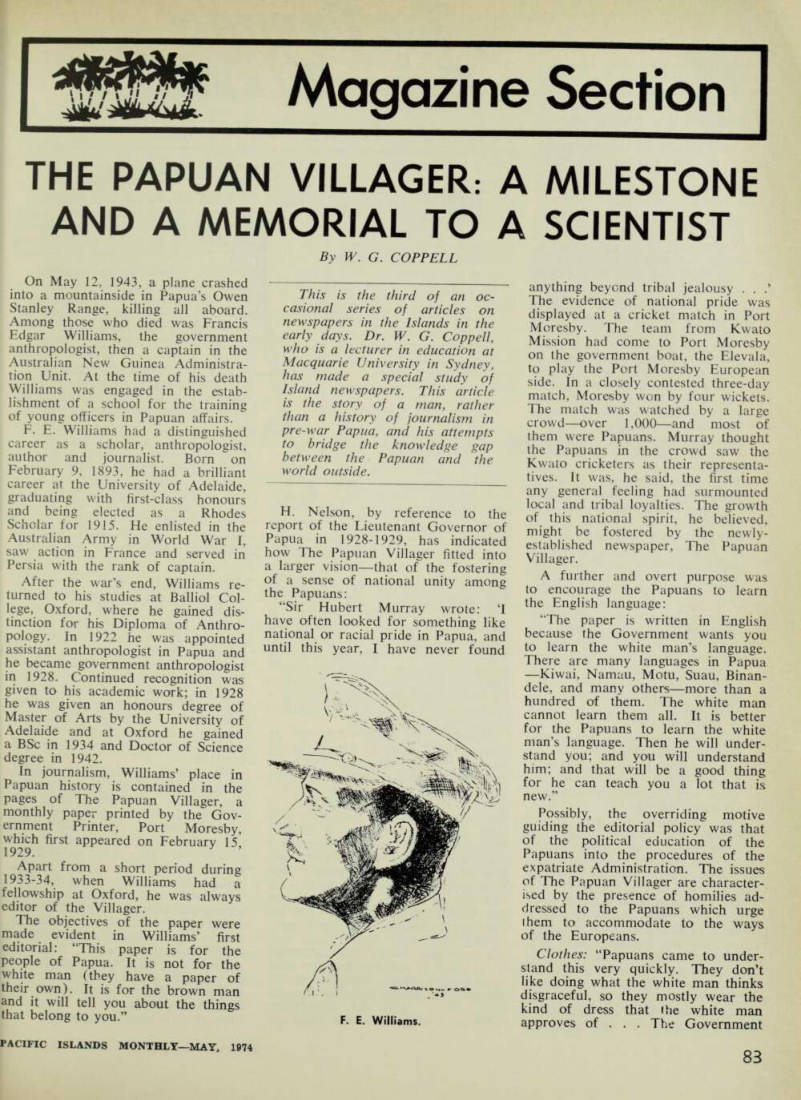
F. E. Williams.
has made a good law that you are to wear ramis where there are many white people about.”
Working for Europeans: “I do not know exactly why this should be, but I suppose it is because they are harder-working and stronger, and be cause they know a lot that the grand fathers of the Papuan had never found out. But, no matter what the reason, these white men seem to be bosses wherever they go.”
Roads and Bridges: “And the more you go about the country meeting the people who used to be your enemies, the sooner you will forget about the bad days when you were always fight ing each other.”
Taxation: “Nearly all of us have to pay taxes. There are some kinds of things that many people want at one time and these have to be paid for. So each man gives a little bit ©f money called a Tax, and when all these little bits are added together there is a big lot of money. Out of this the people pay for the things they all want at one time.”
Frequently, the editor was sup ported in this particular function by contributions from leading officials in the Administration, including among others, the Chief Medical Officer, the Government Printer, and the Director of Public Works.
One of the stated objectives of The Papuan Villager was> to encourage Papuans to contribute to its columns, and in its early issues the paper contained contributed items about canoe voyages, fishing exploits, feasts and various Papuan social occasions.
Nelson states that: “Apparently the editor was not satisfied with this; it did not make a Papuan newspaper.
He announced a plan in the Villager of February, 1930, to appoint corres pondents in all Divisions. ‘lt will be the business of the correspondents,’ said the editor, ‘to send in all the news of their divisions —things that are done in the village or on the Station, feasts, dances, adventures, accidents, funny stories—whatever you think will interest the readers of The Papuan Villager.’
“The correspondents were to re ceive their copies of the Villager free and they were to be issued with a special rami decorated with black and blue braid and Papuan Villager written in red in the corner.
“The first section on District News appeared in the following issue, March, 1930; and it was a regular feature until the Villager ceased pub lication. Generally, District News was sub-headed by the proud an nouncement: ‘From our own Corres pondents’.”
Competitions were used to en courage contributors and usually a
prize of five shillings was paid to the best contributions for the month.
Williams’ overriding interest in anthropology is always evident in The Papuan Villager and its pages frequently feature myths and accounts of various Papuan customs, and, until January, 1935, contained a profusion of photographs obviously taken by a professional with an acute perception of anthropological detail.
However, the paper did not entirely confine itself to Papuan affairs and did contain items of Australian and world news. However, there must be wonderment at the readers’ possible understanding of reports of Test cricket matches played in England, or the appreciation of an item on cricket which said: “Cricket is a very important thing . . . Cricket was first of all an English game. Now it is a British Empire game ... If you are all tied up inside, then you can bowl very fast, or chase the ball very hard, and you will feel better.”
The January, 1935, issue announced that future editions would be reduced in size and that the number of photographs would be greatly reduced, because of financial stringencies arising from the very heavy costs of publication which were met
from native taxation, However, this was an opportunity for Williams to re-state the purposes of the paper: “But The Papuan Villager, as we said, is written for Papuans, and we want you always to remain Papuans . . . You can learn quite a lot from Europeans and still be a true Papuan, The policies, format and style ot content of The Papuan Villager re mained consistent until it ceased publication with the issue of Novem ber, 1941.
The Papuan Villager is probably unique among Pacific Island publica tions in that its editor was a man of considerable academic training, who worked on the paper as an adjunct to his professional role as government anthropologist. Williams was a prolific author on Papuan anthropological objects and his wnt ings vividly and succmtly reveal tne conceptual and philosophical frame work which obviously fashioned his policies as expressed m the columns of The Papuan Villager, His views on the use of EnghsU are unequivocal: One looks ? forward to the time when the native s school shall be as wide as Territory, when communication shall be um
versal owing to the possesion of a universal language; and, most impor tantly, when every white man shall be a potential teacher , . . and if the European at large is to be an educator of the native, that medium can be nothing but English, for the ample reason that the average Britisher will not take the trouble, or has not got the brains, to learn a native language.”
Similarly, his use of the paper to shape Papuan thinking, and to change and adapt “the sentiments and leading ideas in native society” was based on a firmly held view: “Applied anthropology, however, in the service of an Administration must concern itself not merely with the native society as it is, but also with native society as it should be; it must contemplate adaption to new conditions.”
The emphasis which The Papuan Villager gave to Papuan arts and crafts also reflects Williams’ perspec tive of the utilitarian function of the paper: “But, since artistry is so unpre dictable and artists so unmanageable, can we really do anything about it?
Why not leave the native artists to look after themselves. They have done pretty well in the past, so why not in the future? I think, notwith standing these rhetorical questions, that native art is likely to have a thin time of it under the stress of contact and change . . . one must not imagine that every native is or can be an artist—many will fail and eventually give up. But it will do everything good to try his hand; and thus those who have it in them will be given their opportunity.”
The Papuan Villager often ex horted its readers to improve their gardening and crop-raising tech niques, and Williams conceptualised this need in these terms: “For my own part—and be it remembered, I am speaking of the education of Papuan primitives—l confess to a somewhat Horatian preference for the materialistic end . . . and the essential of a policy of practical education such as I would advocate will be to put him in the way of rais ing his standard of living; in the com mon phrase, we shall help him to help himself.”
In its final issue, The Papuan Vil lager did little to prepare its Papuan readers for the holocaust which would shortly engulf them: “Japan is like a very snappy litttle dog, barking at three big dogs that just lie down and look at her. The three big dogs are Great Britain, America and Russia. If this little dog ever begins to bite, then the three
big dogs will jump on her and tear her to pieces.”
“Last month we told you about the Japanese. They are not in the war and we hope they will not be silly enough to come in.”
In 1950, the Department of Educa tion revived the spirit of The Papuan Villager by publishing the monthly Papua and New Guinea Villager, which was printed by the Govern ment Printer at Port Moresby. The two journals were similar in format but the later arrival obviously did not have the multi-faceted objectives of its predecessor and was principally a means of providing a general topical news service and was more akin to a school journal. It ceased publication in May, 1960.
The last book published by F. E.
Williams was the Drama of Orokolo, and Professor A. P. Elkin considers that within it can be seen evidence of the author’s concern for the
Papuan people—“his main concern was not with his fellow anthro pologists, although he was not un mindful of the effect of his theorising might have on them; rather it was with those others administrative and missionary by profession, who have a more direct influence on the native’s future.”
Writing Williams’ epitaph in 1943, Professor Elkin used the sentiments expressed in the final sentence in the Drama of Orokolo in his eulogy: “There are many fine things now threatened with extinction in the cul tures of Papua and other native countries. This book concludes with the hope, however idealistic, that things like Hevehe (the Drama of Orokolo) will elsewhere be given a better chance; that the new order will show a readier disposition to com promise with the old; and that the highest products of a not ignoble past may more often live on in the future.”