Wedding Boom Echoes In The Forests
p. 61 · Read in the full issue
pjl th T e [ e , 1S - one . thm 8 ™. ost Pacific Islands have in quantities, apart from copra, it is timber.
The demand for timber, or lum- Der m Japan, has increased
KXof
the growth of the economy. The j l! y^ aSe rate between 19 rL and r 19 I° WaS 6d lerI er “?• The climate surrounding the demand for timber has been undergoing a change in the last few years, because of changes in architectural styles and housing production methods, improvements in living standards and the development of various substitute materials.
Housing construction in recent years has shown a remarkable rise and is the focus of attention by various quarters as a growth industry, next only to those of automobiles and electrical home appliances. Under a five-year plan (1971-75) about 9.5 million housing units will be built. The target figure is far above the 6.7 million units of the previous fiveyear plan.
The hl 8 h economic growth rate of Japan has raised the national income level rapidly. At the same time, it has helped to improve the mode of people’s H / e an( f thr . OUgh th i e m ? der r ation of architectural styles, has promoted new construction ma f erials ’ such as Plywood, chips and synthetic wood. Other nonwood materials sought are light section steel, aluminium sash, plaster-board, cement materials and vinyl tiles.
New and substitute materials notwithstanding, many Japanese still want timber for their houses.
The domestic supply of timber is severely restricted because of the need to protect resources. This has given a big fillip to the demand for imports. In five years between 1965 and 1970 the amount of imported timber rose from 26 per cent to 53 per cent of the total used.
The supply of domestic timber won’t increase for years, so there is virtually an open field for imports.
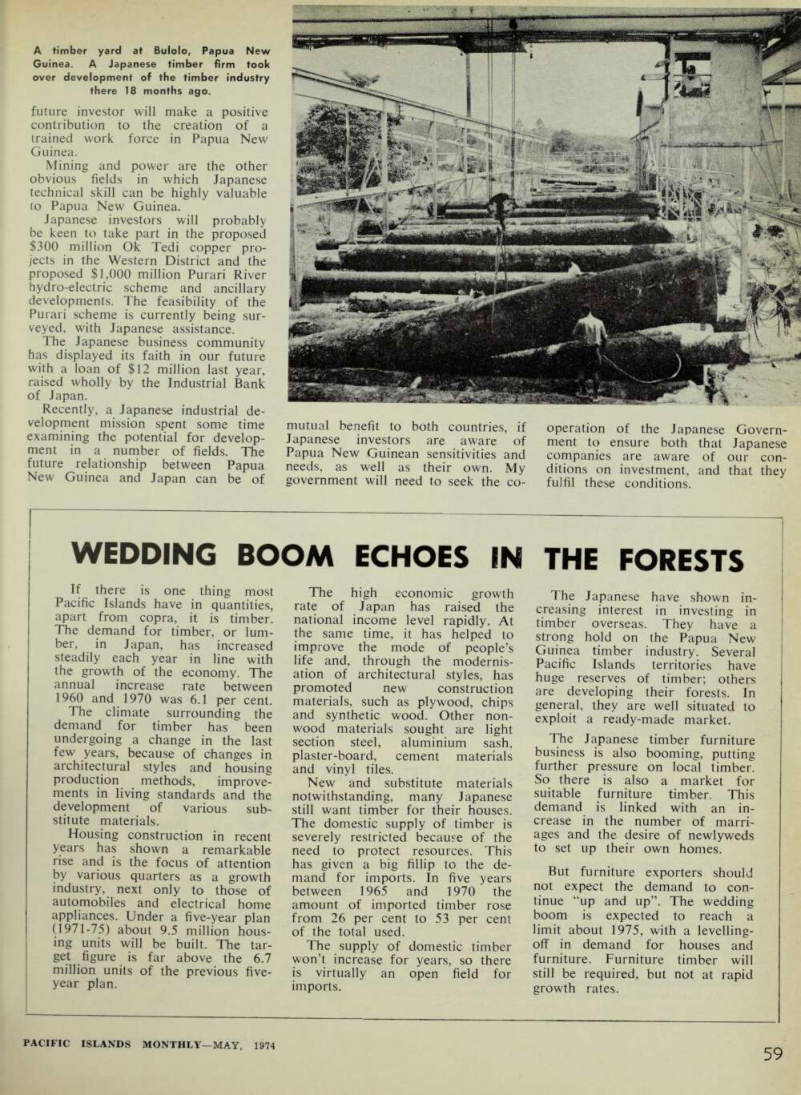
The Japanese have shown in creasing interest in investing in timber overseas. They have a strong hold on the Papua New Guinea timber industrv Several “ “ terrilories have huge reserves of timber- others are developing their forests In general, the P y fre well situated to exploit a readv-made market P readymade market.
The Japanese timber furniture business is also booming, putting further pressure on local timber, So there is also a market for suitable furniture timber. This demand is linked with an in crease in the number of marri ages and the desire of newlyweds *° se * U P their own homes, f Kut turmt ure exporters should not e *P ect the demand to con tinue up and up . The wedding boom is expected to reach a limit about 1975, with a levelling off in demand for houses and furniture. Furniture timber will still be required, but not at rapid growth rates.