Brush Up On Your Etiquette
pp. 63-65 · Read in the full issue

Because It's Different
Doing Business In Tokyo
Doing business with the Japanese in their own land is something different. Differences can lead to misunderstandings, sometimes quite serious, even though allowances are made. A lithe study of local customs before making a business visit to Japan, can work wonders.
Don t feel insulted or that you are not wanted if a Japanese businessman, on greeting you, extends the palm of his hand outwards and then bends his fingers. To the European, and others, that is the waving g n-ff Dye *' . .
Different meanings can be given to “yes” in Japan. To non-Japanese the simple words “yes” and “no” are direct opposites. A European could say, “You haven’t brought your order book have you?”, and if the person addressed did not have it the answer would be “no”. But to the Japanese the appropriate answer would be “yes”. That is to say, “Yes—what you say is correct, I have not brought my order book.”
It is also important to remember that when a Japanese contact says “yes”, for which his own word is “hai”, that does not necessarily mean agreement with what was said. The Japanese word “hai” and its English translation may simply mean that the Japanese person understands what has been said.
A frequent complaint to Japanese
trade centres, is that Japanese com panics do not answer letters. That complaint does not apply to major companies.
Failure to answer a letter does not necessarily mean lack of interest, There can be a number of reasons f or s j ow response to the letter. For example, it might not give sufficient information. There may be a problem 0 f communication. Small to medium sized firms are not accustomed to direct contact with foreign business concerns, and may be at a loss to provide an answer in a foreign lancmape f. 8 . 4 1 ? 0 ’ Process of making decisions is somewhat slower in ,ap f % fa £* that A lme may be needed *° r f ach ? decision can be a reason for delay ln answerln g letters - Another reason is that most Japan ese companies, especially those of small to medium size, are accustomed to to potential customers face to face. While that may not always be possible, it is advisable to seek op portunities of face-to-face contact rather than rely on correspondence, But in doing that it is well to remember the differences between the business customs of Japan, compared with other countries. An effort to understand those customs could prove rewarding.
The business card is important in
Japan, probably more so than in some other countries, and this is essential for first contacts. The cards also have a useful function. They give the name, position and company of each person met. A file of such cards can be an important asset to anyone doing business in Japan.
The typical card for a visitor would have on one side the name of the individual, his company, the address of his company, and his position in it. The other should have a Japan ese translation of the same details.
Before handing it over make sure which is the top and which is the bottom of the translation. To hand a card over upside down will not make a good impression on Japanese busi ness contacts.
If the caller is meeting a number of people he should not hand his cards round as if dealing from a pack. The exchange of cards in Japan is an important part of the introduc tion process. For that reason, they should be exchanged one at a time, and with some care.
In arranging a first meeting it is helpful if the way can be smoothed by a mutual contact, or through a diplomatic agency.
It is not necessary to copy Japanese behaviour standards in contacts. At the beginning and end of every meet ing, Japanese men will bow very formally. Should the caller do this, or shake hands? Most Japanese busi-
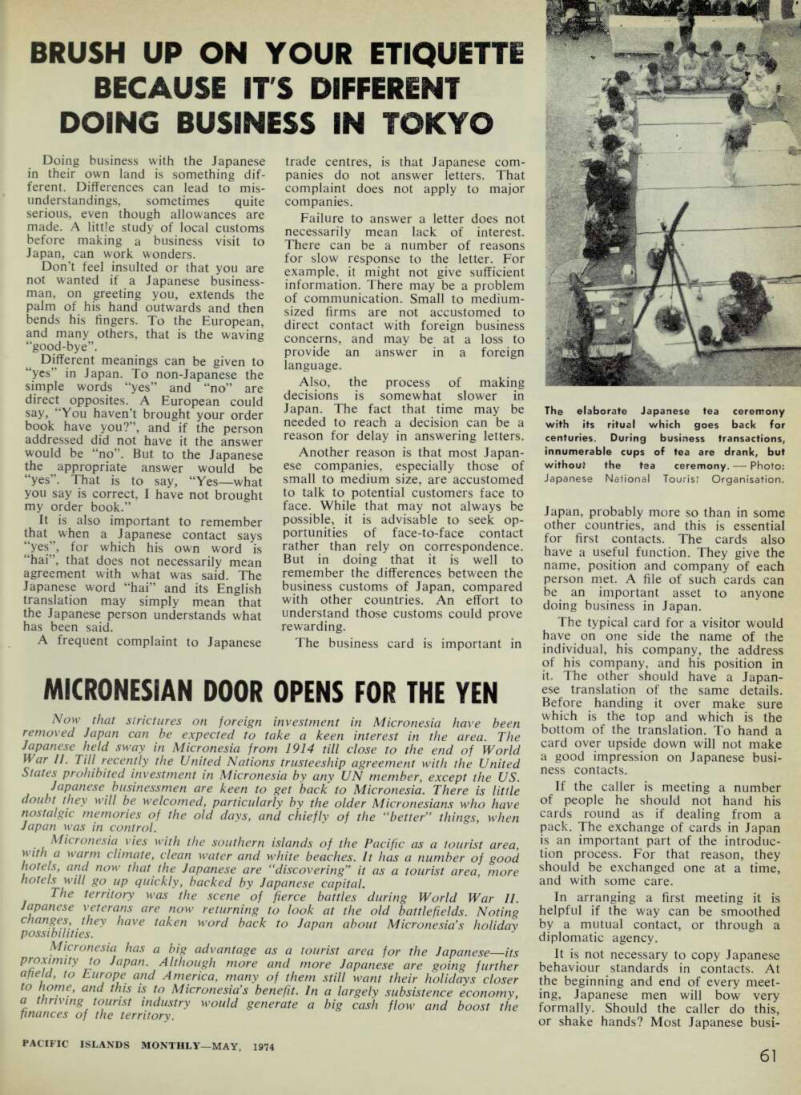
The elaborate Japanese tea ceremony with its ritual which goes back for centuries. During business transactions, innumerable cups of tea are drank, but without the tea ceremony. -Photo: Japanese National Tourist Organisation.
Language pitfalls
nessmen with experience in dealing with foreigners will shake hands. A good tip is to wait and see what the Japanese will do. A nod of the head or a slight bow is all that is neces sary from the caller if bows are exchanged.
In business negotiations, the Japan ese language should only be used if the non-Japanese is very experienced in it. The Japanese language has at least three levels of politeness to fit different relationships and situations.
Reaching a decision takes a great deal of time by western standards.
But the logic of the process is that the decision that emerges has behind it the thought and backing of most of the responsible executives of the com pany. In the end it is a better decision than one made by a single executive which, though it may be quick, might have to be countermanded by un foreseen difficulties.
The essence of a decision is that it has to be clear and thoroughly researched. That is why non-Japan ese businessmen, who expect results in a week or two, are disappointed.
Depending on the importance of
the matter concerned, negotiations may extend up to several months. The discussions may involve conferences with government officials, or with other companies, and premature an nouncement of the expected outcome may create pressures which would lead to a breakdown in the negotia tions.
Where negotiations are of sufficient importance, the foreign businessman who cannot spare the time to remain in Japan should arrange some local representation.
Entertaining is an important element in the conduct of business in Japan, perhaps more so than in other countries. The typical pattern is to entertain visitors at restaurants and nightclubs. The homes of even prosperous Japanese businessmen are seldom suited to entertaining. It is mainly for that reason that the Japan ese businessman’s wife does not play the same role in entertaining as in other countries.
For businessmen staying in Japan and thinking of entertaining, it is an acceptable compliment to invite both husband and wife of a Japanese family, but it should not be taken an an insult if the wife fails to appear.
Apart from restricted space in the home area, there is divided opinion in Japan about the extent to which the Japanese wife should take part in social activities. A dwindling number of conservatives still hold that the wife’s place is in the home, and restricted to household affairs. It is quite proper for wives of visiting businessmen or officials to accompany their husbands when they are being entertained by their Japanese counter parts, provided an invitation has been extended. But it should not be re garded as unusual if no Japanese wives are present.