Japanese
pp. 59-61 · Read in the full issue
How PNG sees the Japanese Investor
I believe that is essential that I start by pointing out some basic Papua New Guinean attitudes before outlining the present position of Japanese investment in our country.
There are three points I wish to make absolutely clear. The first of these is that the Papua New Guinea Government will only do business with other countries on an equal footing. We will not accept that we are the poor relation in any future deal.
We may want development through investment, but this will be a two-way deal. We have rich re sources and every investor must re cognise that his company, whether Japanese, Australian, or from any other country, is part of the world market.
Secondly, all investors must realise that we are working from the basis that our resources belong to our people. We may require the skills and investment to exploit these re sources, but the major share of the benefits must go to the people who own the resources.
Thirdly, the experiences of other countries have already shown that development through investment is not always beneficial, and in some cases may actually do harm.
Papua New Guineans have a dig nified way of life. We seek self reliance, as stated in the Govern ment’s eight-point improvement plan.
But, in fact, before our country was contacted by others, our people were self-reliant. Our earth and water gave us nearly all our needs, which is more than many other countries have been able to say. Our standards of living may not have been high when compared with the present day “developed” societies, but we were self-reliant.
To some extent outside influences
By Michael Somare, Chief
Minister of Papua New Guinea.
have destroyed part of that self reliance, by introducing us to new desirable ways of life. Now we seek a return to self-reliance, and over seas investment will be one of the tools we will need to achieve this aim. I have attempted to point out some of the factors that will effect our philosophy to Japanese and other investment in our country.
Now I will deal with the specific of Japanese investment.
For the first time last year Papua New Guinea’s trade balance with Japan moved in Papua New Guinea’s favour. Exports to Japan for the 11 months from July, 1972, to May, 1973, were worth $71,798,621 —a huge jump of almost $5l million on the previous year.
This was mainly due to the influence
of the Bougainville copper mine on our trade with Japan.
Imports from Japan remained reasonably steady at $32,208,748 for the 11 months period, compared with $38,009,000 for the 1971-72 year. Copper exports, as I have pointed out had the most dramatic effect, were worth $58,219,924, while the other major exports were timber—s4,623,llo; and c0pra— 52,594,562.
The major imports were: Trans port equipment, $13,057,608; non electric machinery, $5,160,815; fish preparations, $4,053,231; and rubber goods, $3,469,069.
The reversal in the balance of trade was a welcome sign, and re flects the generally high prices being paid on the world market for our natural resources.
The signs for the future are for increasing expansion of the trade between Japan and Papua New Guinea. My government has spent some time expanding and clarifying policies on foreign investment.
In the February reshuffle of the Cabinet, I appointed Mr Gavera Rea to the new portfolio of National Development.
This new ministry will have over all responsibility for four major functions; the new National Invest ment and Development Authority (NIDA), which will register and supervise all foreign investors; the Papua New Guinea Investment Corporation, the government agency for holding equity in business ven tures; the secondary industry branch of the former Department of Trade and Industry; and the Labour De partment, which supervises our
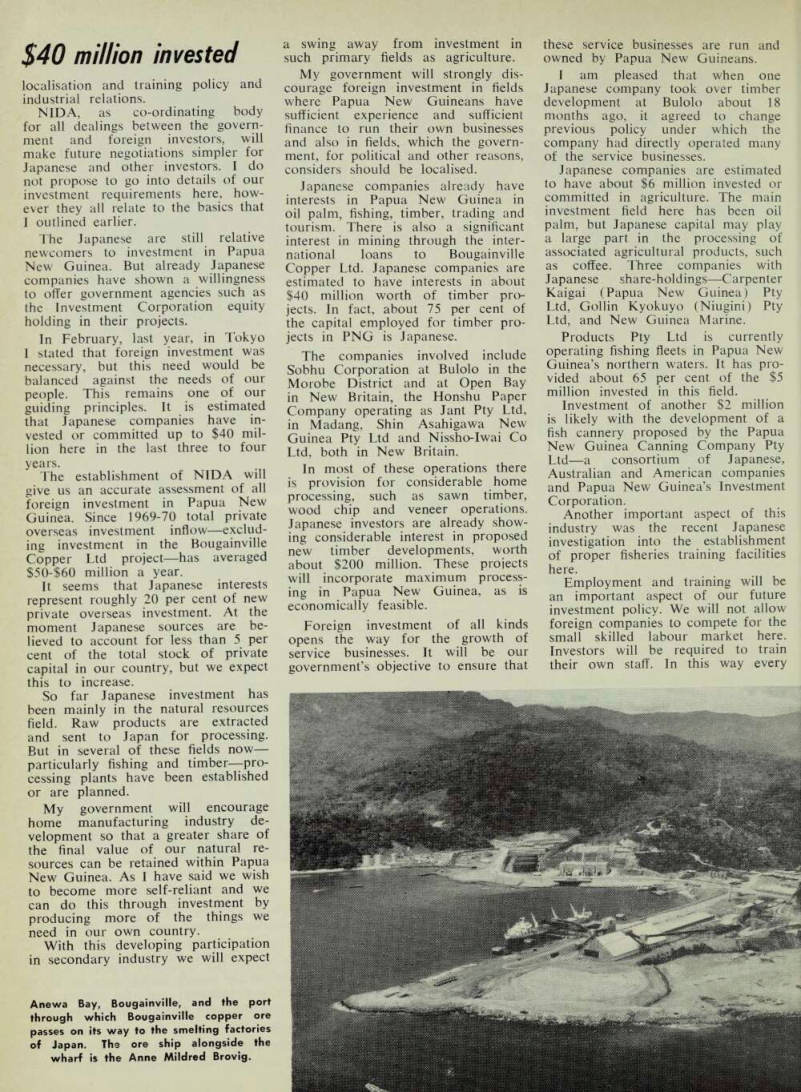
Mr Michael Somare.
$4O million invested
localisation and training policy and industrial relations.
NIDA, as co-ordinating body for all dealings between the govern ment and foreign investors, will make future negotiations simpler for Japanese and other investors. I do not propose to go into details of our investment requirements here, how ever they all relate to the basics that I outlined earlier.
The Japanese are still relative newcomers to investment in Papua New Guinea. But already Japanese companies have shown a willingness to offer government agencies such as
the Investment Corporation equity
holding in their projects.
In February, last year, in Tokyo I stated that foreign investment was necessary, but this need would be balanced against the needs of our people. This remains one of our guiding principles. It is estimated that Japanese companies have in vested or committed up to $4O mil lion here in the last three to four years.
The establishment of NIDA will give us an accurate assessment of all foreign investment in Papua New Guinea. Since 1969-70 total private overseas investment inflow—exclud ing investment in the Bougainville Copper Ltd project—has averaged $5O-$6O million a year.
It seems that Japanese interests represent roughly 20 per cent of new private overseas investment. At the moment Japanese sources are be lieved to account for less than 5 per cent of the total stock of private capital in our country, but we expect this to increase.
So far Japanese investment has been mainly in the natural resources field. Raw products are extracted and sent to Japan for processing.
But in several of these fields now—
particularly fishing and timber—pro
cessing plants have been established or are planned.
My government will encourage home manufacturing industry de velopment so that a greater share of the final value of our natural re sources can be retained within Papua New Guinea. As I have said we wish to become more self-reliant and we can do this through investment by producing more of the things we need in our own country.
With this developing participation
in secondary industry we will expect
a swing away from investment in such primary fields as agriculture.
My government will strongly dis courage foreign investment in fields where Papua New Guineans have sufficient experience and sufficient finance to run their own businesses and also in fields, which the govern ment, for political and other reasons, considers should be localised.
Japanese companies already have interests in Papua New Guinea in oil palm, fishing, timber, trading and tourism. There is also a significant interest in mining through the inter national loans to Bougainville Copper Ltd. Japanese companies are estimated to have interests in about $4O million worth of timber pro jects. In fact, about 75 per cent of the capital employed for timber pro jects in PNG is Japanese.
The companies involved include Sobhu Corporation at Bulolo in the Morobe District and at Open Bay in New Britain, the Honshu Paper Company operating as Jant Pty Ltd, in Madang, Shin Asahigawa New Guinea Pty Ltd and Nissho-Iwai Co Ltd, both in New Britain.
In most of these operations there is provision for considerable home processing, such as sawn timber, wood chip and veneer operations.
Japanese investors are already show ing considerable interest in proposed new timber developments, worth about $2OO million. These projects will incorporate maximum process ing in Papua New Guinea, as is economically feasible.
Foreign investment of all kinds opens the way for the growth of service businesses. It will be our government’s objective to ensure that
these service businesses are run and owned by Papua New Guineans.
I am pleased that when one Japanese company took over timber development at Bulolo about 18 months ago, it agreed to change previous policy under which the company had directly operated many of the service businesses.
Japanese companies are estimated to have about S 6 million invested or committed in agriculture. The main investment field here has been oil palm, but Japanese capital may play a large part in the processing of associated agricultural products, such as coffee. Three companies with Japanese share-holdings—Carpenter Kaigai (Papua New Guinea) Pty Ltd, Gollin Kyokuyo (Niugini) Pty Ltd, and New Guinea Marine.
Products Pty Ltd is currently operating fishing fleets in Papua New Guinea’s northern waters. It has pro vided about 65 per cent of the $5 million invested in this field.
Investment of another $2 million is likely with the development of a fish cannery proposed by the Papua New Guinea Canning Company Pty Ltd—a consortium of Japanese, Australian and American companies and Papua New Guinea’s Investment Corporation.
Another important aspect of this industry was the recent Japanese investigation into the establishment of proper fisheries training facilities here.
Employment and training will be an important aspect of our future investment policy. We will not allow foreign companies to compete for the small skilled labour market here.
Investors will be required to train their own staff. In this way every
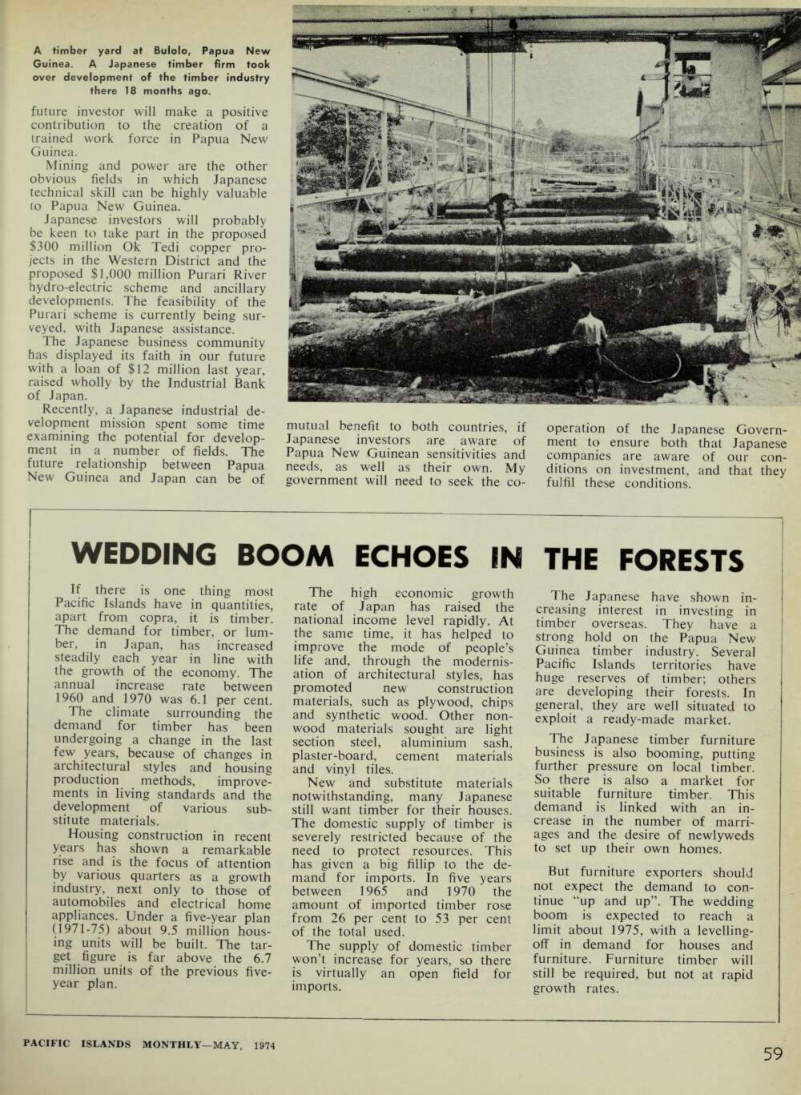
Anewa Bay, Bougainville, and the port through which Bougainville copper ore passes on its way to the smelting factories of Japan. The ore ship alongside the wharf is the Anne Mildred Brovig.
future investor will make a positive contribution to the creation of a trained work force in Papua New Guinea.
Mining and power are the other obvious fields in which Japanese technical skill can be highly valuable to Papua New Guinea.
Japanese investors will probably be keen to take part in the proposed $3OO million Ok Tedi copper pro jects in the Western District and the proposed $l,OOO million Purari River hydro-electric scheme and ancillary developments. The feasibility of the Purari scheme is currently being sur veyed, with Japanese assistance.
The Japanese business community has displayed its faith in our future with a loan of $l2 million last year, raised wholly by the Industrial Bank of Japan.
Recently, a Japanese industrial de velopment mission spent some time examining the potential for develop ment in a number of fields. The future relationship between Papua New Guinea and Japan can be of
mutual benefit to both countries, if Japanese investors are aware of Papua New Guinean sensitivities and needs, as well as their own. My government will need to seek the co
operation of the Japanese Govern ment to ensure both that Japanese companies are aware of our con ditions on investment, and that they fulfil these conditions.
A timber yard at Bulolo, Papua New Guinea. A Japanese timber firm took over development of the timber industry there 18 months ago.