Eight Million More Free-Spending
p. 54 · Read in the full issue
Tourists Expected In The Islands
The Pacific Islands are about to tap a virtually new tourist source, which could lead to a tremendous uplift in the industry. The Pacific has largely drawn its tourists from the United States, Canada, Australia and New Zealand, with small numbers coming from Europe, mainly in round-the world luxury cruise ships.
The Japanese are expected to be come tourists in a big way, wanting to see as much as possible in holidays of 10 days to two weeks. Japanese are visiting Europe in increasing numbers for those short periods, often taking in as much as four or five countries can offer them.
Projections are that by 1980, eight million Japanese will go abroad for holidays. By 1985 the figure is ex pected to be 25 million—just a quarter of the total population. The Pacific is expected to get about 10 per cent of those tourists. Just imagine, an extra 2.5 million tourists in the Pacific in one year, demanding all the services the tourist industry has to offer.
Two and a quarter million tourists are going to require a tremendous number of hotel rooms alone. They will want an active holiday, doing and seeing, rather than lying on a beach, although, no doubt, some of them will want to spend a few minutes lazing in the sun. Golf courses —the Japanese tourist wants his game of golf—spear-fishing, visiting villages, seeing how copra is cut, native arts and crafts will all interest the Japanese.
New hotels, motels, guest houses, will be required, and the Pacific at present just could not cater for such an influx, as well as the present run of tourists. The current building boom in the more popular tourist areas is likely to be given an added boost.
Outside capital is likely to pour into these areas—from the US, Canada, Australia and New Zealand, and Japan. The Japanese have looked
closely at many of the islands, seeking out likely areas to develop for their countrymen’s holidays.
Following the building boom will be the demand for services, for goods to sell to the visitors, for they have plenty of money to spend, and have the reputation of being free spenders.
It may seem ironic to try to sell duty free goods to the Japanese in the South Pacific, for much of what is offered comes from Japan. But the Japanese is not going to buy a National or Sony transistor radio or a Seiko watch, or Japanese whisky.
He will buy similar articles made elsewhere, prestige articles such as Swiss watches, German or British cameras, German transistors and Scotch whisky. He will also buy French wine, perhaps exotic clothes from the Middle East if they are available.
All this will widen the field for duty free sales, building up internal revenue and passing through the economic pipeline for the ultimate benefit of a country. Duty free shop ping may have pitfalls, just as any growth has problems in the long run, but they have not yet shown up.
Although a free spender, the Japan ese tourist will want value for his money. Shoddy services, shoddy goods, might result in some short term gain but they will soon be passed over by the Japanese as the word gets round.
Guam has been a popular tourist area for the Japanese, and so have parts of the US Trust Territory.
French Polynesia interests him, so much so that it is a stop on the Japan-Tahiti-Peru air service. But there are many islands between Japan and Tahiti, some of them which have “woken up” to tourism, others which are slowly shaking themselves out of their lethargy and starting to embrace the tourist industry as a matter of necessity in today’s hard world.
In the 10 days to two weeks’ annual holiday the Japanese will take away from the polluted atmosphere of his own cities he wants to see and do as much as he can. Don’t keep him waiting for air connections or taxis.
Offer him more than he can absorb— he will then fill those 10 days or two weeks to his own satisfaction, and be ready for more when the next holidays come along.
There is concrete evidence that many Japanese businessmen want to cater for their own people when they are on holiday, or rather provide the facilities. There has been a steady advance into the South Pacific tourist industry. Missions have gone to various groups to go over possibilities and report back.
In October, 1973, the Japan-Tonga Association was established by private enterprise and is planning at least one hotel, the forerunner to other hotels to back up the Dateline.
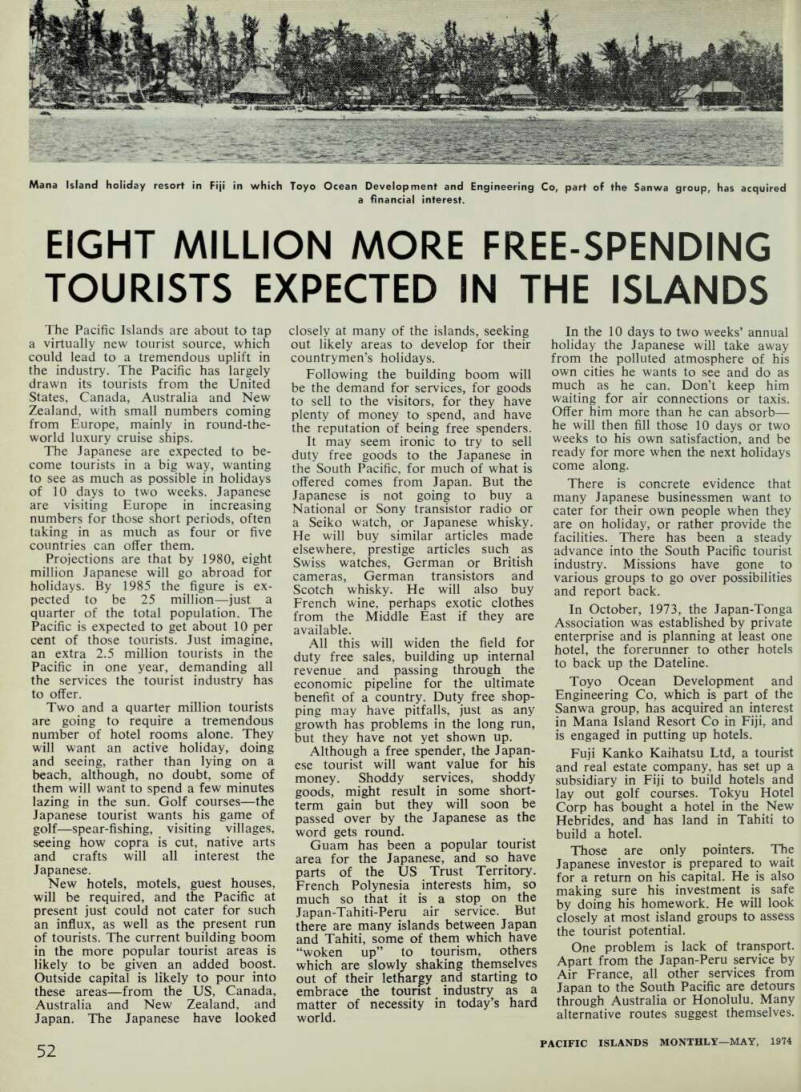
Toyo Ocean Development and Engineering Co, which is part of the Sanwa group, has acquired an interest in Mana Island Resort Co in Fiji, and is engaged in putting up hotels.
Fuji Kanko Kaihatsu Ltd, a tourist and real estate company, has set up a subsidiary in Fiji to build hotels and lay out golf courses. Tokyu Hotel Corp has bought a hotel in the New Hebrides, and has land in Tahiti to build a hotel.
Those are only pointers. The Japanese investor is prepared to wait for a return on his capital. He is also making sure his investment is safe by doing his homework. He will look closely at most island groups to assess the tourist potential.
One problem is lack of transport.
Apart from the Japan-Peru service by Air France, all other services from Japan to the South Pacific are detours through Australia or Honolulu. Many alternative routes suggest themselves.
Mana Island holiday resort in Fiji in which Toyo Ocean Development and Engineering Co, part of the Sanwa group, has acquired a financial interest.