navigators!
pp. 25-27 · Read in the full issue

Hands off the Polynesian navigators!
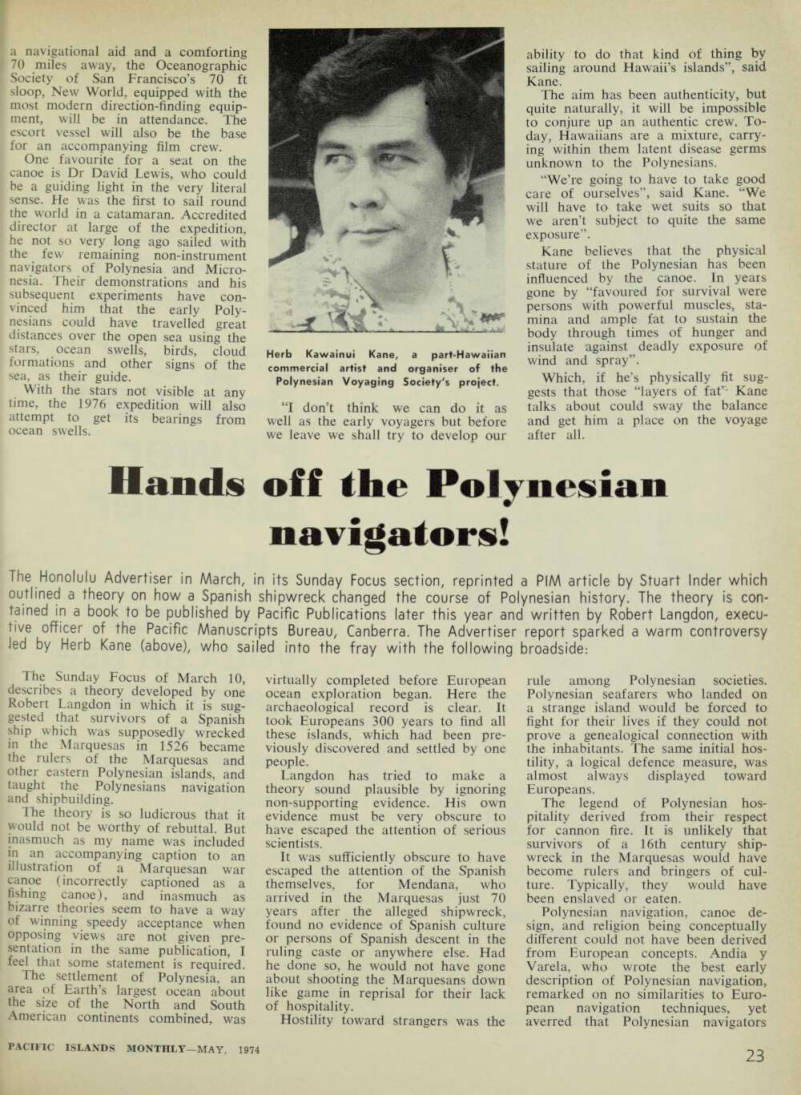
The Honolulu Advertiser in March, in its Sunday Focus section, reprinted a PfM article by Stuart Inder which outlined a theory on how a Spanish shipwreck changed the course of Polynesian history. The theory is con tained in a book to be published by Pacific Publications later this year and written by Robert Langdon, execu tive officer of the Pacific Manuscripts Bureau, Canberra. The Advertiser report sparked a warm controversy Jed by Herb Kane (above), who sailed into the fray with the following broadside:
The Sunday Focus of March 10, describes a theory developed by one Robert Langdon in which it is sug gested that survivors of a Spanish ship which was supposedly wrecked in the Marquesas in 1526 became the rulers of the Marquesas and other eastern Polynesian islands, and taught the Polynesians navigation and shipbuilding.
The theory is so ludicrous that it would not be worthy of rebuttal. But inasmuch as my name was included in an accompanying caption to an illustration of a Marquesan war canoe (incorrectly captioned as a fishing canoe), and inasmuch as bizarre theories seem to have a way of winning speedy acceptance when opposing views are not given pre sentation in the same publication, I feel that some statement is required.
The settlement of Polynesia, an area of Earth’s largest ocean about the size of the North and South American continents combined, was
virtually completed before European ocean exploration began. Here the archaeological record is clear. It took Europeans 300 years to find all these islands, which had been pre viously discovered and settled by one people.
Langdon has tried to make a theory sound plausible by ignoring non-supporting evidence. His own evidence must be very obscure to have escaped the attention of serious scientists.
It was sufficiently obscure to have escaped the attention of the Spanish themselves, for Mendana, who arrived in the Marquesas just 70 years after the alleged shipwreck, found no evidence of Spanish culture or persons of Spanish descent in the ruling caste or anywhere else. Had he done so, he would not have gone about shooting the Marquesans down like game in reprisal for their lack of hospitality.
Hostility toward strangers was the
rule among Polynesian societies.
Polynesian seafarers who landed on a strange island would be forced to fight for their lives if they could not prove a genealogical connection with the inhabitants. The same initial hos tility, a logical defence measure, was almost always displayed toward Europeans.
The legend of Polynesian hos pitality derived from their respect for cannon fire. It is unlikely that survivors of a 16th century ship wreck in the Marquesas would have become rulers and bringers of cul ture. Typically, they would have been enslaved or eaten.
Polynesian navigation, canoe de sign, and religion being conceptually different could not have been derived from European concepts. Andia y Varela, who wrote the best early description of Polynesian navigation, remarked on no similarities to Euro pean navigation techniques, yet averred that Polynesian navigators
Conquest of Nature
“hit off with as much precision as the most expert navigator of civilised nations could achieve”.
He also found that Polynesian meteorology was superior . . . “for, in spite of all that our navigators and cosmographers have observed and written anent this subject, they have not mastered this accomplish ment”. Vessel design was different in form (because the Polynesians knew no metal tools or fastenings) and in intent.
The quality of workmanship in Tuamotuan vessels which moved De Quiros (1606) to state that “better could not be made in Castille” in no way suggests that Polynesians learned shipbuilding from the Castil lian Spanish.
Designed to glide over waves lightly and sail with the winds, Poly nesian vessels differed from the floating fortresses of Europe which were designed to barge through the waves in any season.
The difference is one of attitude toward nature. The European ob session with a “conquest of Nature” which led to constructing ships were offensive toward natural forces and defensive from natural forces, was an attitude which was incompre hensible to Polynesians who re garded their gods, deifications of natural forces, as ancestors to be respected rather than feared. This leads to the conceptual difference in religion. Polynesian gods were of nature, not supernatural in the same sense as are the gods of Western religions. These differences suggest independent cultural development Europeans have long been making fools of themselves trying to find some simple explanation for the fact of Polynesian settlement of the Paci fic, apparently unwilling to believe that Polynesians were capable ma riners long before European sailors dared to leave the presence of land behind them.
Theories of sunken continents and land bridges which might have afforded pedestrian passage for an cestral Polynesians, theories of origins from the Americas (Heyer dahl), theories of lost groups— always European-like (Heyerdahl) or European (Langdon;) bringing rule and culture to Polynesia, theories of settlement by helpless, drifting canoes (Sharp)—all have been proposed. Demolished and dis credited by serious scientific investi-
gation, they rise again later in dif ferent plumage.
This inordinate concern about Polynesian origins and scepticism about Polynesian maritime capa bilities, described by some writers as “The Polynesian Problem”, has never been a problem to the Poly
nesians. It, however, is a proper sub ject for scientific investigation.
Such investigation has been con ducted by anthropologists for de cades, without great publicity, with out sufficient funds or sufficient time, without sufficient public support or encouragement, but with a grim de termination to get at the truth. And the true story of Polynesian pre history is surely unfolding as the re sult of their work.
If all the hullabaloo, the printed paper, television time, expended human energy, and profits made by proponents of bizarre theories could be somehow turned to the support of serious effort, the truth will unfold much more rapidly.
One serious effort to learn more about Polynesian maritime capa bilities is the present plan to replicate a voyaging canoe and conduct an experimental voyage between Hawaii and Tahiti, and return. Data derived from experiments in non-instrument navigation, canoe performance, food energy, psychological aspects of voy aging, physiological effects, and in transporting plants and animals, will hopefully fill gaps in our present knowledge.
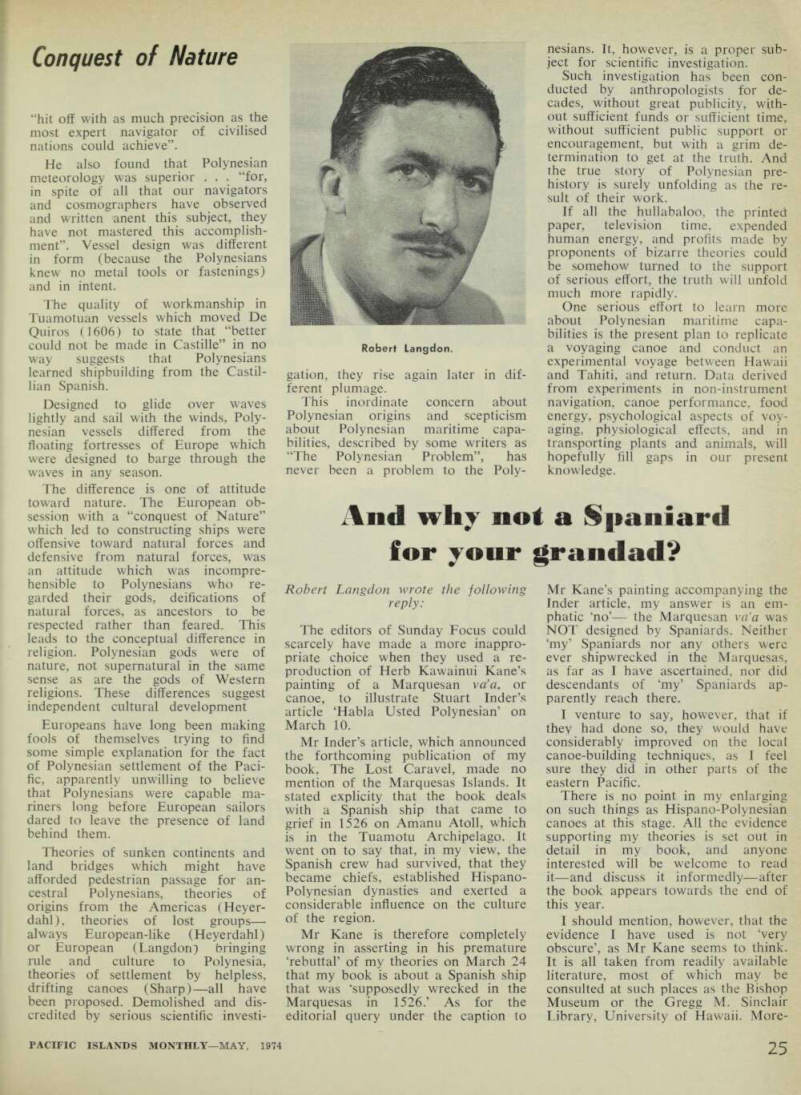
Robert Langdon.