into history
pp. 23-25 · Read in the full issue
Hawaiians will sail back into history
From MIKE HOHENSEE in Honolulu
Sometime in 1976 a replica of an ancient voyaging canoe is planned to leave Hawaiian waters and head into the north-east trades on the first half of a 6,000-mile journey. The 24-man crew hopes to sail to Tahiti and back on a craft similar to that used by Hawaii’s first settlers more than 1,000 years ago.
They hope to prove that their forefathers, the Polynesians, arrived on Hawaiian shores after a deli berate search for land and were able to find their way back. Each leg of the voyage should take from 20 days to five weeks depending on the weather and the accuracy of their non-instrument navigation.
The Polynesian Voyaging Society, a Honolulu-based, non-profit organ isation, has been formed for the pro ject. It has been giving away in formation brochures, selling T-shirts and posters and soliciting honorary memberships, and has already raised a third of the $U595,000 needed to float the expedition.
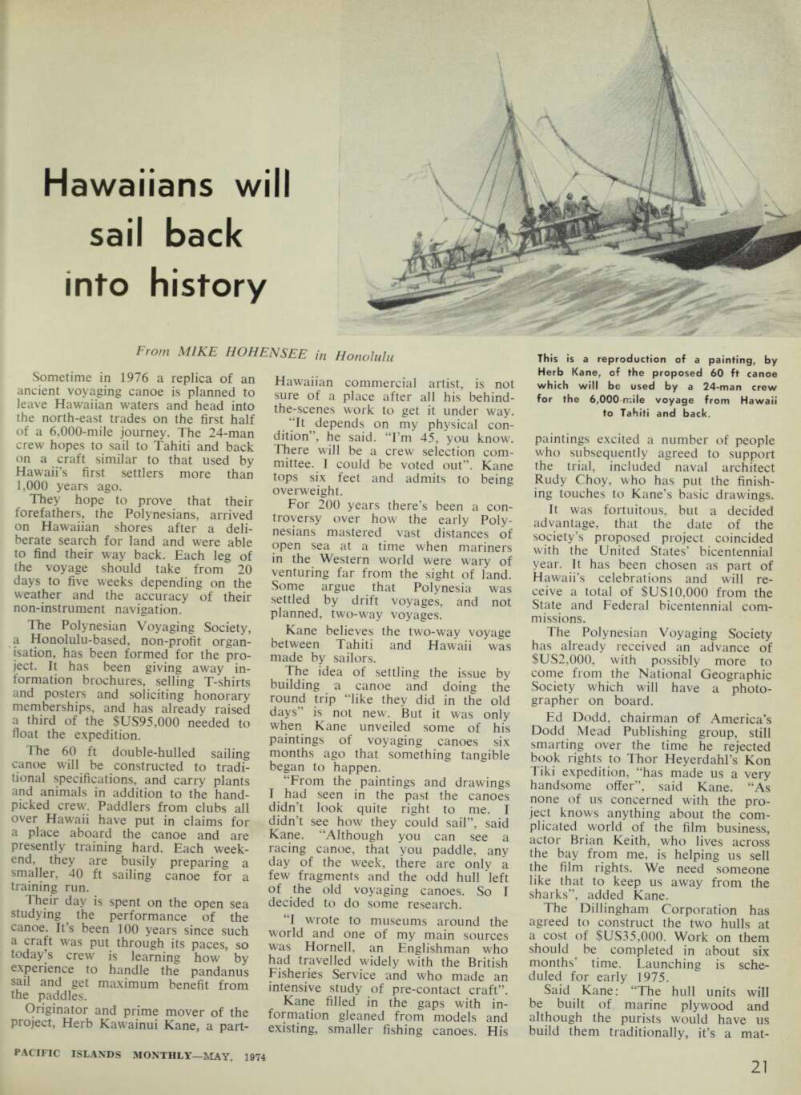
The 60 ft double-hulled sailing canoe will be constructed to tradi tional specifications, and carry plants and animals in addition to the hand picked crew. Paddlers from clubs all over Hawaii have put in claims for a place aboard the canoe and are presently training hard. Each week end, they are busily preparing a smaller, 40 ft sailing canoe for a training run.
Their day is spent on the open sea studying the performance of the canoe. It’s been 100 years since such a craft was put through its paces, so today[s crew is learning how by experience to handle the pandanus sail and get maximum benefit from the paddles.
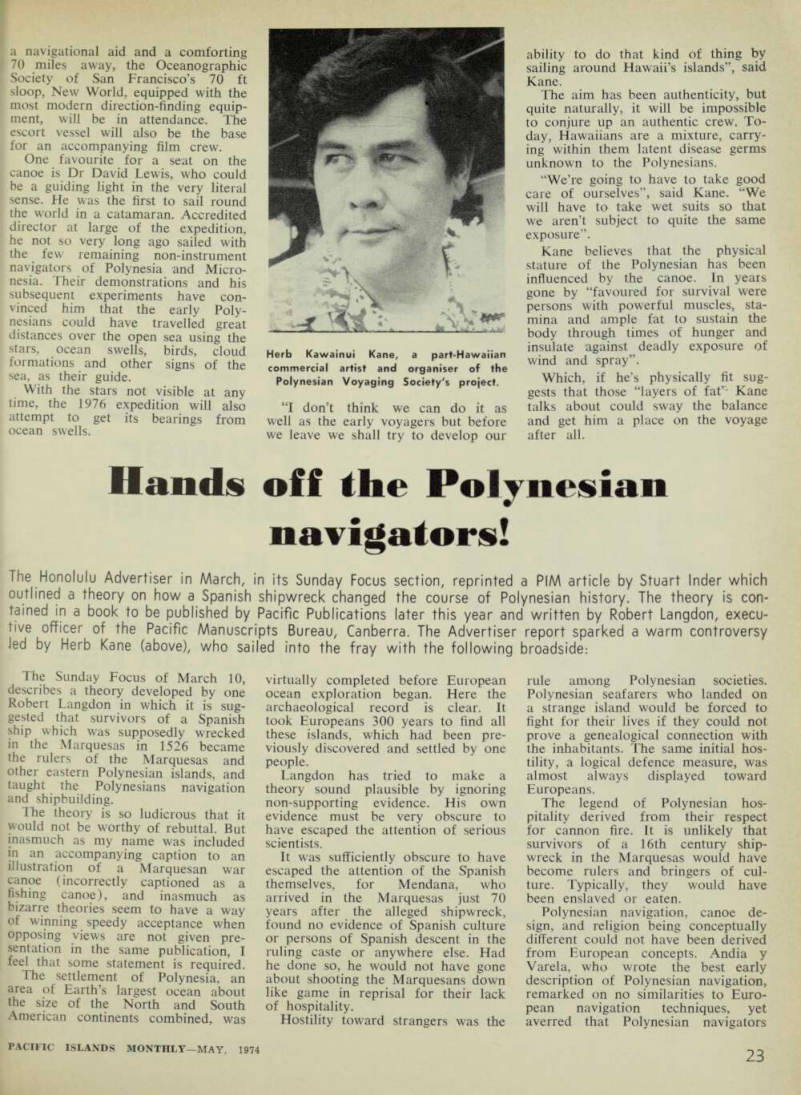
Originator and prime mover of the project, Herb Kawainui Kane, a part-
Hawaiian commercial artist, is not sure of a place after all his behind the-scenes work to get it under way.
“It depends on my physical con dition”, he said. “I’m 45, you know.
There will be a crew selection com mittee. I could be voted out”. Kane tops six feet and admits to being overweight.
For 200 years there’s been a con troversy over how the early Poly nesians mastered vast distances of open sea at a time when mariners in the Western world were wary of venturing far from the sight of land.
Some argue that Polynesia was settled by drift voyages, and not planned, two-way voyages.
Kane believes the two-way voyage between Tahiti and Hawaii was made by sailors.
The idea of settling the issue by building a canoe and doing the round trip “like they did in the old days” is not new. But it was only when Kane unveiled some of his paintings of voyaging canoes six months ago that something tangible began to happen.
“From the paintings and drawings I had seen in the past the canoes didn’t look quite right to me. I didn’t see how they could sail”, said Kane. “Although you can see a racing canoe, that you paddle, any day of the week, there are only a few fragments and the odd hull left of the old voyaging canoes. So I decided to do some research.
“I wrote to museums around the world and one of my main sources was Hornell, an Englishman who had travelled widely with the British Fisheries Service and who made an intensive study of pre-contact craft”.
Kane filled in the gaps with in formation gleaned from models and existing, smaller fishing canoes. His
paintings excited a number of people who subsequently agreed to support the trial, included naval architect Rudy Choy, who has put the finish ing touches to Kane’s basic drawings.
It was fortuitous, but a decided advantage, that the date of the society’s proposed project coincided with the United States’ bicentennial year. It has been chosen as part of Hawaii’s celebrations and will re ceive a total of SUSIO.OOO from the State and Federal bicentennial com missions.
The Polynesian Voyaging Society has already received an advance of SUS2,OOO, with possibly more to come from the National Geographic Society which will have a photo grapher on board.
Ed Dodd, chairman of America’s Dodd Mead Publishing group, still smarting over the time he rejected book rights to Thor Heyerdahl’s Kon Tiki expedition, “has made us a very handsome offer”, said Kane. “As none of us concerned with the pro ject knows anything about the com plicated world of the film business, actor Brian Keith, who lives across the bay from me, is helping us sell the film rights. We need someone like that to keep us away from the sharks”, added Kane.
The Dillingham Corporation has agreed to construct the two hulls at a cost of $U535,000. Work on them should be completed in about six months’ time. Launching is sche duled for early 1975.
Said Kane: “The hull units will be built of marine plywood and although the purists would have us build them traditionally, it’s a mat-
This is a reproduction of a painting, by Herb Kane, of the proposed 60 ft canoe which will be used by a 24-man crew for the 6,000-mile voyage from Hawaii to Tahiti and back.
Sailing into history
ter of time. It would take us years to build them in the old way. Their function and performance will be the same. We are interested in their use rather than the formality of con struction. We’re building a floating laboratory in which to make experi ments”. he said, “Eight miles of hand-braided sen nit rope from Fiji and Tonga will be used for lashing. We want to know the properties of sennit. That’s all the Polynesians had. Our en gineering will also be with sennit.
Their sails were of pandanus, so our sails will be of pandanus.
“We get onto the swells and winds past Koko Head. I think we get about 15 knots in 25 mph winds, with gusts at 35 mph and 10 ft swells. In the conventional sailboat it’s difficult to move well in that situation because of the turbulence of the water and of the air over the water.
“However, this boat is very smooth riding. The raised end pieces have a very definite function, we’ve discovered. They split the surface tension of the swell to prevent the channel hulls from boneyarding— which could be disastrous.
“Because modern boats are rigidly rigged with wire, there’s little flexi bility. As a result, when the mast heels the boat heels. In our case,
we’re using ropes for rigging, they
are flexible, and when the wind strikes suddenly and hard the mast heels over but the boat doesn’t.
“At the point where the boat starts to heel and the shrouds begin to pick up, the cut of the sail, which has a dip in it along the top, spills the excess wind and prevents a cap size.
“Now I know why they cut the sail that way.”
The canoe is steered by raising and lowering a large paddle at the stern, and because there is no jib and very little sail for the size of the boat, coming about is difficult.
That’s where the paddlers come into their own.
Even with a larger canoe and two sails, Kane can’t guarantee a com fortable voyage. Quarters are con fined, according to ancient guide lines. A main deck shelter will ac commodate one-third of the crew at a time in eight hour shifts: a turn round of eight sleeping and 16 working. The lower part of the hulls will be used as storage areas.
The returning crew may not be wholly the same. After a month away “some of the boys may want
to get back to their jobs and families”.
“We may supplement the crew for the homeward voyage by flying some out to Tahiti and even take on some Tahitians, because the people in Tahiti are really stoked on this”, said Kane.
There will at least be three new faces on board on the return —a pig, a chicken and a dog. “We want to see how they were kept alive”, he said.
One thing the Hawaiians can re member is the culinary arts of their forebears. The material amassed for the voyagers is soon to be published in a cook book by the Polynesian Voyaging Society, the proceeds going towards the trip.
Said Kane: “We’ll be taking dried fish, dried bananas from Rarotonga and dried breadfruit mash, prepared much like the Mexican tortilla. It is dried in the sun, tightly rolled and wrapped in tea leaves and bound in sennit. You can cut off a slice at a time. It tastes very much like dried apricots”.
For all that, Kane estimates that if the voyage goes past 30 days and the fishing, to supplement carried food and water, has been poor “we could be in serious trouble”.
The emergency radio will be sealed so that it cannot be used as
a navigational aid and a comforting 70 miles away, the Oceanographic Society of San Francisco’s 70 ft sloop, New World, equipped with the most modern direction-finding equip ment, will be in attendance. The escort vessel will also be the base for an accompanying film crew.
One favourite for a seat on the canoe is Dr David Lewis, who could be a guiding light in the very literal sense. He was the first to sail round the world in a catamaran. Accredited director at large of the expedition, he not so very long ago sailed with the few remaining non-instrument navigators of Polynesia and Micro nesia. Their demonstrations and his subsequent experiments have con vinced him that the early Poly nesians could have travelled great distances over the open sea using the stars, ocean swells, birds, cloud formations and other signs of the sea, as their guide.
With the stars not visible at any time, the 1976 expedition will also attempt to get its bearings from ocean swells.
“I don’t think we can do it as well as the early voyagers but before we leave we shall try to develop our
ability to do that kind of thing by sailing around Hawaii’s islands”, said Kane.
The aim has been authenticity, but quite naturally, it will be impossible to conjure up an authentic crew. To day, Hawaiians are a mixture, carry ing within them latent disease germs unknown to the Polynesians.
“We’re going to have to take good care of ourselves”, said Kane. “We will have to take wet suits so that we aren’t subject to quite the same exposure”.
Kane believes that the physical stature of the Polynesian has been influenced by the canoe. In years gone by “favoured for survival were persons with powerful muscles, sta mina and ample fat to sustain the body through times of hunger and insulate against deadly exposure of wind and spray”.
Which, if he’s physically fit sug gests that those “layers of fat n Kane talks about could sway the balance and get him a place on the voyage after all.
Herb Kawainui Kane, a part-Hawaiian commercial artist and organiser of the Polynesian Voyaging Society's project.