Tropicalities
pp. 16-18 · Read in the full issue
Lost! One
constitution
The Case of the Missing Constitu tion is raising eyebrows in Honiara.
The proposed constitution, sent to London for vetting by legal experts, was originally promised for April, and was confidently expected to con tain eagerly-awaited details of the ministerial system of government and to provide the go-ahead for the elec tion of the first Chief Minister for the Solomons.
But then an item over the BSIP radio news announced that the arrival of the new constitution had been delayed.
This was where the plot began to thicken. A train of events was set in motion which was to cause an noyance to the Governing Council members, embarrassment to the administrators, and frustration to the government information service.
One of the main reasons given over the Solomons radio for the delay in the constitution’s arrival, quoting an unnamed Secretariat spokesman, was that the introduction of the three-day working week in Britain had led to delays in Whitehall, and that one of the victims of these hold-ups was the proposed BSIP constitution.
However, at a subsequent open meeting of the Governing Council, when pressed by Ashley Wickham, the member for Honiara and a former information officer himself, a senior official denied that the introduction of the three-day week had had anything to do with the delay. The hold-up, claimed the official, was due to a section in the proposed constitution on Human Rights, which had caused some confusion in London and had to be sent back to Honiara for clarification.
The question currently being debated with some heat in the Solomons is—who exactly said what to whom in the press briefing? Was there a genuine misunderstanding, or did the information service, as it hotly
claims, report the official correctly?
Was the slow-down in London one of the reasons for the delay in ap proving the constitution, and did the Honiara administrators chicken out when they saw this reason publicly announced?
It is unlikely that the answers to these questions will emerge. What is certain is that relations between the energetic information service and the stone-walling administrators, cool at best, are now definitely frigid. And, of course, the Protectorate is still waiting for its constitution.
From an atoll to a
baroque basilica
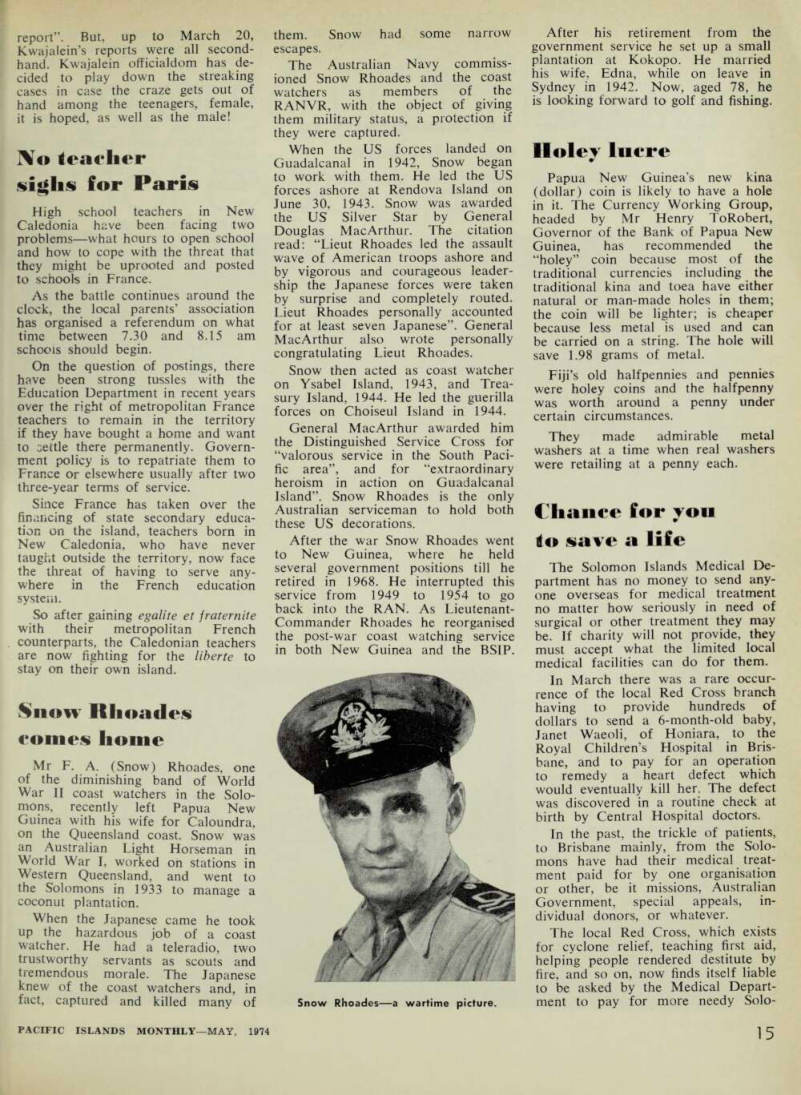
Last October’s PIM featured win some 21-year-old Aborina Tenano rake, from North Tarawa, as the star of the first professionally-produced motion picture in the GEIC, the full length Sailing in the Trade Winds, and reported that she would fly to West Germany for the final interior shooting in the studios in Munich, Pictured here is Aborina again, not in the role of a film star, but as a bride of the film director, Karl- Heinz von Stellmach, who didn’t realise, when he discovered the star for the film he was making for the Roman Catholic Church in the colony, that he had also found a wife.
They were married in the beauti ful Roman Catholic basilica of Waldsassen. Aborina carried a bou quet of mauve orchids which had been flown from Fiji where she also obtained her wedding gown.
So far as Aborina was concerned, there couldn’t have been a greater contrast between her atoll home and the baroque-style church, nor in the weather—it was snowing! But the wintry weather hasn’t worried her— “ German winter clothes are most efficient and their central heating system in all their houses is really something wonderful”.
The von Stellmachs have been in vited to London. The Queen is see ing the film Sailing in the Trade Winds at a showing in Buckingham Palace. Which isn’t surprising. It’s described as a splendid film which should put the GEIC on the map, and the GEIC is one of the few re-
maining Crown colonies. In no time at all now, it’ll be an ex-colony.
Streakers run
the missile range
Streaking, that peculiar craze of running naked through a crowded place, which, like most crazes, originated in the United States, has hit that most top-secret of places in the Pacific Islands, Kwajalein.
Two young men wearing stocking caps, sneakers and nothing else, dashed through the Yokwe Yuk Club on Kwajalein, the United States missile range, which is closed to all but those approved by the US Army’s Redstone Arsenal.
The local American Forces Radio Station (APRS) interrupted its re gular programme at 9.30 pm on March 20 to announce: “It’s finally happened at Kwajalein. Two streak ers wearing stocking caps have just run through the Yuk Club, out through the Yuk Theatre and into the night”.
The craze is so popular in the USA at present that many radio stations, including Kwajalein’s carry a daily five-minute “Streaker
Mr and Mrs Karl Heinz von Stellmach.
report”. But, up to March 20, Kwajalein’s reports were all second hand. Kwajalein officialdom has de cided to play down the streaking cases in case the craze gets out of hand among the teenagers, female, it is hoped, as well as the male!
No teacher
sighs for Paris
High school teachers in New Caledonia have been facing two problems—what hours to open school and how to cope with the threat that they might be uprooted and posted to schools in France.
As the battle continues around the clock, the local parents’ association has organised a referendum on what time between 7.30 and 8.15 am schools should begin.
On the question of postings, there have been strong tussles with the Education Department in recent years over the right of metropolitan France teachers to remain in the territory if they have bought a home and want to settle there permanently. Govern ment policy is to repatriate them to France or elsewhere usually after two three-year terms of service.
Since France has taken over the financing of state secondary educa tion on the island, teachers born in New Caledonia, who have never taught outside the territory, now face the threat of having to serve any where in the French education system.
So after gaining egalite et fraternite with their metropolitan French counterparts, the Caledonian teachers are now fighting for the liberte to stay on their own island.
Snow lllioades
monies home
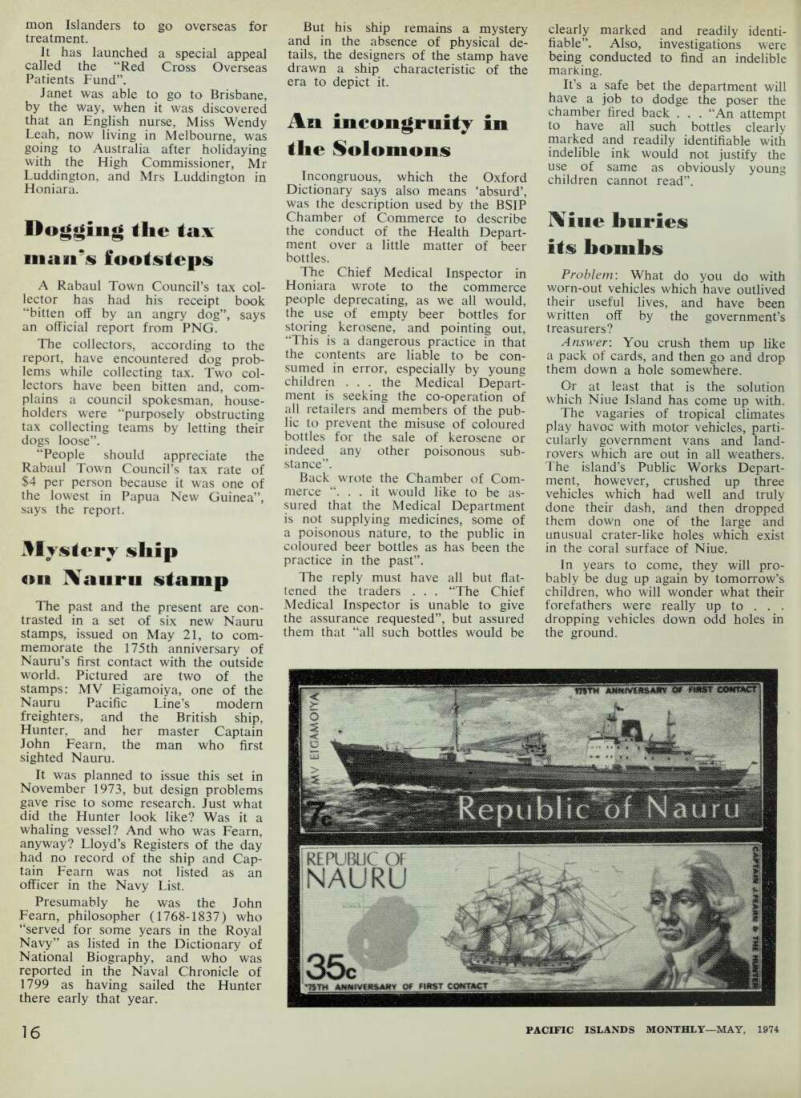
Mr F. A. (Snow) Rhoades, one of the diminishing band of World War II coast watchers in the Solo mons, recently left Papua New Guinea with his wife for Caloundra, on the Queensland coast. Snow was an Australian Light Horseman in World War I, worked on stations in Western Queensland, and went to the Solomons in 1933 to manage a coconut plantation.
When the Japanese came he took up the hazardous job of a coast watcher. He had a teleradio, two trustworthy servants as scouts and tremendous morale. The Japanese knew of the coast watchers and, in fact, captured and killed many of
them. Snow had some narrow escapes.
The Australian Navy commiss ioned Snow Rhoades and the coast watchers as members of the RANVR, with the object of giving them military status, a protection if they were captured.
When the US forces landed on Guadalcanal in 1942, Snow began to work with them. He led the US forces ashore at Rendova Island on June 30, 1943. Snow was awarded the US Silver Star by General Douglas MacArthur. The citation read: “Lieut Rhoades led the assault wave of American troops ashore and by vigorous and courageous leader ship the Japanese forces were taken by surprise and completely routed.
Lieut Rhoades personally accounted for at least seven Japanese”. General MacArthur also wrote personally congratulating Lieut Rhoades.
Snow then acted as coast watcher on Ysabel Island, 1943, and Trea sury Island, 1944. He led the guerilla forces on Choiseul Island in 1944.
General MacArthur awarded him the Distinguished Service Cross for “valorous service in the South Paci fic area”, and for “extraordinary heroism in action on Guadalcanal Island”. Snow Rhoades is the only Australian serviceman to hold both these US decorations.
After the war Snow Rhoades went to New Guinea, where he held several government positions till he retired in 1968. He interrupted this service from 1949 to 1954 to go back into the RAN. As Lieutenant- Commander Rhoades he reorganised the post-war coast watching service in both New Guinea and the BSIP.
After his retirement from the government service he set up a small plantation at Kokopo. He married his wife, Edna, while on leave in Sydney in 1942. Now, aged 78, he is looking forward to golf and fishing.
Holey lucre
Papua New Guinea’s new kina (dollar) coin is likely to have a hole in it. The Currency Working Group, headed by Mr Henry Toßobert, Governor of the Bank of Papua New Guinea, has recommended the “holey” coin because most of the traditional currencies including the traditional kina and toea have either natural or man-made holes in them; the coin will be lighter; is cheaper because less metal is used and can be carried on a string. The hole will save 1.98 grams of metal.
Fiji’s old halfpennies and pennies were holey coins and the halfpenny was worth around a penny under certain circumstances.
They made admirable metal washers at a time when real washers were retailing at a penny each.
Chance for you
do save a life The Solomon Islands Medical De partment has no money to send any one overseas for medical treatment no matter how seriously in need of surgical or other treatment they may be. If charity will not provide, they must accept what the limited local medical facilities can do for them.
In March there was a rare occur rence of the local Red Cross branch having to provide hundreds of dollars to send a 6-month-old baby, Janet Waeoli, of Honiara, to the Royal Children’s Hospital in Bris bane, and to pay for an operation to remedy a heart defect which would eventually kill her. The defect was discovered in a routine check at birth by Central Hospital doctors.
In the past, the trickle of patients, to Brisbane mainly, from the Solo mons have had their medical treat ment paid for by one organisation or other, be it missions, Australian Government, special appeals, in dividual donors, or whatever.
The local Red Cross, which exists for cyclone relief, teaching first aid, helping people rendered destitute by fire, and so on, now finds itself liable to be asked by the Medical Depart ment to pay for more needy Solo
Snow Rhoades—a wartime picture.
mon Islanders to go overseas for treatment.
It has launched a special appeal called the “Red Cross Overseas Patients Fund”.
Janet was able to go to Brisbane, by the way, when it was discovered that an English nurse, Miss Wendy Leah, now living in Melbourne, was going to Australia after holidaying with the High Commissioner, Mr Luddington, and Mrs Luddington in Honiara.
Dogging the tax
man’s footsteps
A Rabaul Town Council’s tax col lector has had his receipt book “bitten off by an angry dog”, says an official report from PNG.
The collectors, according to the report, have encountered dog prob lems while collecting tax. Two col lectors have been bitten and, com plains a council spokesman, house holders were “purposely obstructing tax collecting teams by letting their dogs loose”.
“People should appreciate the Rabaul Town Council’s tax rate of S 4 per person because it was one of the lowest in Papua New Guinea”, says the report.
Mystery ship
on Nauru stamp
The past and the present are con trasted in a set of six new Nauru stamps, issued on May 21, to com memorate the 175th anniversary of Nauru’s first contact with the outside world. Pictured are two of the stamps: MV Eigamoiya, one of the Nauru Pacific Line’s modern freighters, and the British ship, Hunter, and her master Captain John Fearn, the man who first sighted Nauru.
It was planned to issue this set in November 1973, but design problems gave rise to some research. Just what did the Hunter look like? Was it a whaling vessel? And who was Feam, anyway? Lloyd’s Registers of the day had no record of the ship and Cap tain Fearn was not listed as an officer in the Navy List.
Presumably he was the John Fearn, philosopher (1768-1837) who “served for some years in the Royal Navy” as listed in the Dictionary of National Biography, and who was reported in the Naval Chronicle of 1799 as having sailed the Hunter there early that year.
But his ship remains a mystery and in the absence of physical de tails, the designers of the stamp have drawn a ship characteristic of the era to depict it.
Aei incongruity in
the Solomons
Incongruous, which the Oxford Dictionary says also means ‘absurd’, was the description used by the BSIP Chamber of Commerce to describe the conduct of the Health Depart ment over a little matter of beer bottles.
The Chief Medical Inspector in Honiara wrote to the commerce people deprecating, as we all would, the use of empty beer bottles for storing kerosene, and pointing out, “This is a dangerous practice in that the contents are liable to be con sumed in error, especially by young children ... the Medical Depart ment is seeking the co-operation of all retailers and members of the pub lic to prevent the misuse of coloured bottles for the sale of kerosene or indeed any other poisonous sub stance”.
Back wrote the Chamber of Com merce “. . . it would like to be as sured that the Medical Department is not supplying medicines, some of a poisonous nature, to the public in coloured beer bottles as has been the practice in the past”.
The reply must have all but flat tened the traders . . . “The Chief Medical Inspector is unable to give the assurance requested”, but assured them that “all such bottles would be
clearly marked and readily identi fiable”. Also, investigations were being conducted to find an indelible marking.
It’s a safe bet the department will have a job to dodge the poser the chamber fired back . . . “An attempt to have all such bottles clearly marked and readily identifiable with indelible ink would not justify the use of same as obviously young children cannot read”,
Niue buries
its bombs
Problem : What do you do with worn-out vehicles which have outlived their useful lives, and have been written off by the government’s treasurers?
Answer : You crush them up like a pack of cards, and then go and drop them down a hole somewhere.
Or at least that is the solution which Niue Island has come up with.
The vagaries of tropical climates play havoc with motor vehicles, parti cularly government vans and land rovers which are out in all weathers.
The island’s Public Works Depart ment, however, crushed up three vehicles which had well and truly done their dash, and then dropped them down one of the large and unusual crater-like holes which exist in the coral surface of Niue.
In years to come, they will pro bably be dug up again by tomorrow’s children, who will wonder what their forefathers were really up to . . . dropping vehicles down odd holes in the ground.