Filipinos
p. 15 · Read in the full issue
queue tor PNG posts
Between 2,000 and 3,000 Filipinos have applied for 200 positions ad vertised in the Philippines by the Papua New Guinea Public Service Board, some of them highly-qualified professional people.
More than 40 of the positions ad vertised are for teachers, but others sought include architects, engineers, surveyors and medical officers.
PNG decided to recruit in the Philippines because the government can see itself seriously short of skilled people following independ ence. Most expatriates come from Australia, but the Filipinos are not only available but are considerably cheaper to employ. Also, their entry into PNG’s labour force helps the image that both PNG and Australia want to portray—that of casting off the colonial image.
By the standards of salary paid to Australians the Filipino workers are extraordinarily cheap. It could be that they are too cheap and that after their original two-year contracts are completed, and it is found that their occupational skills meet PNG requirements, realistic increases may be discussed. It is understood that PNG is prepared to do this, and is looking on the employment as an experiment in the first instance.
Knowing little about PNG con ditions, the Filipino recruits are naturally apprehensive about the cost of living in the country, including income taxes they may have to pay both to PNG and the Philippines.
Mr Gini Uru, head of the PNG recruiting team which went to Manila, is optimistic that, if the pro grammes prove successful, the PNG Government may not have to look anywhere else to fill positions that cannot yet be occupied by New Guineans. He thinks more Filipinos may be offered jobs. If salaries and conditions are what the Filipinos want, the arrangement might well be a successful two-way arrangement.
PNG, with a population of only 2.8 million, is in dire need of pro fessional and skilled workers, while the densely-populated Philippines (40 million) is burdened with an over-supply of labour.
Most of the jobs offered fall with in an annual salary range of from $A3,000 to $A5,000. The highest salary is $A 10,267 for a specialist
medical officer and the lowest is 5A2,451 for an accounting machin ist. These salaries are payable after 12 months satisfactory service. Other salaries include architect class 1, $4,493 to commence and $4,547 after 12 months; engineer class 1, $4,318 and, later $4,519; senior draftsman $5,597 to $5,763; tutor sister $4,097; education officer 1, $3,156 to $3,340; general steno grapher, $3,123 to $3,232.
Meanwhile, the government has before it a report on incomes, wages and prices which, if some of its pro visions are introduced, could drastic ally stem the flow of expatriate man power into PNG, slash the expatriate wages bill and impose personal in come tax rises of up to 17.5 per cent.
The document was commissioned from a three-man interdepartmental committee in 1972 and released by the government in April. One of its proposals is that the present system of selective entry for employment be replaced by work permits giving greater control of people wanting to enter the country for work. It sug gests recruitment should come from English-speaking countries where the average income fell below that of Australia, “because it is not neces sary to employ all expatriates at Australian rates”.
Under recommended income tax rates the minimum taxable income would be raised from $422 a year to $522, with marginal increases. Com pany tax would rise to up to 35 per cent, and by retaining the present 15 per cent witholding tax, companies which transferred all their profits to their home country would pay a total tax on profits of 44.75 per cent.
Other pay recommendations in clude establishment of a national contributory superannuation scheme for both public servants and private employees and a 40-hour week for public servants, with no pay increase.
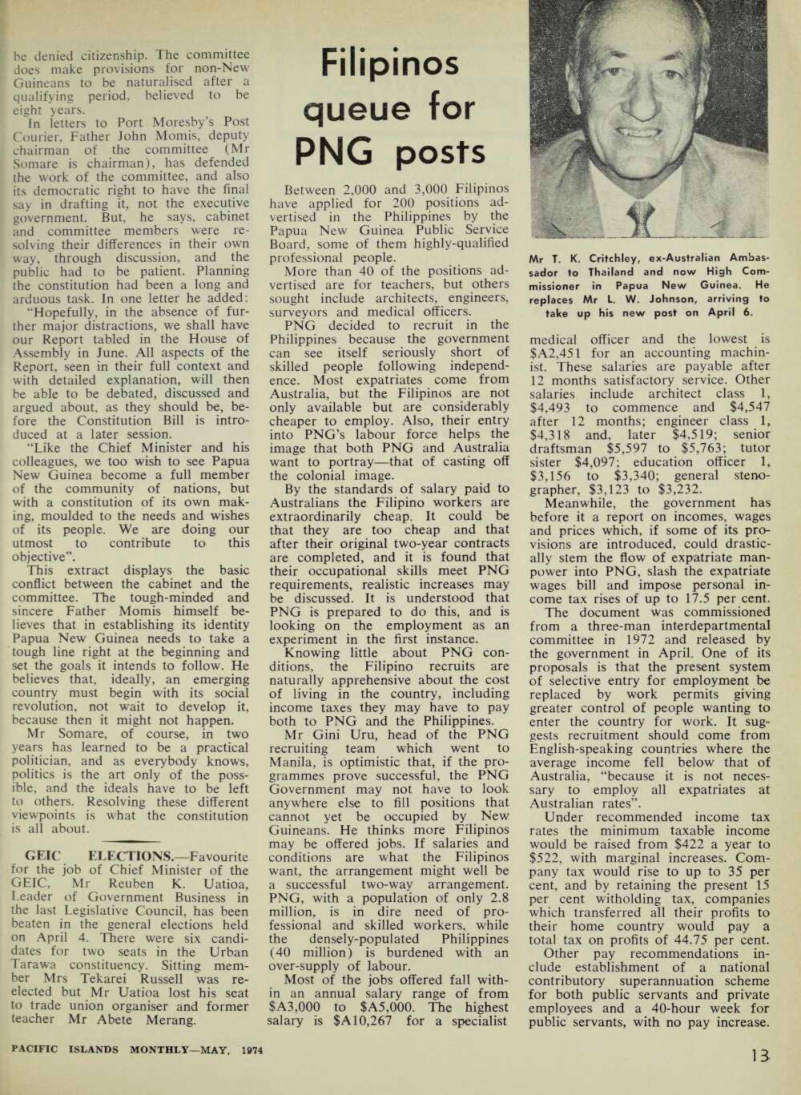
Mr T. K. Critchley, ex-Australian Ambas sador to Thailand and now High Com missioner in Papua New Guinea. He replaces Mr L. W. Johnson, arriving to take up his new post on April 6.