Independence:
pp. 14-15 · Read in the full issue
Mr Somare to spell it out
Prom a Port Moresby correspondent
Papua New Guinea’s probably possibly-maybe target date of De cember 1 for independence now looks even more improbable than it did in March, when Chief Minister Michael Somare started to hedge on it within 12 hours of announcing the date to the House of Assembly.
It has since become more obvious that a lot of people in Papua New Guinea think December 1 is too soon, and there have been demon strations and meetings in many parts of the country opposing it. To listen to some of the argument, December 1 next year or even the year after, would also be too soon. There is no understanding of what it means, and there has also been dissatisfaction in many areas by leaders who feel the country should have been consulted about the date.
Reaction has been such that Chief Minister Somare said in April that he intends to tour the country with his cabinet to explain independence to the people. He said he was sure that people would accept the in dependence date once they under-
stood what it means.
But he still declined to bow to pressure for a referendum on the question of independence. He said it would not only be expensive, but people would also answer either yes or no “without really thinking”. He also said, to questions, that he had decided the target date himself and had not discussed it beforehand with his cabinet or the Australian Prime Minister.
Mr Somare added that it was not the government’s intention to achieve independence without a constitution.
This comment followed reaction over the news that publication of PNG’s constitution has been further delayed, and it won’t now be tabled in the House until the June meeting.
Once debated it then has to be made into a bill and passed and all sorts of machinery measures instituted here, in Canberra and the United Nations before independence. There might simply be not time enough to do all this by December 1, especially as, during the month, the Australian Parliament was dissolved and there
is to be an election for both the Representatives and the Senate on May 18. This Australian political crisis will have its effect on the PNG constitutional crisis.
It is possible for PNG to attain independence without a constitution.
The Republic of Nauru gained in dependence in 1968 within hours of
an incomplete constitution being
passed, and it was several months before the constitutional assembly of Nauru completed its deliberations and finally decided on the presiden tial system of government. In the meantime the country was ruled by a council of state.
It now seems likely that PNG’s constitution will have a rocky pass age through the Assembly, as it is already having with the cabinet. The constitutional committee reports to cabinet, and cabinet is discussing aspects of the report with committee members as the details appear.
Mr Somare himself has made no secret of the fact that he is against any racially-biased proposals on the citizenship qualifications, and that he thinks some of the proposals of the committee are racially unacceptable.
The committee’s recommendation is that citizenship be granted to New Guineans, three of whose grand parents were born in New Guinea; another is that the children of a New Guinean father and an expatriate mother be granted automatic citizen ship, but children of an expatriate father and a New Guinean mother
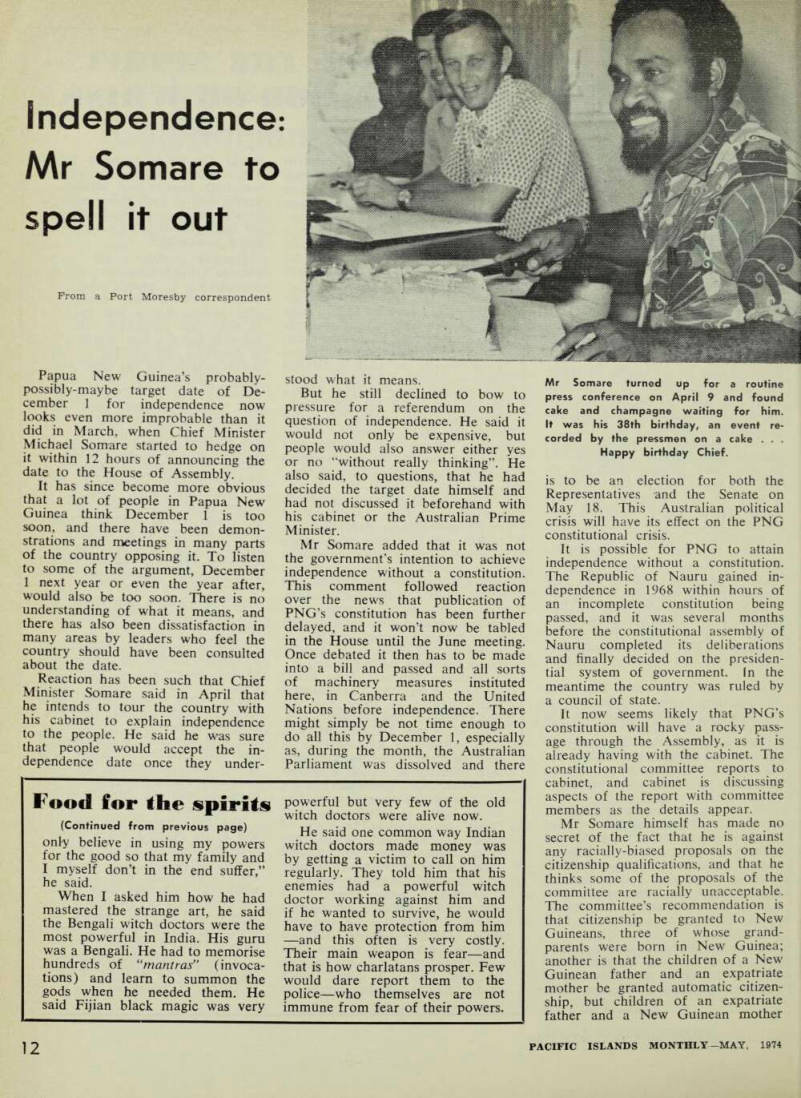
Mr Somare turned up for a routine press conference on April 9 and found cake and champagne waiting for him.
It was his 38th birthday, an event re corded by the pressmen on a cake ...
Happy birthday Chief.
be denied citizenship. The committee does make provisions for non-New Guineans to be naturalised after a qualifying period, believed to be eight years.
In letters to Port Moresby’s Post Courier, Father John Momis, deputy chairman of the committee (Mr Somare is chairman), has defended the work of the committee, and also its democratic right to have the final say in drafting it, not the executive government. But, he says, cabinet and committee members were re solving their differences in their own way, through discussion, and the public had to be patient. Planning the constitution had been a long and arduous task. In one letter he added: “Hopefully, in the absence of fur ther major distractions, we shall have our Report tabled in the House of Assembly in June. All aspects of the Report, seen in their full context and with detailed explanation, will then be able to be debated, discussed and argued about, as they should be, be fore the Constitution Bill is intro duced at a later session.
“Like the Chief Minister and his colleagues, we too wish to see Papua New Guinea become a full member of the community of nations, but with a constitution of its own mak ing, moulded to the needs and wishes of its people. We are doing our utmost to contribute to this objective”.
This extract displays the basic conflict between the cabinet and the committee. The tough-minded and sincere Father Momis himself be lieves that in establishing its identity Papua New Guinea needs to take a tough line right at the beginning and set the goals it intends to follow. He believes that, ideally, an emerging country must begin with its social revolution, not wait to develop it, because then it might not happen, Mr Somare, of course, in two years has learned to be a practical politician, and as everybody knows, politics is the art only of the poss ible, and the ideals have to be left to others. Resolving these different viewpoints is what the constitution is all about.
GEIC ELECTlONS. —Favourite for the job of Chief Minister of the GEIC, Mr Reuben K. Uatioa, Leader of Government Business in the last Legislative Council, has been beaten in the general elections held on April 4. There were six candi dates for two seats in the Urban Tarawa constituency. Sitting mem ber Mrs Tekarei Russell was re elected but Mr Uatioa lost his seat to trade union organiser and former teacher Mr Abete Merang.