for your grandad?
pp. 27-29 · Read in the full issue

And why not a Spaniard for your grandad?
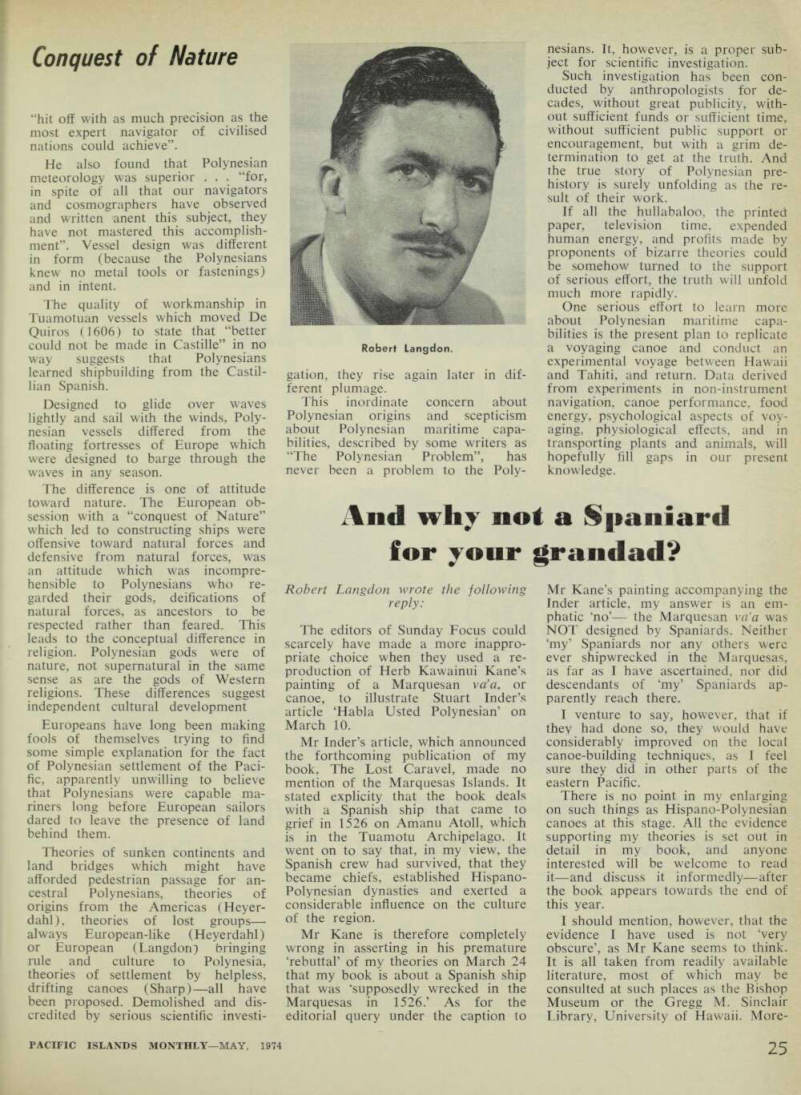
Robert Langdon wrote the following reply: The editors of Sunday Focus could scarcely have made a more inappropriate choice when they used a reproduction of Herb Kawainui Kane’s painting of a Marquesan va’a. or canoe, to illustrate Stuart Inder’s article ‘Habla Usted Polynesian’ on March 10.
Mr Inder’s article, which announced the forthcoming publication of my book. The Lost Caravel, made no mention of the Marquesas Islands. It stated explicity that the book deals with a Spanish ship that came to grief in 1526 on Amanu Atoll, which is in the Tuamotu Archipelago. It went on to say that, in my view, the Spanish crew had survived, that they became chiefs, established Hispano- Polynesian dynasties and exerted a considerable influence on the culture of the region.
Mr Kane is therefore completely wrong in asserting in his premature ‘rebuttal’ of my theories on March 24 that my book is about a Spanish ship that was ‘supposedly wrecked in the Marquesas in 1526.’ As for the editorial query under the caption to
Mr Kane’s painting accompanying the Inder article, my answer is an em phatic ‘no’— the Marquesan va’a was NOT designed by Spaniards. Neither ‘my’ Spaniards nor any others were ever shipwrecked in the Marquesas, as far as I have ascertained, nor did descendants of ‘my’ Spaniards ap parently reach there, j venture to say, however, that if they had done so, they would have considerably improved on the local canoe-building techniques, as I feel sure they did in other parts of the eastern Pacific.
There is no point in my enlarging on such things as Hispano-Polynesian canoes at this stage. All the evidence supporting my theories is set out in detail in my book, and anyone interested will be welcome to read it—and discuss it informedly—after the book appears towards the end of this year.
I should mention, however, that the evidence I have used is not ‘very obscure’, as Mr Kane seems to think, It is all taken from readily available literature, most of which may be consulted at such places as the Bishop Museum or the Gregg M. Sinclair Library, University of Hawaii. More
over, Mr Kane should not be surprised that* this evidence has previously ‘escaped the attention of serious scientists.’
There are many examples in history where scientists have trotted along for centuries like blinkered horses—all too serious to notice items of evidence that are now obvious to every school boy. Look how long it took them to realise that the earth is round! Look how long they held on to the belief that we are all descended from Adam and Eve in the Garden of Eden!
If Mr Kane is not impervious to reason, I think there’s a good chance that The Lost Caravel will eventually remove even his blinkers concerning the ancient Polynesians. If it does, then he will probably finish up agreeing with me that the Polynesians were not just descended from other Polynesians; that the inhabitants of Polynesia came from a variety of places; that they were all subject to a multitude of different influences; and that some of them, including many Hawaiians, almost certainly had castaway Spaniards for their an cestors.
What’s wrong with having a Spaniard for a great-great-great-et cetera-grandad, anyway? Robert Langdon.
Convirt fhapel
converted
A former convicts’ chapel in Noumea has been turned into an open air theatre and used by actors flown in from Paris.
The abandoned chapel is in Noumea harbour, on lie Nou, the island which was used last century as a convict settlement for political deportees from France. Many of the old prison buildings have been de molished, while remaining structures have either been left deserted or occupied by government institutions.
The tumble-down, old stone chapel was seized upon by an imaginative French theatrical entrepreneur, Michel Camboulives, who in March presented the first dramatic perform ance there —Le Bossu (The Hunch back), for which Jean Marais flew in from Paris to take the leading part.
For Michel Camboulives, who has already delighted Noumea audiences with various theatrical troupes from France, the open air Theatre de I’lle has been a most inspiring enter prise bringing new life to the aban doned prison chapel on the Isle of Nou.