Wandering the seven seas
pp. 77-79 · Read in the full issue

and sinister places
Cruising yachtsmen and armchair adventurers alike already are acquaint ed with Eric Hiscock and his wife Susan who made and wrote about their deep sea voyages in Wanderer 111. They have also flitted in and out of PI M’s yachting news over the years.
During the Wanderer 111 period, however, they alternated yachting with home ownership on the Isle of Wight until, in the late 19605, they con cluded that the two didn’t mix, and that the house had to go.
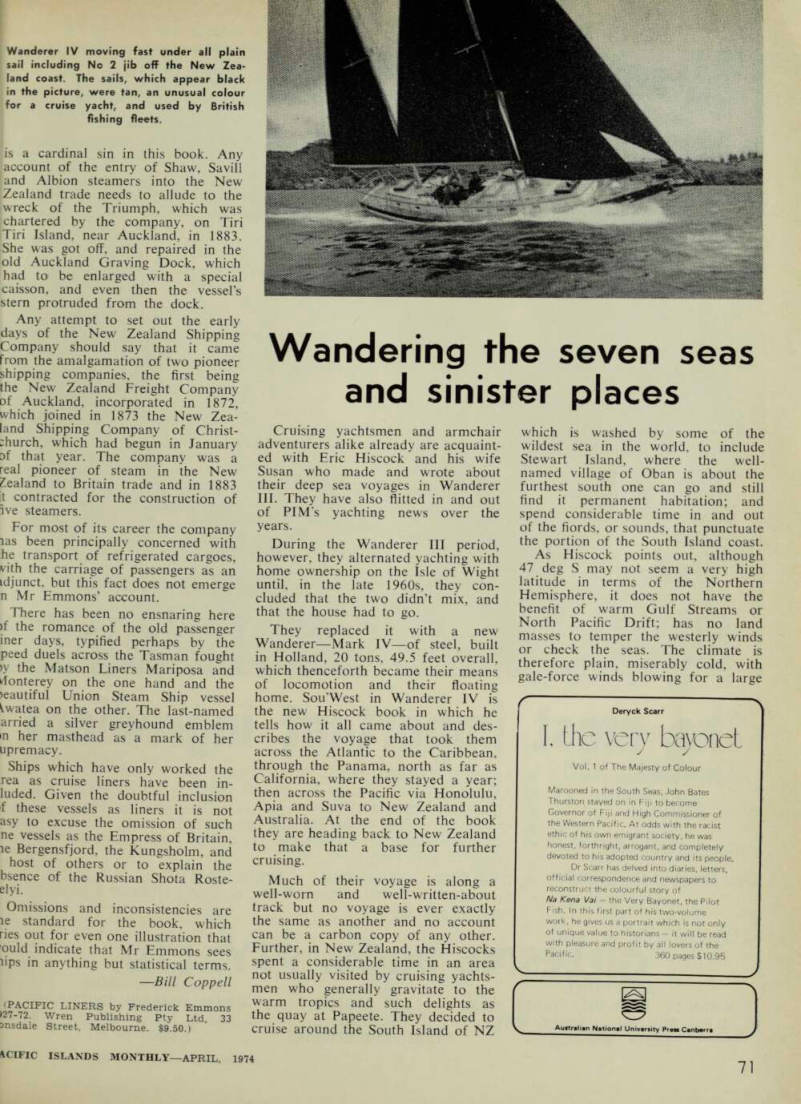
They replaced it with a new Wanderer—Mark IV—of steel, built in Holland, 20 tons, 49.5 feet overall, which thenceforth became their means of locomotion and their floating home. Sou’West in Wanderer IV is the new Hiscock book in which he tells how it all came about and des cribes the voyage that took them across the Atlantic to the Caribbean, through the Panama, north as far as California, where they stayed a year; then across the Pacific via Honolulu, Apia and Suva to New Zealand and Australia. At the end of the book they are heading back to New Zealand to make that a base for further cruising.
Much of their voyage is along a well-worn and well-written-about track but no voyage is ever exactly the same as another and no account can be a carbon copy of any other.
Further, in New Zealand, the Hiscocks spent a considerable time in an area not usually visited by cruising yachts men who generally gravitate to the warm tropics and such delights as the quay at Papeete. They decided to cruise around the South Island of NZ
which is washed by some of the wildest sea in the world, to include Stewart Island, where the well named village of Oban is about the furthest south one can go and still find it permanent habitation; and spend considerable time in and out of the fiords, or sounds, that punctuate the portion of the South Island coast.
As Hiscock points out, although 47 deg S may not seem a very high latitude in terms of the Northern Hemisphere, it does not have the benefit of warm Gulf Streams or North Pacific Drift; has no land masses to temper the westerly winds or check the seas. The climate is therefore plain, miserably cold, with gale-force winds blowing for a large
proportion of the time.
The sounds, moreover, offer hazards [of another kind. These long fingers of water protruding into the mountainous land are very deep right up to the rock bound shores and pro vide little water shallow enough to anchor a yacht. They also frequently act as wind tunnels for the prevailing wind. Apart from tourists at Milford Sound, at the extreme north of Fiordland, and occasional fishermen and deerstalkers in others of the dozen drowned valleys that make up the complex, the sounds are as Nature left them, having scarcely felt the hand of man.
“During our years of voyaging,” says Hiscock, “we have spent nights in some strange, wild and lonely places . . . but somehow Sportsmans Cove [in Dusky Sound] seemed more lonely than most and far more lonely than the open oceans hundreds, or thousands, of miles from land. When darkness came after a flaming scarlet and orange sunset that was not so much beautiful as frightening, there was scarcely a sound; no creature stirred though there must have been many around us; no fish disturbed the mirror surface of the inky water; there was absolutely nothing to be heard but the chilly tinkle of the little stream, the ticking of the French :arnage clock in the saloon and the beating of one’s heart. Here, it seemed, was a place utterly separated From man and from any form of wild ife; silent and sinister.”
They were not sorry to depart next Doming, bound for Breaksea Sound hrough Acheron Passage, a specta :ular seven-mile waterway only half i mile wide in places and from each ; ide of which 3,000 ft and 4,000 ft nountains rear into the sky.
The voyagers visited Doubtful, fhompson, George and Milford ounds before they called it quits, :xperiencing inches of rain, wild vinds, the companionship of fisher nen and some of the most spectacular cenery in the world. Plus, of course, he west coast’s celebrated sandflies, lews of which was first recorded by r aptain Cook who visited Dusky ►ound in 1770 and said . . small •lack sandflies which are very lumerous and so troublesome that hey exceed everything of the kind hat I ever met with,”
Two hundred years later the
Hiscocks could still heartily endorse Cook’s opinion. Not even modern insect repellant had any effect for more than 10 minutes, they said.
“One could watch the creatures hovering over an anointed area of skin until the first effects were off and then come in to attack, and we wondered what they lived on when there were no humans around.”
There is an appendix to the book giving all technical data on Wanderer IV and early chapters with a running account of the bugs, and their re medies, seemingly inherent in such a
custom-made ship.
Judy Tudor.
(Sou’West In Wanderer Iv. By Eric
Hiscock Oxford University Press, 7 Bowen Crescent, Melbourne. $11.00.1