Books, Reviews, Writers
pp. 75-77 · Read in the full issue
A Doubtful Salute To The
Great Pacific Liners
It is sad to read a book about ships that have engaged in the passenger trade in the Pacific, which fails lamentably to met any discernible
[goal.
It would be presumed that the basic [objective of Pacific Liners would be •to capture the interest of the ardent [ship lover, for whom ships are more [than mere collections of plates and bolts, or bald catalogues of registry statistics. There are few ships that do not encounter adventures and mis haps and these events should be the stuff of any book setting out to chronicle the vessels that served a particular trade.
In this case the author seems to have relied almost entirely upon Lloyd’s Register as his source book, but his account lacks the accuracy of the Register.
The Rangitane is misnamed as Rangitani (in capitals at that) and the list of vessels owned by the Matson Line does not include the second pair of sister ships named Mariposa and Monterey, although they appear in their later ownership by the Pacific Far East Line.
The book lacks definition—for in stance, what is a Pacific Liner? It would be thought that the emphasis would be upon ships which traded in the Pacific, yet many Australian ships that did not work outside the Austra lian coastal passenger trade are in cluded. On the other hand there is no mention of the Union Steam Ship Line or Anchor Line vessels which )ave been on the New Zealand inter island trade and would seem to be equivalent in class to their Australian
poastal counterparts.
Although the vessels listed in the book are categorised as being passen ger liners, in very few instances is fny information given about the num ber of passengers accommodated and n many cases the outline drawings of he vessels give the impression that he title of passenger liner is doubtful.
Ships with obviously limited accom nodation have been included but ves
sels which have endeared themselves to hundreds of Pacific travellers are not honoured.
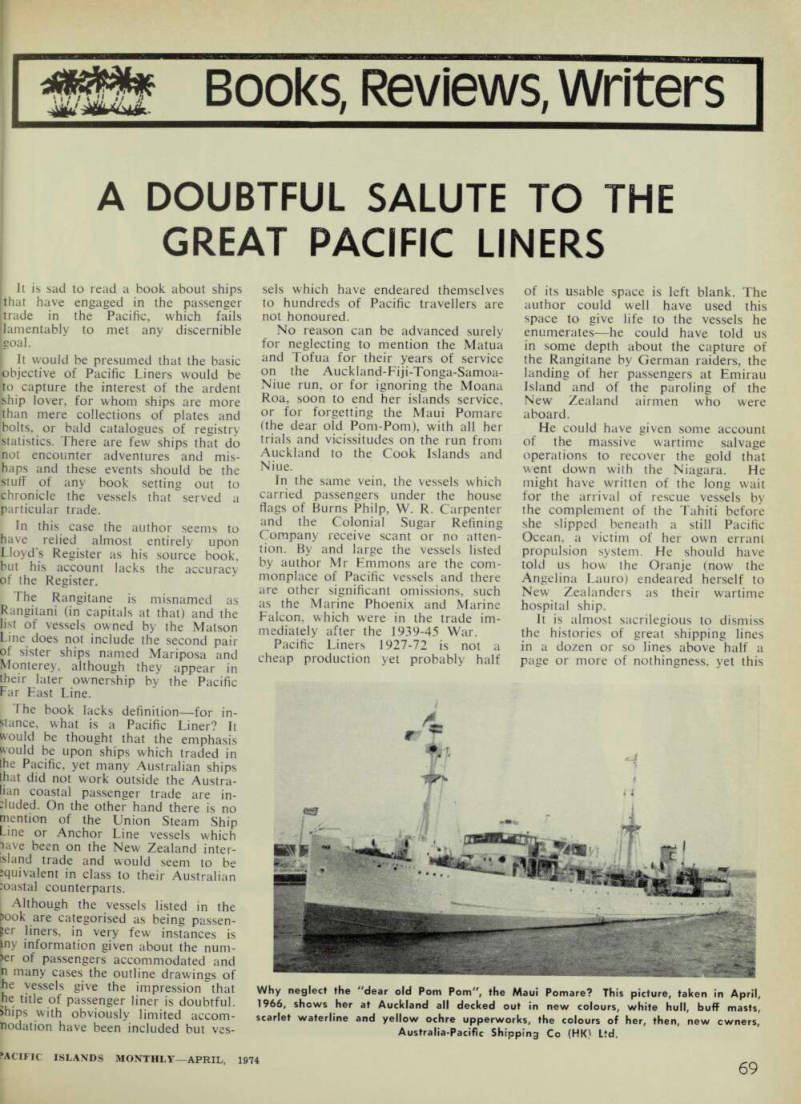
No reason can be advanced surely for neglecting to mention the Matua and Tofua for their years of service on the Auckland-Fiji-Tonga-Samoa- Niue run, or for ignoring the Moana Roa, soon to end her islands service, or for forgetting the Maui Pomare (the dear old Pom-Pom), with all her trials and vicissitudes on the run from Auckland to the Cook Islands and Niue.
In the same vein, the vessels which carried passengers under the house flags of Burns Philp, W. R. Carpenter and the Colonial Sugar Refining Company receive scant or no atten tion. By and large the vessels listed by author Mr Emmons are the com monplace of Pacific vessels and there are other significant omissions, such as the Marine Phoenix and Marine Falcon, which were in the trade im mediately after the 1939-45 War.
Pacific Liners 1927-72 is not a cheap production yet probably half
of its usable space is left blank. The author could well have used this space to give life to the vessels he enumerates —he could have told us in some depth about the capture of the Rangitane by German raiders, the landing of her passengers at Emirau Island and of the paroling of the New Zealand airmen who were aboard.
He could have given some account of the massive wartime salvage operations to recover the gold that went down with the Niagara. He might have written of the long wait for the arrival of rescue vessels by the complement of the Tahiti before she slipped beneath a still Pacific Ocean, a victim of her own errant propulsion system. He should have told us how the Oranje (now the Angelina Lauro) endeared herself to New Zealanders as their wartime hospital ship.
It is almost sacrilegious to dismiss the histories of great shipping lines in a dozen or so lines above half a page or more of nothingness, yet this
Why neglect the "dear old Pom Pom", the Maui Pomare? This picture, taken in April, 1966, shows her at Auckland all decked out in new colours, white hull, buff masts, scarlet waterline and yellow ochre upperworks, the colours of her, then, new owners,
Australia-Pacific Shipping Co (HK) Ltd.
is a cardinal sin in this book. Any account of the entry of Shaw, Savill and Albion steamers into the New Zealand trade needs to allude to the wreck of the Triumph, which was chartered by the company, on Tiri Tiri Island, near Auckland, in 1883.
She was got off, and repaired in the old Auckland Graving Dock, which had to be enlarged with a special caisson, and even then the vessel’s stern protruded from the dock.
Any attempt to set out the early days of the New Zealand Shipping Company should say that it came From the amalgamation of two pioneer shipping companies, the first being the New Zealand Freight Company of Auckland, incorporated in 1872, which joined in 1873 the New Zea land Shipping Company of Christ :hurch, which had begun in January of that year. The company was a real pioneer of steam in the New Zealand to Britain trade and in 1883 it contracted for the construction of ive steamers.
For most of its career the company las been principally concerned with he transport of refrigerated cargoes, vith the carriage of passengers as an idjunct, but this fact does not emerge n Mr Emmons’ account.
There has been no ensnaring here >f the romance of the old passenger iner days, typified perhaps by the peed duels across the Tasman fought >y the Matson Liners Mariposa and donterey on the one hand and the >eautiful Union Steam Ship vessel on the other. The last-named arried a silver greyhound emblem m her masthead as a mark of her upremacy.
Ships which have only worked the rea as cruise liners have been in luded. Given the doubtful inclusion f these vessels as liners it is not asy to excuse the omission of such ne vessels as the Empress of Britain, ie Bergensfjord, the Kungsholm, and host of others or to explain the bsence of the Russian Shota Roste elyi.
Omissions and inconsistencies are ie standard for the book, which ries out for even one illustration that ould indicate that Mr Emmons sees lips in anything but statistical terms. —Bill Coppell >o? ACIFIC Ii NERS by Frederick Emmons >27-72. Wren Publishing Pty Ltd, 33 onsdale Street, Melbourne. $9.50.)
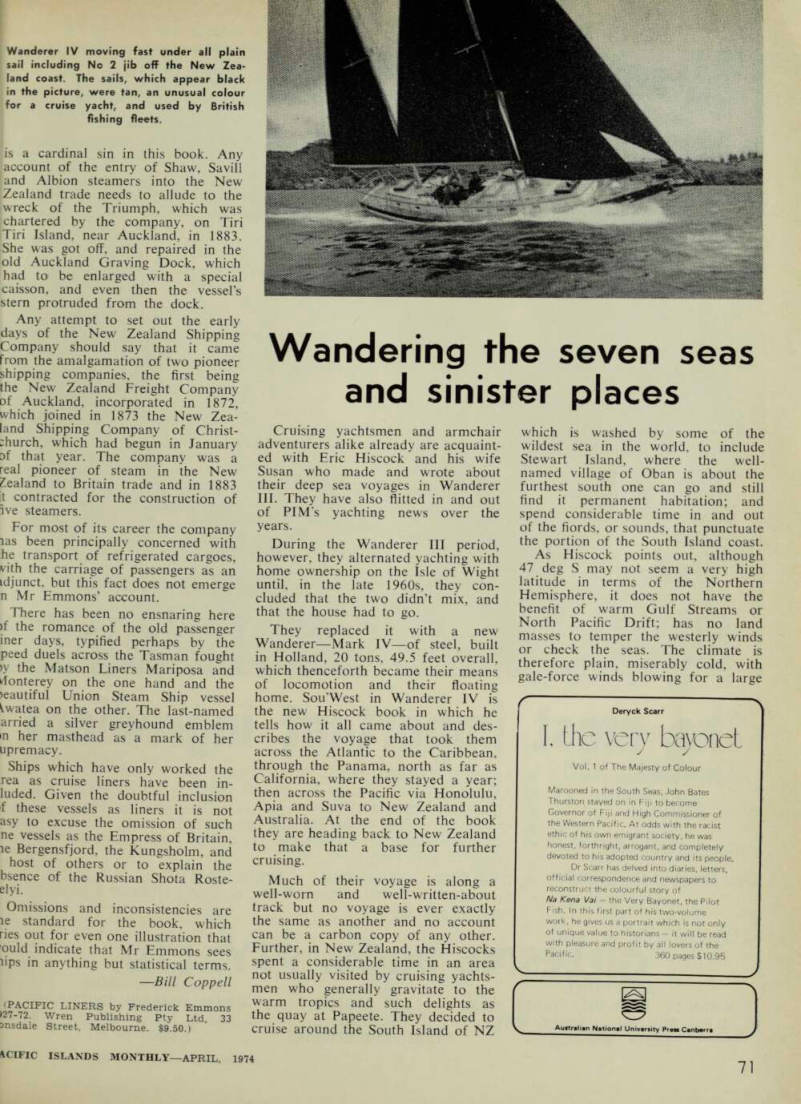
Wanderer IV moving fast under all plain sail including No 2 jib off the New Zea land coast. The sails, which appear black in the picture, were tan, an unusual colour for a cruise yacht, and used by British fishing fleets.