drinking Tahitians
pp. 21-22 · Read in the full issue
more abruptly; and also where the clash between traditionally-expected behaviour patterns and so-called western values was most acute.
Evidence from the Marianas and to a lesser extent, the Marshalls, suggested the exposure to alterna tives of using alcohol could, in time, produce alternative behaviours, which would be less threatening so cially, and less physically hazardous.
Those beer
drinking Tahitians
The French press in the Pacific has noted with surprise that French Polynesia last year consumed a total af 90,000 hectolitres of beer (2 mil lion gallons). Beer has become so popular that it is reported to “often pass into the housewife’s shopping basket ahead of milk, bread or meat”. The overall intake means that an the average every adult is drink ing over a pint of beer per day, and there are some who don’t touch i drop.
Local brews are most popular, vith brands such as Hinano, Manuia md Vahine amounting to 77,483 lectolitres (1 hectolitre = 100 litres = 180 pints).
Imported beers totalled 12,234 lectolitres last year. Small quantities :ame from the USA (34,914 litres) md New Zealand (84 litres). The /alue of this imported beer was CFP 51 million (about $A430,000 in 1973).
While the consumption of im icrted beer rose about 5,000 hecto litres, there was a decided drop of 2,600 hectolitres in locally-produced brew. The situation for Tahitian breweries is expected to improve this pear, however, in view of the in :reased import taxes being applied to overseas beer.
In the meantime, the matter opens up a field of research to any socio logist who may wish to study the possible relationships between this tendency towards non-French drink ing habits and the move for internal autonomy.
New Caledonia’s
bronze insult
A plaque depicting Melanesian warriors handing over their arms to French masters continues to stand in Noumea central park as a bone of contention between young Caledo nians and the French authorities.
The bronze plaque is attached to the pedestal of a statue of Admiral
Olry, an early governor of the colony.
In his recent book, New Caledonia in the Heyday of Postcards (PIM, March, p 71), Patrick O’Reilly includes a photo of the statute with the remark that “this bronze plaque has recently been transferred to a discreet corner of the town’s museum”.
However, a walk through the park in February showed the offending plaque still in place. A petition was then being circulated by the militant Melanesian Foulards Rouges and the Union of Caledonian Youth (UJC), demanding the removal of the plaque which they claim is an insult to the Canaque people and Caledonians generally, a denial of fraternity and equality and an insulting portrayal of racial submission of black man to white.
Agitation for removal of the plaque was raised in the Territorial Assembly in 1972.
A thorn in
Sir Albert's side
Leader of the Cook Islands par liamentary Opposition Tom Davis and his Democratic Party have jab bed another thorn into the side of Premier Sir Albert Henry and the ruling Cook Islands Party. The thorn is a new newspaper, Demo cratic News, which by the end of January, had appeared twice.
A six-page cyclostyled publication in a style almost identical with that of the Cook Islands News, Demo cratic News doesn’t pull its punches.
A two-edged weapon —it comes in English and Maori—it puts the boot into Sir Albert’s administration with
articles headlined “Audit Report 1971”, “Government as static as fruit prices”, “No encouragement for our people” and “Who fouled the fuel shortage?”
One item alleges that “Anybody who is not a supporter of the Cook Islands Party is being subjected to discrimination and victimisation.
Every way in which they try to im prove their position is blocked and thwarted by a system of licences and controls and outright intimida tion. This is being done on an island and an individual basis. At least one overseas company has been told in plain language that if it sympathises with the Democratic Party, it would receive nothing but hostility from the Government. How can our people progress when the present Govern ment deliberately sets out to divide our country and keep it divided”.
An unusual feature of the new newspaper is its frequent use of poetry, some of it pointedly direct, and some obscure to all but those in the know.
Over the years, the Democratic News has had several predecessors dating back to the battles of Te Torea and loi Karanga, which filled the role in turn in the Moss ad ministration (PIM, Feb p 57). Te Akatauira (The Morning Star) which was published on Rarotonga by Albert Henry and Willie Watson, served as a political sounding board for the former, who was just be ginning a career largely in opposi tion to the NZ administration. Its life extended from 1936 until the early years of World War II when it came under NZ censorship and ceased publication.
Democratic News could provide
Dr Tom Davis.
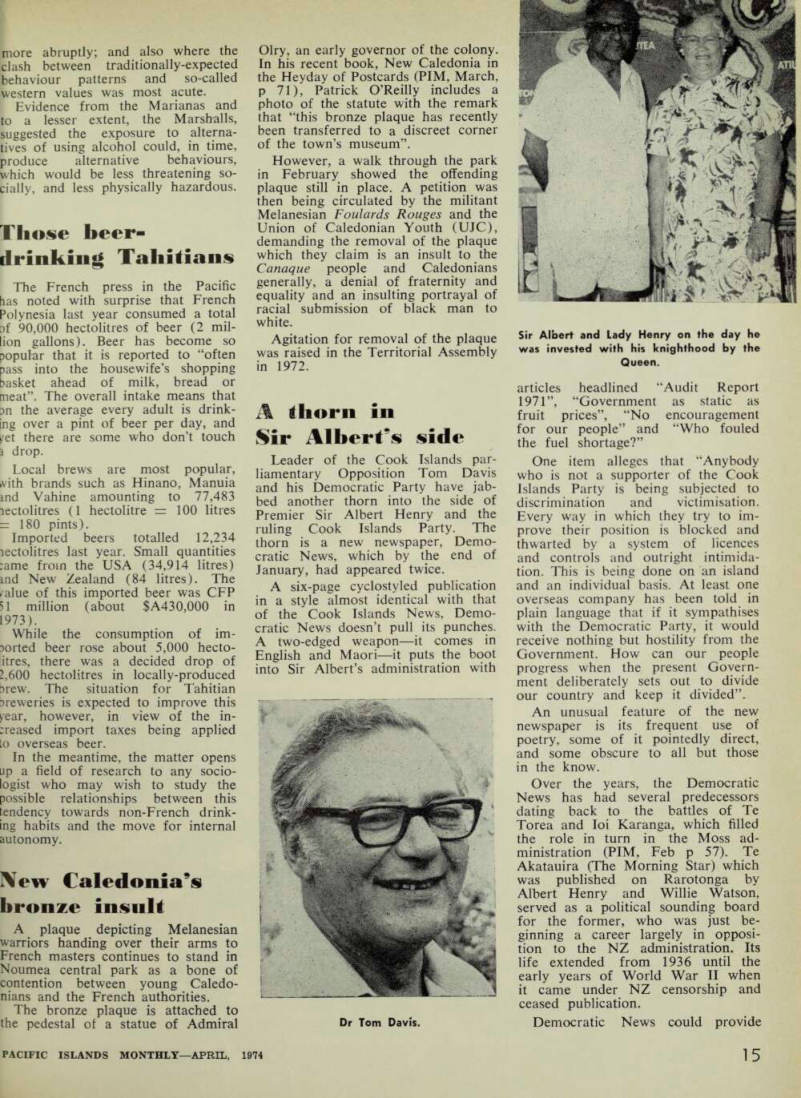
Sir Albert and Lady Henry on the day he was invested with his knighthood by the Queen.
a powerful platform for Sir Albert Henry’s opponents who accuse him of controlling all the news media.
But it’s hardly likely that Sir Albert, shining with the lustre of his new knighthood, will be unduly worried so far. As a commoner, he was, socially at least, on a lower strata to the Arikis (chiefs) but the question being asked now is how many arikis equal one parfait knight?
No autonomy
for rlorks
Caledonians in March had to cope with an irritating confusion of work ing and school hours, as a Paris law stopped the clocks from returning to normal time.
On January 1, in a bid to economise on lighting fuel by sav ing daylight hours, Caledonian clocks had been advanced one hour.
However, as March approached, the sun began to catch up on the Cale donians. It was fine for those enjoy ing an evening swim, but those starting work early in the morning were faced with the prospect of hav ing to drive in the dark with their headlights on. Obviously it was time to turn back the clocks; the only problem was that a Paris ministerial decision had fixed the daylight sav ing hours until March 31.
Since Governor Eriau could not reverse this decision, his only solu tion was to decree a change in local working hours, just for March. This way the Caledonians could still live their lives by the usual rhythm of daylight hours.
The only problem then was the fact that every school and business house seemed to fix its own particu lar working hours, so the daily press was flooded with notices indicating their timetables. Most government offices worked uniform hours, but the four city banks all closed at dif ferent times; the three international airlines opened at 15 minute inter vals in the morning; three large supermarkets opened at 15 minute intervals after lunch.
The situation was all the more confusing since the new hours coin cided with the beginning of the new school year on March 1. “Taxi driver” mothers who had to drive children back and forth four times a day to and from school (including home for lunch-break) had to cope with different schools operating on different timetables.
So as far as the chaotic timetables were concerned, everyone was await ing April 1 when the Paris law
allowed the clocks to turn back to normal time.
Actually, Caledonian schools had a record intake of students this year, with a seven per cent rise in enrol ments bringing the total number to 38,500. For a population of 126,000, this means almost one in every three persons in New Caledonia is at school, from kindergarten to tertiary
college level.
Stamps 4*ome at
a fast lick
If 1974 is remembered for any thing in the South Pacific it should be for the spate of new stamps. So far nine countries or territories have mounted the new issue band wagon.
Some issues commemorate the Queen’s tour, one commemorates 100 years of cricket, one is an Easter issue, and the rest seem to have no
particular significance.
As usual, with Pacific Islands stamps, they are colourful issues,
with imaginative designs.
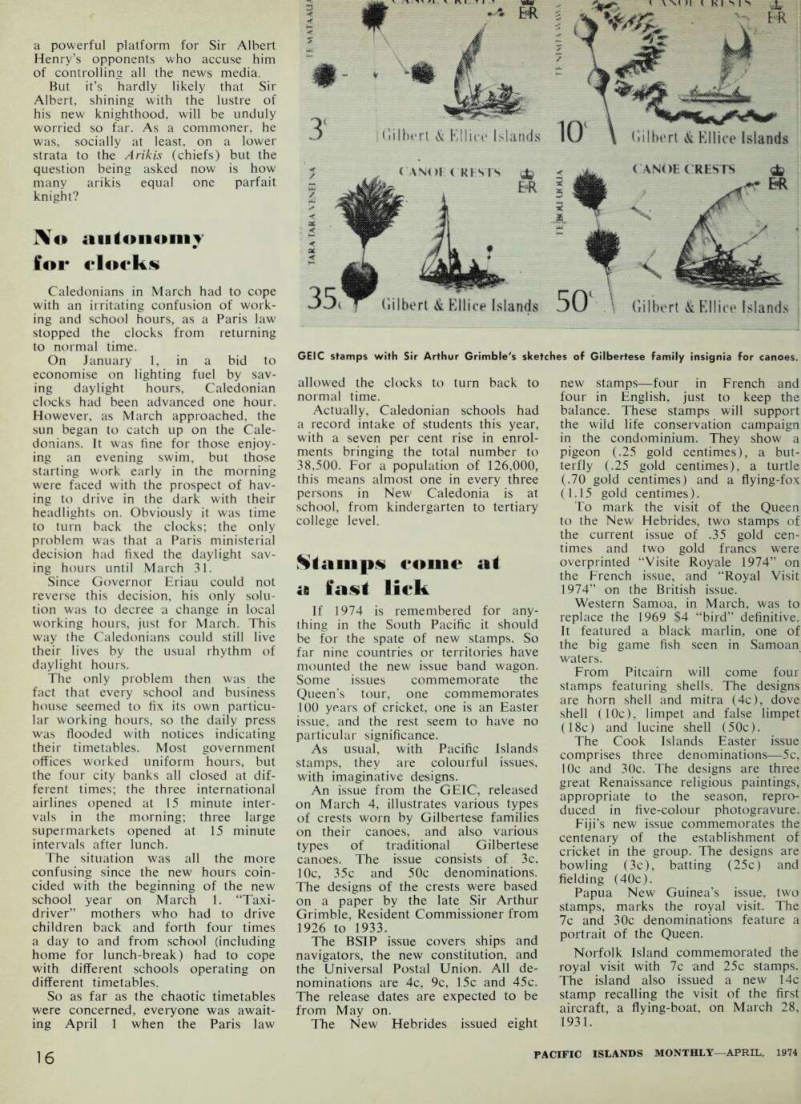
An issue from the GEIC, released on March 4, illustrates various types of crests worn by Gilbertese families on their canoes, and also various types of traditional Gilbertese canoes. The issue consists of 3c, 10c, 35c and 50c denominations.
The designs of the crests were based on a paper by the late Sir Arthur Grimble, Resident Commissioner from 1926 to 1933.
The BSIP issue covers ships and navigators, the new constitution, and the Universal Postal Union. All de nominations are 4c, 9c, 15c and 45c.
The release dates are expected to be from May on.
The New Hebrides issued eight
new stamps—four in French and four in English, just to keep the balance. These stamps will support the wild life conservation campaign in the condominium. They show a pigeon (.25 gold centimes), a but terfly (.25 gold centimes), a turtle (.70 gold centimes) and a flying-fox (1.15 gold centimes).
To mark the visit of the Queen to the New Hebrides, two stamps of the current issue of .35 gold cen times and two gold francs were overprinted “Visite Royale 1974” on the French issue, and “Royal Visit 1974” on the British issue.
Western Samoa, in March, was to replace the 1969 S 4 “bird” definitive.
It featured a black marlin, one of the big game fish seen in Samoan waters.
From Pitcairn will come four stamps featuring shells. The designs are horn shell and mitra (4c), dove shell (10c), limpet and false limpet (18c) and lucine shell (50c).
The Cook Islands Easter issue comprises three denominations—sc, 10c and 30c. The designs are three great Renaissance religious paintings, appropriate to the season, repro duced in five-colour photogravure.
Fiji’s new issue commemorates the centenary of the establishment of cricket in the group. The designs are bowling (3c), batting (25c) and fielding (40c).
Papua New Guinea’s issue, two stamps, marks the royal visit. The 7c and 30c denominations feature a portrait of the Queen.
Norfolk Island commemorated the royal visit with 7c and 25c stamps.
The island also issued a new 14c stamp recalling the visit of the first aircraft, a flying-boat, on March 28, 1931.
GEIC stamps with Sir Arthur Grimble's sketches of Gilbertese family insignia for canoes.