Tropicalities
p. 19 · Read in the full issue
Fiji’s btisv
ambassadors
in i\ew Guinea
Until recent years, Papua New Guinea’s doctors, dentists and other medical staff were trained at the Fiji School of Medicine. In an amazingly short space of years, many of these people have come to leading positions in Papua New Guinea. During their time in Fiji they made many friends, who have since become significant political connections, but many of them also acquired Fiji-born wives who have done a great deal to increase
inter-Pacific understanding.
The many Fijian and part-Fijian wives, and a handful of Fijian men in Port Moresby have formed a Viti Club which is very active and which supports members in times of dif ficulty. Even though many of the wives have been in New Guinea for up to 20 years, they still retain strong links with Fiji. For example, when hurricane Bebe struck the group in 1972, they organised a fund-raising campaign and sent $720 to the Prime Minister’s Hurricane Relief Fund. Just recently they again organised a col lection for the victims of hurricane Lottie and have sent $512 to the Prime Minister’s Hurricane Relief Fund for that purpose.
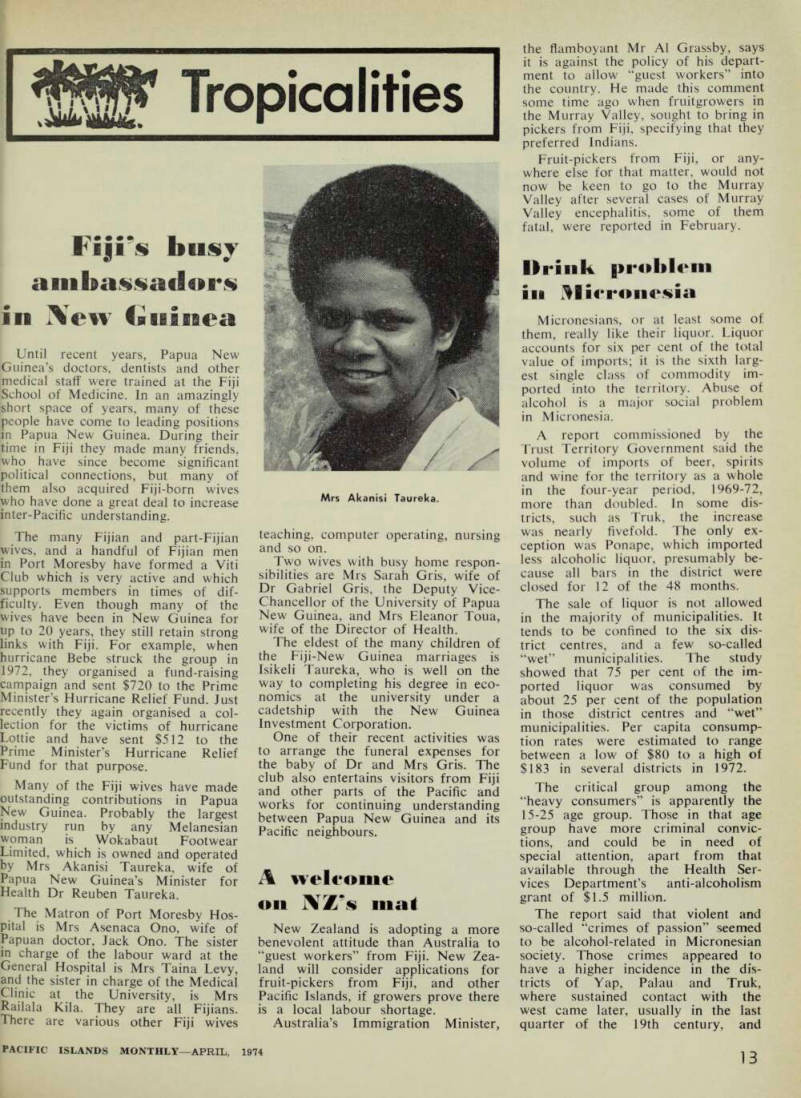
Many of the Fiji wives have made outstanding contributions in Papua New Guinea. Probably the largest industry run by any Melanesian woman is Wokabaut Footwear Limited, which is owned and operated by Mrs Akanisi Taureka, wife of Papua New Guinea’s Minister for Health Dr Reuben Taureka.
The Matron of Port Moresby Hos pital is Mrs Asenaca Ono, wife of Papuan doctor, Jack Ono, The sister in charge of the labour ward at the General Hospital is Mrs Taina Levy, and the sister in charge of the Medical Clinic at the University, is Mrs Railala Kila. They are all Fijians.
There are various other Fiji wives
teaching, computer operating, nursing and so on.
Two wives with busy home respon sibilities are Mrs Sarah Gris, wife of Dr Gabriel Gris, the Deputy Vice- Chancellor of the University of Papua New Guinea, and Mrs Eleanor Toua, wife of the Director of Health, The eldest of the many children of the Fiji-New Guinea marriages is Isikeli Taureka, who is well on the way to completing his degree in eco nomics at the university under a cadetship with the New Guinea Investment Corporation.
One of their recent activities was to arrange the funeral expenses for the baby of Dr and Mrs Gris. The club also entertains visitors from Fiji and other parts of the Pacific and works for continuing understanding between Papua New Guinea and its Pacific neighbours.
A welcome
on NZ's mat New Zealand is adopting a more benevolent attitude than Australia to “guest workers” from Fiji. New Zea land will consider applications for fruit-pickers from Fiji, and other Pacific Islands, if growers prove there is a local labour shortage.
Australia’s Immigration Minister,
the flamboyant Mr A 1 Grassby, says it is against the policy of his depart ment to allow “guest workers” into the country. He made this comment some time ago when fruitgrowers in the Murray Valley, sought to bring in pickers from Fiji, specifying that they preferred Indians.
Fruit-pickers from Fiji, or any where else for that matter, would not now be keen to go to the Murray Valley after several cases of Murray Valley encephalitis, some of them fatal, were reported in February,
II rink problem
in Micronesians, or at least some of them, really like their liquor. Liquor accounts for six per cent of the total value of imports; it is the sixth larg est single class of commodity im ported into the territory. Abuse of alcohol is a major social problem in Micronesia.
A report commissioned by the Trust Territory Government said the volume of imports of beer, spirits and wine for the territory as a whole in the four-year period, 1969-72, more than doubled. In some dis tricts, such as Truk, the increase was nearly fivefold. The only ex ception was Ponape, which imported less alcoholic liquor, presumably be cause all bars in the district were closed for 12 of the 48 months.
The sale of liquor is not allowed in the majority of municipalities. It tends to be confined to the six dis trict centres, and a few so-called “wet” municipalities. The study showed that 75 per cent of the im ported liquor was consumed by about 25 per cent of the population in those district centres and “wet” municipalities. Per capita consump tion rates were estimated to range between a low of $BO to a high of $lB3 in several districts in 1972.
The critical group among the “heavy consumers” is apparently the 15-25 age group. Those in that age group have more criminal convic tions, and could be in need of special attention, apart from that available through the Health Ser vices Department’s anti-alcoholism grant of $1.5 million.
The report said that violent and so-called “crimes of passion” seemed to be alcohol-related in Micronesian society. Those crimes appeared to have a higher incidence in the dis tricts of Yap, Palau and Truk, where sustained contact with the west came later, usually in the last quarter of the 19th century, and
Mrs Akanisi Taureka.