More Politics, Less Drink
p. 11 · Read in the full issue
From a Port Moresby correspondent
The all-party constitutional plan ning committee has been working to (the early hours of the morning to get PNG’s draft constitution ready for the House of Assembly meeting which [opens on February 28. It’ll be touch and go, and probably the Assembly iWon't see the finished product until bbout March 7—a week before the meeting is expected to finish. Debate |won’t take place before April, perhaps pane.
In early February the committee's leaders interrupted their main work to discuss, and finally to issue a state ment, deploring a news report in the Sydney Morning Herald by lan Hicks claiming the committee would recom mend that PNG citizenship be re stricted to indigenous people only— and exclude Chinese, whites and mixed-race. Father Momis, deputy chairman of the CPC, angrily de scribed the report as grossly distorted, and said citizenship would be open to any person of any race or nationality, f they were prepared to meet the criteria for naturalisation.
He didn't say what the criteria was, )ut he attacked those who “attempted o interfere in PNG affairs”—which vas probably not so much an attack in Hicks, a former SMH Port Moresby staff correspondent noted or his objectivity, as on those whom Momis believes fed Hicks information or their own political ends—whatever hey may be.
It’s understood here that the pro osal f or banning everybody but adigenes from citizenship was made * an early draft and was rejected, nere will be restrictions on citizen , P’ bu t they won’t be that rough, 'ollowmg talks with Somare, the ommittee agreed there would be no
premature revelation of the citizen ship provisions. • The other important news in PNG during the month was the intro duction on January 31 of new liquor laws throughout the country, follow ing passage of three bills through the House of Assembly last year. After a week’s operation the laws seem to have been well received, even by licensees, but it’s too early to make any useful comment.
New hours for hotels, taverns and clubs are 11 am-2 pm and 4 pm-8 pm weekdays; 10-2 and 4-8 Saturdays; 11-1 and 5-7 Sundays. Liquor stores will close at 6 pm, and bottle-shops two hours before hotels. Bottle-shops are a new concept—licences can be granted to a publican, tavern keeper or club manager and are for the sale of liquor to take away. Liquor to take away now can’t be sold at bars.
Club members and guests can re main after trading hours, but they can't drink liquor.
As hotel and tavern licences come up for renewal, a condition will be that only ale, beer, cider and light alcoholic drinks may be sold in public bars. It will be an offence to drink in a public place.
Advertising of spirits and wines has been banned except on licensed premises or vehicles owned by licensees.
The most interesting change in the laws is one giving District or Local Courts the power to order part of the wages of an habitual drunkard to be paid to his wife or children’s guardian. A near relative of the wife or child, a policeman, a district officer, community development officer or local government councillor can apply to the court for an order.
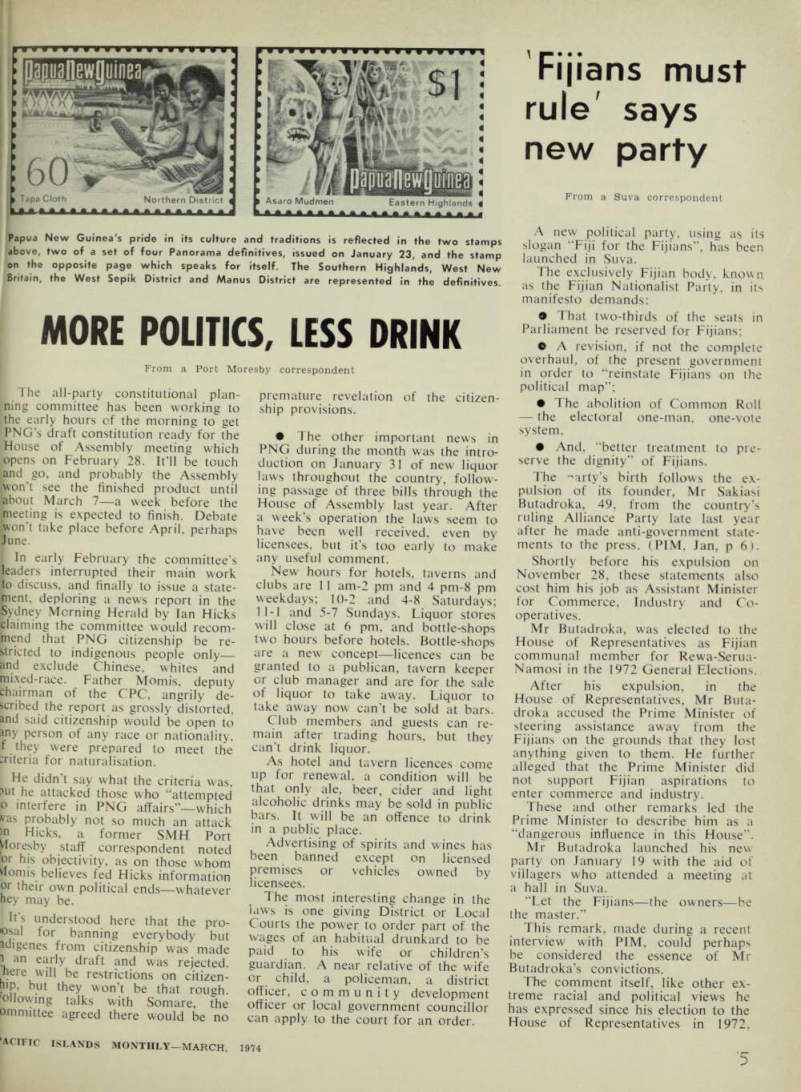
Papua New Guinea's pride in its culture and traditions is reflected in the two stamps above, two of a set of four Panorama definitives, issued on January 23, and the stamp on the opposite page which speaks for itself. The Southern Highlands, West New Britain, the West Sepik District and Manus District are represented in the definitives.