have a copper lining
pp. 9-10 · Read in the full issue
Pacific Islands Monthly
New Guinea storm clouds have a copper lining
Prom a Port Moresby correspondent
One might have thought that the announcement by Bougainville Copper Ltd that it had made a massive profit of $145.8 million for 1973 in its Bougainville operations, which began producing only in April, 1972, would be cause for rejoicing in Papua New Guinea. But the news has made everybody bitchy.
Chief Minister Michael Somare said unless he found a way of getting PNG a greater share he would fail to represent the country’s interests.
Finance Minister Julius Chan said he intended to find a solution that would cover not only Bougainville Copper but other major projects to be de veloped in the near future.
The Australian Minister responsible for PNG affairs, Mr Bill Morrison, visited Port Moresby when the an nouncement was made in February, said he supported renegotiation of the copper agreement, made in 1967.
PNG’s Minister for Justice John Kaputin, and Father John Momis, MHA and deputy chairman of PNG’s constitutional planning committee, speaking jointly they said on behalf of a group of politicians and com munity leaders, demanded that
Bougainville copper immediately pay
80 per cent company tax, that the government take a controlling interest in it through a new authority to be set up to operate it and other mining companies, including the Ok Tedi copper prospect of Western Papua.
They said the American Kennecott (PNG) Pty Ltd must play no part in the development of the Ok Tedi,
because experience in developing
countries showed that foreign countries exploited both the resources and the people. PNG had no need -to seek out foreign companies to ex ploit its resources; it could do its own exploiting with selected, highly com petent, international experts.
The House of Assembly Oppo sition’s shadow minister for finance, Mr John Middleton, sa ; d a review of the Bougainville company’s tax position might be necessary, rather than a renegotiation of the whole
agreement, which could frighten away potential investors. But the Kaputin/ Momis statement, he said, was “Marxist - Leninist rather than nationalist”, and most of its sugges tions would be disastrous in the hard economic facts of life. Some of the pair’s proposals were “mainly naive, undisciplined, uninformed and irre sponsible, and will result in under mining of PNG national interest and credibility to the rest of the world”.
Opposition Leader Tei Abal also attacked Messrs Kaputin/Momis and supported Somare’s “conference table approach”.
Bougainville Copper Ltd is 20 per cent owned by the PNG Govern ment, 52,6 per cent owned by the British-controlled corporation of Con zinc Riotinto of Australia, with the remaining shares in public hands, in cluding the New Guinea public.
Under its agreement it has a tax holi day until 1975, although a withhold ing tax is paid.
The 1973 profit was in fact SISB million, but $13.8 million of this was due to profit on currency exchange.
High recent copper prices are mainly responsible for the huge profit, but even then, CRA doesn’t get the lion’s share of the booty—the banks do. The banks will get about $53 million towards loan repayments; CRA will get about $36 million; PNG will get about $35 million; the public about $lB million.
PNG’s share comprises sl6 million of dividends, $9.5 million in taxes, $9.7 million in royalties, duty and taxes on employees’ wages.
The company is playing it cool about renegotiation.
The possibility was first mooted as long as 12 months ago, and Bougain
ville is aware that it has to talk to the government if the government wants to talk to it. It will wait until it gets to the conference table, but so far it has not been asked.
The reason for this is that Mr Somare wants to know what guide lines will be in the constitutional committee’s report, due in early March, before he gets down to de tails with Bougainville, Kennecott, or any other outside mining interest.
There is a strong view in govern ment, despite the radical noises of Messrs Kaputin and Momis, that it would be shortsighted to take Bougainville to the cleaners now with demands for larger equity, because the overseas bankers will watch closely how the government treats the banks’ first major Papua New Guinea risk, and will tighten up on loans when approached by other big investors. This won’t do much for PNG’s standing in the overseas capital market.
And it particularly won’t do any thing for Kennecott PNG Pty Ltd, which has got neither the money nor the go-ahead for its Ok Tedi develop ment.
The decision to go ahead or not with it, and the conditions under which a contract would be approved, are up to the PNG Government. And they have been up to the government since the middle of 1972, when Ken necott completed both its drilling pro gramme and its engineering survey, and reported to the government that it was ready to 1 talk business.
Negotiations since 1972 haven’t exactlv gone at a cracking pace, due almost entirely to the fact that since mid-1972 the national coalition in PNG has been more fully occupied in
Bougainville,
Kennecott compared
taking over the reins of government.
But the government also has spent some time checking out Kennecott’s facts and figures (with the help of technical advice from the Peru Gov ernment) so as to equip itself for the talks.
The point has been reached where the government is able to sit down with Kennecott and either accept or reject the company’s evaluation of what has been found on the Ok Tedi —and decide what happens next.
The technical and economic facts appear to be that Kennecott since 1968, when it first began testing for copper on the Ok Tedi, has spent sl4 million on its investigations, and fairly well satisfied itself that it has about 150 million tons of mineable copper ore, with some gold credits, under a hill called Mt Fubilan. (Fubilan is 6,800 ft above sea level.) This would produce about 75,000 to 80,000 tons of copper in concentrate per year, but to develop the mine would cost about S3OO million.
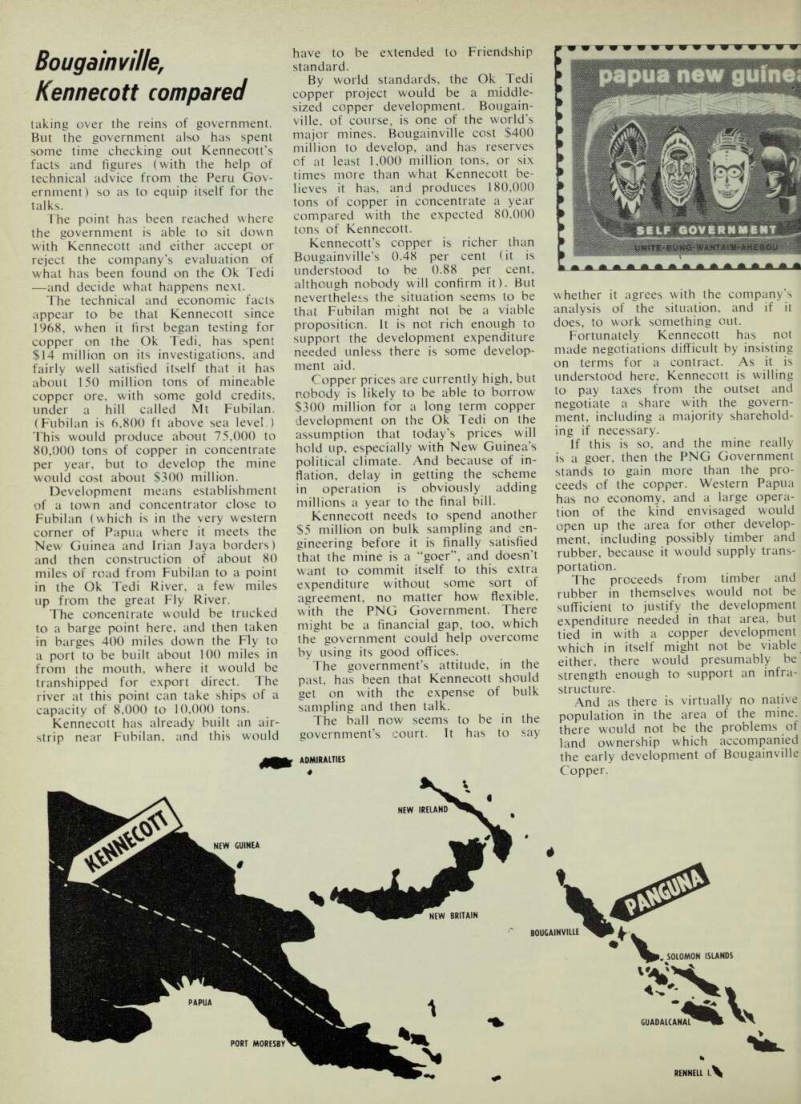
Development means establishment of a town and concentrator close to Fubilan (which is in the very western corner of Papua where it meets the New Guinea and Irian Jaya borders) and then construction of about 80 miles of road from Fubilan to a point in the Ok Tedi River, a few miles up from the great Fly River.
The concentrate would be trucked to a barge point here, and then taken in barges 400 miles down the Fly to a port to be built about 100 miles in from the mouth, where it would be transhipped for export direct. The river at this point can take ships of a capacity of 8,000 to 10,000 tons.
Kennecott has already built an air strip near Fubilan. and this would
have to be extended to Friendship standard.
By world standards, the Ok Tedi copper project would be a middle sized copper development. Bougain ville, of course, is one of the world's major mines. Bougainville cost S4OO million to develop, and has reserves of at least 1,000 million tons, or six times more than what Kennecott be lieves it has, and produces 180,000 tons of copper in concentrate a year compared with the expected 80,000 tons of Kennecott.
Kennecott’s copper is richer than Bougainville’s 0.48 per cent (it is understood to be 0.88 per cent, although nobody will confirm it). But nevertheless the situation seems to be that Fubilan might not be a viable proposition. It is not rich enough to support the development expenditure needed unless there is some develop ment aid.
Copper prices are currently high, but nobody is likely to be able to borrow S3OO million for a long term copper development on the Ok Tedi on the assumption that today’s prices will hold up, especially with New Guinea’s political climate. And because of in flation, delay in getting the scheme in operation is obviously adding millions a year to the final bill.
Kennecott needs to spend another $5 million on bulk sampling and en gineering before it is finally satisfied that the mine is a "goer”, and doesn’t want to commit itself to this extra expenditure without some sort of agreement, no matter how flexible, with the PNG Government. There might be a financial gap, too, which the government could help overcome by using its good offices.
The government’s attitude, in the past, has been that Kennecott should get on with the expense of bulk sampling and then talk.
The ball now seems to be in the government’s court. It has to say
whether it agrees with the company's analysis of the situation, and if it does, to work something out.
Fortunately Kennecott has not made negotiations difficult by insisting on terms for a contract. As it is understood here, Kennecott is willing to pay taxes from the outset and negotiate a share with the govern ment, including a majority sharehold ing if necessary.
If this is so, and the mine really is a goer, then the PNG Government stands to gain more than the pro ceeds of the copper. Western Papua has no economy, and a large opera tion of the kind envisaged would open up the area for other develop ment, including possibly timber and rubber, because it would supply trans
portation.
The proceeds from timber and rubber in themselves would not be sufficient to justify the development expenditure needed in that area, but tied in with a copper development which in itself might not be viable either, there would presumably be strength enough to support an infra structure.
And as there is virtually no native population in the area of the mine, there would not be the problems of land ownership which accompanied the early development of Bougainville Copper.