'Fijians must
pp. 11-12 · Read in the full issue
rule' says new party
From a Suva correspondent
A new political party, using as its slogan “Fiji for the Fijians”, has been launched in Suva.
The exclusively Fijian body, knoun as the Fijian Nationalist Party, in its manifesto demands: o That two-thirds of the seats in Parliament be reserved for Fijians; o A revision, if not the complete overhaul, of the present government in order to “reinstate Fijians on the political map”; • The abolition of Common Roll the electoral one-man, one-vote system, • And, "better treatment to pre serve the dignity” of Fijians.
The •'arty’s birth follows the ex pulsion of its founder, Mr Sakiasi Butadroka, 49, from the country’s ruling Alliance Party late last year after he made anti-government state ments to the press. (PIM, Jan, p 6).
Shortly before his expulsion on November 28, these statements also cost him his job as Assistant Minister for Commerce, Industry and Co operatives.
Mr Butadroka, was elected to the House of Representatives as Fijian communal member for Rewa-Serua- Namosi in the 1972 General Elections.
After his expulsion, in the House of Representatives, Mr Buta droka accused the Prime Minister of steering assistance away from the Fijians on the grounds that they lost anything given to them. He further alleged that the Prime Minister did not support Fijian aspirations to enter commerce and industry.
These and other remarks led the Prime Minister to describe him as a “dangerous influence in this House”.
Mr Butadroka launched his new party on January 19 with the aid of villagers who attended a meeting at a hall in Suva.
“Let the Fijians—the owners—be the master.”
This remark, made during a recent interview with PIM, could perhaps be considered the essence of Mr Butadroka’s convictions.
The comment itself, like other ex treme racial and political views he has expressed since his election to the House of Representatives in 1972.
obviously springs from a strong sense of grievance.
But what led to this . . . and, ultimately, to his dismissal from the post of Assistant Minister for Com merce, Industry and Co-operatives and expulsion from the Alliance Party?
He told PIM that he first con sidered entering politics after reading the objects of the Fijian Association, the Alliance Party’s main constituent body.
He said he felt that in politics he would have a greater opportunity to help further the development of the Co-operatives movement, an organisa tion he had worked for since leaving school. (When he resigned, he was manager of the Central Co-operatives Associa tion.) “When I was elected,” Mr Buta droka said, “I was a great supporter of the multi-racial movement. But when I started pointing out the prob lems of the Fijian people, I was greatly surprised when I was called a racist.
“In my capacity as a Fijian com munal representative, I think I had every right to voice this and I was guided by the objects of the (Fijian) association, of which I am a member.
But every time I brought forward the problems of the Fijian people I was called a racist.
“I don’t think I can reconcile myself with this.”
He said that in the association’s national committee and in the Alliance Party nearly every month, he had raised the issue of develop ment of land by the government, and also of education, commerce, scholar ships and industry as they affected Fijians.
“I felt the government was putting too much money into the hands of the ‘haves’. I didn’t want money from the government for these purposes as a free gift. It could have been in the form of loans.
Asked about his party’s submission that Fijians should have two-thirds representation in Parliament and who he thought should comprise the remaining third —Mr Butadroka said: “Any other races. The Indians are big in population; the Europeans are big in money.
“But let the Fijians—the owners— be the master. This could cause some resentment. But you only have to see what is going on in other parts of the world.”
Asked what alternative to common roll he could suggest, Mr Butadroka said machinery to deal with this could be set up. He did not elaborate.
Asked why he had not tried to promote his case through the existing political framework, Mr Butadroka said; “I did. I tried my 100 per cent
best after I was elected to the House.”
He said he did not know the exact number of members of his new party, “but from what I’ve heard I’ve got thousands of followers. The majority of my constituents are in favour of what I’m doing”.
Asked how many had paid their 50 cents-a-year membership fee, Mr Butadroka again said he could give no exact figure, “but some have paid”.
When referred to suggestions that many of the people he was trying to influence were illiterate or semi literate villagers, Mr Butadroka said that since Independence the lot of the Fijians had dropped back and his supporters had begun to realise this.
“If they wouldn’t listen to me, B would have resigned my seat in the: House. I think if I called another march in two or three months’ time, the streets would be filled.”
He said his next move would be to voice the “Fijian view” in Parlia ment, and that he was now working on some motions to this effect. He did not know when he would get a reply to his party’s submissions, but he added that, even if they were rejected, he would still press ahead with his plans. He felt confident his new party would be a fully effective one by the end of this year.
And if it should fail?
Mr Butadroka thought for c moment, and then said: “I just cam not imagine that happening.”
Footnote: Soon after the launching of Mr Butadroka’s party, Prime Minister Ratu Sir Kamisese Man called on supporters of the Alliance Party’s multi-racial policies to “stam up and be counted”. ?
Speaking as chairman of his party i national council meeting at Nadi, Rati Mara delivered a cutting openinj address aimed at opponents of multi racialism. He referred to the forma tion of the Fijian Nationalist Part as a timely moment for the Allianc to take stock of itself. There was n< room in the party for those witl views opposite to multi-racial ones The idea of Fijians’ interests bein paramount was a firm part of th Fiji Constitution.
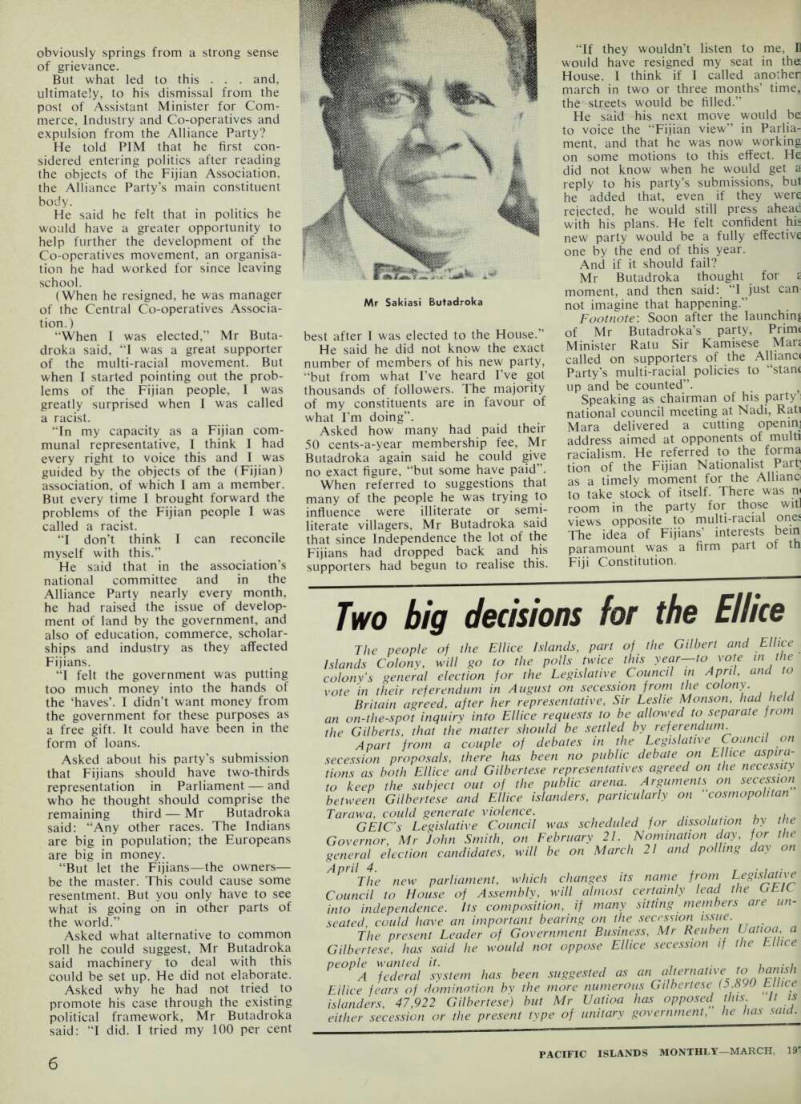
Mr Sakiasi Butadroka