A Job To Do Before The Games At
pp. 35-37 · Read in the full issue
Guam-Put The Record Straight
By Stuart Inder
When the Fourth South Pacific Games ended in Papeete in 1971 I reported at length in PIM about the unreliability of the lists of medal winners, not only for that Games but for the three previous ones since 1963. I pointed out that over the years some names, times and distances were inaccurate and that something should be done about the confusion before the Fifth Games in Guam in 1975. Last month PIM made an inquiry to see what had been done to rectify the anomalies. The answer was, nothing. Furthermore, it doesn't look as if there are any plans to do anything. The keeping of records for each Games is the responsibility of the particular host country —and there have been four, Fiji, New Caledonia, PNG and Tahiti. But it has been nobody's job to check them against each other. Once each Games is over the Games Council responsible for those Games disbands—until the torch is held by the next host. The story of the anomalies which I reported in PIM in November, 1971, is now reprinted in full below, because these anomalies still exist. There is still the need for the record to be put straight.
Who in the South Pacific Games organisation will now accept this responsibility? Read the facts:
Now that we have a four-year break to the Fifth South Pacific Games in Guam, the South Pacific Games Council should have time enough for a vital job that needs doing—the job of compiling an accurate list of Games times and records. After four Games, the present lists are unreliable.
Each Games since Suva in 1963 has probably added to the inaccuracies, and the Tahiti Games certainly was no exception. Further delay in correcting the records will result in the errors being compounded, but the job shouldn’t be difficult if it is done soon, while the participants and/or the officials are still available to help adjudicate.
As an example, official record lists published in connection with the Tahiti Games, including both the official programme and the official handbook giving general information and regulations, describe the women’s 100 metre track record as having been set by Fiji’s Ana Ramacake in 1963 at 12.85.
Ramacake herself is still available to confirm (or otherwise) that her time was 12.25.
The Tahiti handbook gives the best time in the individual cycling sprint in 1966 to M. Bopp-du-Pont at 11.945. The official published results of the Tahiti Games give no time at all, and spell Bopp-du- Font’s name without the hyphens.
Du-Pont (or du Pont) also took out the gold medal at Tahiti and a study of the detailed results appears to indicate that his best time was 12.425. run in the semi-finals.
But this needs to be confirmed offidally and it should also be stated clearly who holds the record and how he spells his name.
This matter of names, incidentally, involves far more than correct spelling—it involves correct identification. An example is that of the outstanding Fiji women’s athlete Miriama Tuisorisori—which is the name she is listed under at Tahiti. But would anybody studying the Port Moresby records of 1969 realise that the M. Kadavu who took out the gold medal for the long jump was the Tuisorisori who took out the long jump bronze (among other medals) at Tahiti?
A more telling example is that of the boxer Noel Mahe, who took
a silver in the lightweight division at Papeete. Who would imagine that this is the same N. Katoutch who took the bronze in the middle weight division at Port Moresby, and the N. Kaoutche who took the bronze in the welter at Noumea?
It would be difficult to believe that a man who fought as a welt erweight in 1966 could become a middleweight in 1969 and a light weight in 1971, and change his name and appearance in the mean time. But experienced judges such as Stan Brown, of Fiji (who has judged at all four Games) recog nised Noel while watching him weigh-in at Papeete—commenting that he had thinned down to such an extent, and had grown his hair so much longer, that he was a dif ferent person, There is nothing suspicious in the name change. Islanders not in frequently are known by different names. But the official record books should certainly recognise the changes, and get the names spelled correctly while they’re at it.
There are errors of times, iden tification and medal position am
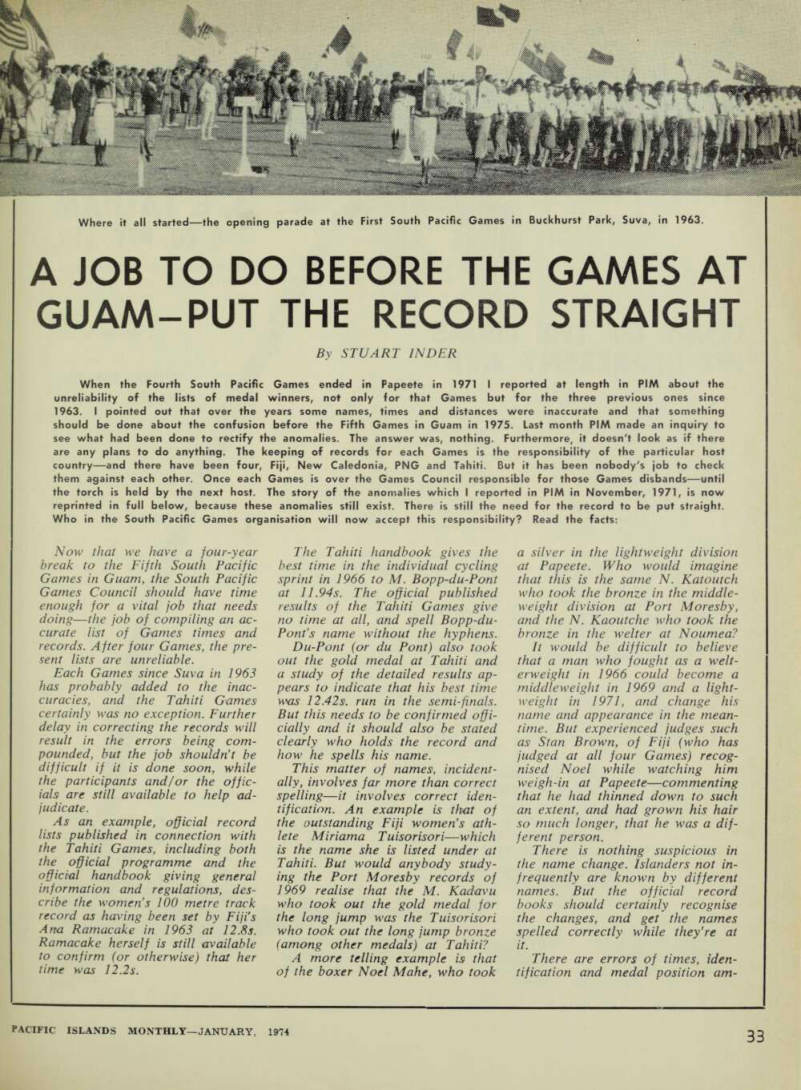
Where it all started—the opening parade at the First South Pacific Games in Buckhurst Park, Suva, in 1963.
ong the Tahiti records. What, for instance does the time of 59.5095. mean against the name of M.
Mouren in the 100 metres mens freestyle swim? The time of 4m. 31.85. given officially against C.
Martin in the 100 metres mens freestyle is I believe incorrect. PIM got it as 31.25. Is the winning time in the 4 x 100 metres men’s med ley 4m. 29.7 or 4m. 29.85.??
Again in swimming, the results published officially in Tahiti give the bronze medal to New Guinea in the 4 x 100 metres men’s relay, which is patently an error, because the winning team is also given as being New Guinea and the names of the bronze medallists are ob viously of the New Caledonian team. Nevertheless this simple error ( somebody has mistaken the initials NC for NG) resulted in the official medal tally being wrongly compiled.
There is another error in the medal tally, as a result of the offi cial lists incorrectly giving a bron ze medal to New Caledonia’s C.
Pita in the lightweight boxing.
Pita was eliminated because he was overweight, and no bronze was awarded.
One of the oddest errors in the final official results is the listing of a silver medal to Ricardo Bias of Guam, in the middleweight divis ion of judo. The first result sheet gave this medal to Frederic Briand, of New Caledonia, and Bias the bronze.
This was a celebrated bout in which Bias had complained about having to play off for the bronze and he did in fact stand on the podium in number three position, and receive his bronze. The final result sheet made some of the Guamanians think that the French officials were attempting to rectify an error in awarding him the silver but I believe it is simply another example of clerical confusion.
PIM corrected the error in its re cord lists, as it has in the others mentioned.
Again, we need an official record of distances translated into both metric and British systems. In the two Games so far held in the French territories, officials have given distances in the metric sys tem and made no effort to trans late them. The British areas did the same thing at Suva and Port Moresby, with the result that we have two different systems, nei
ther guaranteed accurate over the entire four Games, because the Press media have had to do their own arithmetic.
It is hardly surprising that medal tallies vary as a result of the con fusion over Games results. The official tally published in Papeete at the end of the Games was cer tainly incorrect, and while PIM hopes that its medal tally is cor rect (it worked hard at attempting to make it so) it unfortunately can’t guarantee it.
In Papeete, the editor of the monthly Suva paper, Fiji Sport, Mike Hohensee, and I worked into the night in an attempt to recon cile the official medal tally with our own—in vain. Not only were we unable to confirm the accuracy of the official tally, we were un able finally to agree on our own —with the result that the official medal tally and those of Fiji Sport and PIM are all different.
It’s time somebody found out just how many territories won what at the four Games and pub lished the results.
All this confusion was probably inevitable. All the Games have for the most part been run by ded icated volunteers, who gave up their own time to officiate. More than 200 of these people were used in Papeete. It was natural there should be occasional communi cation breakdowns, with even effi cient officials suffering as a result of confusion further down the line.
For instance, the swim officials were among the most efficient ai the Games, and I doubt if the final inaccuracies were their doing.
As an example of what could happen, the Papeete Games organ isation right at the beginning laid down certain abbreviations for the name of territories—Sl for the Solomons, PNG for Papua New Guinea, SA for American Samoa, etc. Some officials soon started calling PNG simply NG, which got confused with NC. The Solo mons became SA (the word is “Salomon” in French), which quickly became confused with American Samoa.
But witch hunts serve no pur pose.
The Games Council should es tablish a committee as soon as possible and come up with a com plete, accurate official list of cumulative results while it is still able to get one.