The Editor's Mailbag
pp. 30-34 · Read in the full issue
Danger Of High-Class Pidgin
As one of the ‘expatriate academ ics’ attracted to the September con ference on New Guinea pidgin des cribed in Percy Chatterton’s article (PIM Nov p 24), I would like to point out some errors of emphasis and even fact in that article.
While I object at least as much as he does to telling other people how they should speak, it is only fair to at least some of the ‘European ling uists’ (most of whom were in fact American or Australian) to point out that what they were afraid of was that a small elite of English-speaking Papua New Guineans would intro duce large numbers of English words and constructions into pidgin, thus producing a ‘high-class’ social dialect of the language which could be used for government communications but which would be largely incompre hensible to the masses of rural pidgin speakers.
That this is a very real danger, several of the papers explicitly poin ted out, but Mr Chatterton seems quite unaware of it, and still less aware of how it could be combatted.
Or does he, under the pretence of ‘non-interference’, actually support the driving of a linguistic wedge be tween the future rulers and the ruled in Papua New Guinea?
As for ‘overseas pisinophiles’ over estimating the universality of pidgin because they ‘don’t get beyond the main centres’, it so happens that a large number, perhaps a majority, of these ‘pisinophiles’ are workers with the Summer Institute of Linguistics, who are also engaged in bible trans lation into the indigenous languages, and whose work, therefore, takes them regularly and for long periods into the remotest villages.
Mr Chatterton’s claim that pidgin is still very far from ‘an adequate vehicle for transacting the business of a nation’ is bizarre, to say the least of it, in view of the fact that over the last few years, over 90 per cent of the House of Assembly’s business has been transacted in it.
Is Mr Chatterton claiming that a body of which he, apparently, was himself a member is 90 per cent inadequate?
Finally, Mr Chatterton claims that ‘only the lunatic fringe supposes that it is practicable to mediate secondary and tertiary education through pid gin’. Is he not aware that, if it hadn’t been for the ‘lunatic fringe’ of Renaissance Europe insisting on ‘mediating secondary and tertiary education’ through their own de spised vernaculars, he would have written this article, not in English, but in Latin?
Derek Bickerton
University of Hawaii, Honolulu.
Kubuna
We have read Mr Livingston’s comments on Kubuna (PIM Dec p 71) and we are concerned that our aim could be so easily misinterpreted.
We are not so presumptious as to see our series as an attempt to pre serve a “heritage” (Mr Livingston’s word).
Our aim has been to produce an inexpensive book that could be effect ively used in Papua New Guinea Primary Schools. We feel we have achieved this.
Despite what Mr Livingston im plies, material based upon Papua New Guinea stories is not readily available to Papua New Guinea tea chers—especially material that has been designed to be used for listening lessons, oral expression lessons, and also designed to encourage teachers to integrate primary school subject areas.
The ultimate judgment that can be made on the Kubunas (the final two books in the series are now avail able) is surely by the practising tea cher, and his pupils. The response has been very enthusiastic. Comments we have received from teachers, and our own observations to pupil re action and participation have con vinced us that the series have met a definite need.
We are in general agreement with Mr Livingston’s comments about improper use of traditional material, but it must be realised that the tra ditional material used in the Ku bunas is merely the vehicle that gives
the teacher the opportunity to im plement difficult aspects of the pri mary school syllabus. We could have easily selected current affairs, geography, Western myths and leg ends as our vehicle, but then, surely, pupil response to the related ac tivities would not have been so en thusiastic, nor the activities so rele vant.
Keith Downer
Daniel J. Doyle
Madang Teachers College,
Png.
Rotuma's home-brew
I read with interest Saumaru Fos ter’s letter in The Editor’s Mailbag (PIM Nov p 42), regarding Rotu ma’s national dish.
The tahroro (which is the correct spelling), according to the Rotuman Dictionary (by C. Maxwell Church ward), is a partly-grown coconut or kind of a native pudding made from it.
In actual fact, it is a coconut sauce used in a variety of Rotuman dishes. It is not a dish of soup as stated by your correspondent.
The preparation of tahroro is also popular in some parts of French Polynesia and Samoa. Traditionally, it is said that the tahroro was intro duced to Rotuma by Samoan ances tors of the Rotuman people. The Samoans called it samilolo.
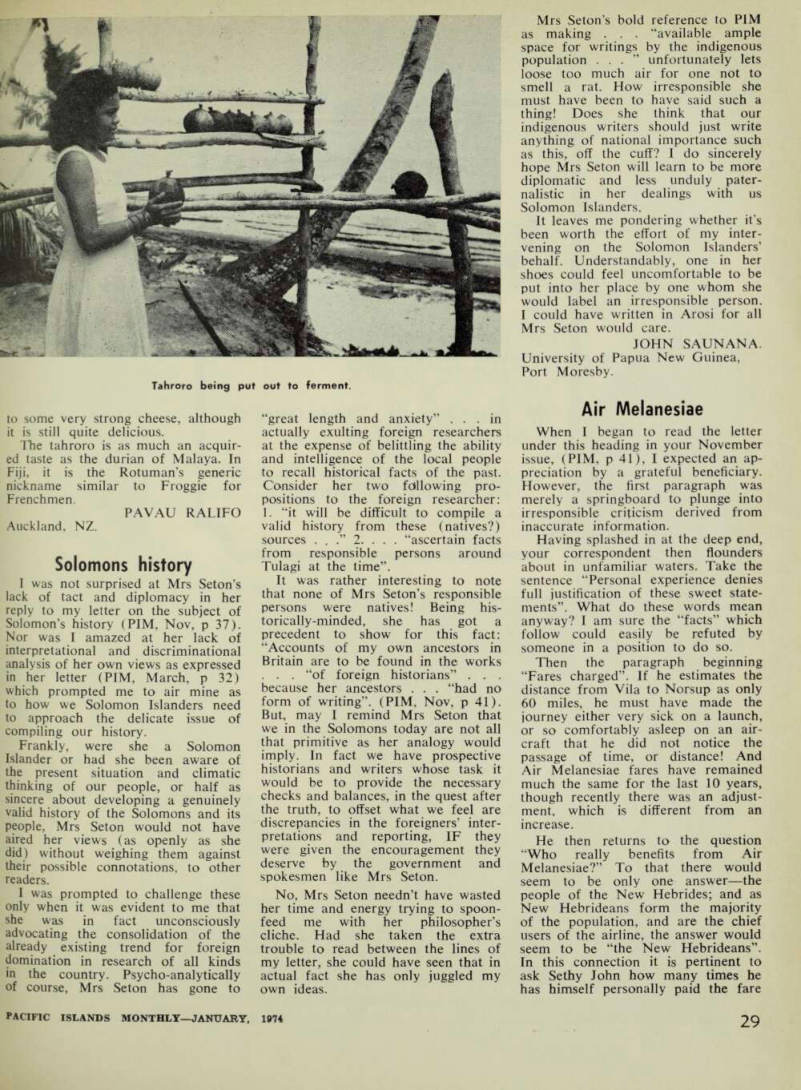
It is made from young green coco nuts (niu tahroro, as the Rotumans called it) at the stage when they are most suitable for drinking. After re moving the husk, the coconut is cleaned and a small hole is made through one of the eyes to let out the juice. The coconut is then filled with either salted fresh water or sea water and closed with a cork made of dry banana leaves.
It is then stored in the sun for two or three weeks to ferment. After that the water is let out and the coconut is shaken to turn the flesh into sauce.
If the coconut has not been kept air-tight during the fermentation pro cess, it would smell “badly”, similar
to some very strong cheese, although it is still quite delicious.
The tahroro is as much an acquir ed taste as the durian of Malaya. In Fiji, it is the Rotuman’s generic nickname similar to Froggie for Frenchmen.
Pavau Ralifo
Auckland, NZ.
Solomons history
I was not surprised at Mrs Seton’s lack of tact and diplomacy in her reply to my letter on the subject of Solomon’s history (PIM, Nov, p 37).
Nor was I amazed at her lack of interpretational and discriminational analysis of her own views as expressed in her letter (PIM, March, p 32) which prompted me to air mine as to how we Solomon Islanders need to approach the delicate issue of compiling our history.
Frankly, were she a Solomon Islander or had she been aware of the present situation and climatic thinking of our people, or half as sincere about developing a genuinely valid history of the Solomons and its people, Mrs Seton would not have aired her views (as openly as she did) without weighing them against their possible connotations, to other readers.
I was prompted to challenge these only when it was evident to me that she was in fact unconsciously advocating the consolidation of the already existing trend for foreign domination in research of all kinds in the country. Psycho-analytically of course, Mrs Seton has gone to
“great length and anxiety” ... in actually exulting foreign researchers at the expense of belittling the ability and intelligence of the local people to recall historical facts of the past.
Consider her two fallowing pro positions to the foreign researcher; 1. “it will be difficult to compile a valid history from these (natives?) sources . . .” 2. . . . “ascertain facts from responsible persons around Tulagi at the time”.
It was rather interesting to note that none of Mrs Seton’s responsible persons were natives! Being his torically-minded, she has got a precedent to show for this fact: “Accounts of my own ancestors in Britain are to be found in the works . . . “of foreign historians” . . . because her ancestors . . . “had no form of writing”, (PIM, Nov, p 41).
But, may I remind Mrs Seton that we in the Solomons today are not all that primitive as her analogy would imply. In fact we have prospective historians and writers whose task it would be to provide the necessary checks and balances, in the quest after the truth, to offset what we feel are discrepancies in the foreigners’ inter pretations and reporting, IF they were given the encouragement they deserve by the government and spokesmen like Mrs Seton.
No, Mrs Seton needn’t have wasted her time and energy trying to spoon feed me with her philosopher’s cliche. Had she taken the extra trouble to read between the lines of my letter, she could have seen that in actual fact she has only juggled my own ideas.
Mrs Seton’s bold reference to PIM as making . . . “available ample space for writings by the indigenous population ...” unfortunately lets loose too much air for one not to smell a rat. How irresponsible she must have been to have said such a thing! Does she think that our indigenous writers should just write anything of national importance such as this, off the cuff? I do sincerely hope Mrs Seton will learn to be more diplomatic and less unduly pater nalistic in her dealings with us Solomon Islanders.
It leaves me pondering whether it’s been worth the effort of my inter vening on the Solomon Islanders’ behalf. Understandably, one in her shoes could feel uncomfortable to be put into her place by one whom she would label an irresponsible person.
I could have written in Arosi for all Mrs Seton would care.
John Saunana.
University of Papua New Guinea, Port Moresby.
Air Melanesiae
When I began to read the letter under this heading in your November issue, (PIM, p 41), I expected an ap preciation by a grateful beneficiary.
However, the first paragraph was merely a springboard to plunge into irresponsible criticism derived from inaccurate information.
Having splashed in at the deep end, your correspondent then flounders about in unfamiliar waters. Take the sentence “Personal experience denies full justification of these sweet state ments”. What do these words mean anyway? I am sure the “facts” which follow could easily be refuted by someone in a position to do so.
Then the paragraph beginning “Fares charged”. If he estimates the distance from Vila to Norsup as only 60 miles, he must have made the journey either very sick on a launch, or so comfortably asleep on an air craft that he did not notice the passage of time, or distance! And Air Melanesiae fares have remained much the same for the last 10 years, though recently there was an adjust ment, which is different from an increase.
He then returns to the question “Who really benefits from Air Melanesiae?” To that there would seem to be only one answer —the people of the New Hebrides; and as New Hebrideans form the majority of the population, and are the chief users of the airline, the answer would seem to be “the New Hebrideans”.
In this connection it is pertinent to ask Sethy John how many times he has himself personally paid the fare
Tahroro being put out to ferment.
Letters
between Vila and Norsup, and how often the church which has supported him in Fiji has accepted responsibility for his transport.
He next digresses to refer to an incident concerning an insult to an islander —not a New Hebridean incidentally, but an expatriate from another Pacific territory. The person concerned was punished by the Court, not by Air Melanesiae, and if the writer believed that the judgment was unjust, an appeal could have been addressed to the appropriate national administration.
It is the company’s declared policy to give seats on the “first come first served” principle and if anyone holds a booking, the company acknowledges an obligation to ful fil that contract, even though it may have been made by another airline anywhere in the world.
In view of the above, Sir, and much more that could be added, I think you will agree, as I hope does Sethy John, that his last paragraph is completely irrelevant.
Amnesia.
• Name and address supplied.
Fijian land
I wish to comment on an extract in your Islands Press column (PIM, Aug, p 36). The extract by Mr Joseph Mohammed was taken from The Fiji Times.
I am, however, rather inclined to comment on the manner in which Joseph has implied his envy of the Fijians for no reason about acres of land held in reserve by the Fijians and not giving it to the landless Indians.
The land that Fijians have in re serve belongs to them. If you have no land to develop, then that remains a fact. The jungles that result be cause of unused land are a blessing to the land. It is nature’s way of preserving the land for future Fijian generations. If they are shortsighted enough to give it to you now, then their future Fijian generation might suffer.
If the land is not used now, then it is the landowner’s own business.
If the Fijians are not willing to give it to you, then it is their own busi ness.
People who have no land should build themselves artificial islands to cultivate.
Jim Kasusu.
Honiara, BSIP.
Gilbertese spelling
Em afraid that Maunaa Itaia’s wish to ka-mauna modern Gilbertese spell ing and pronunciation and restore an older convention which he regards as more “correct” is doomed to failure.
Language is a living and therefore changing thing, and what is “correct” is the usage of the majority of edu cated speakers and writers of that language. Any method of spelling a language is a convention and the fact is there has never been one uni versal orthography for Gilbertese.
The fact that Maunaa Itaia wishes
to keep the older (European intro duced) “aa” for the long “a” sound and that many other Gilbertese use the “a” form (also European intro duced) is evidence of this. The only way to settle the dispute would be to poll every Gilbertese on the way to spell the language—and then force the minority side to accept the spell ing of the majority! The only other solution would be to change the orthography.
But there seems little point in Maunaa Itaia and me arguing about this in print. Since it seems that we are both admirers of the best of
Gilbertese culture and wish to see it kept alive, I should like to take this opportunity to wiwina him to join the newly-formed society to preserve and revitalise Gilbertese arts, skills and traditions that has recently begun on Tarawa. One of the society’s first tasks is to collect as much information as possible on Gilbertese culture —in conjunction with the new museum project—and make it all
available from a single Tarawa loca tion.
At the moment much is known and much has been recorded but it is located literally all over the world, The society is not asking people to give it any books or papers relating to the Gilberts, unless they would like to do so, but would be grateful to be told of anything that is in existence, The society hopes to sponsor a
Gilbertese Festival in 1975. Anyone who is interested should write to Kaburoro Tanielu at Radio Tarawa.
On a personal note: my name is transliterated as Bibian by people here who have only the 13 Gilbertese letters, not Wiwina, but that doesn’t make nearly such a good pun. Ka mauna is to erase, wipe out or abolish; wiwina is to inspire or sug gest; te bibi is the windpipe.
Vivienne Hayward.
Tarawa, GEIC.
No one can stay underwater for ages. I'm glad that Te leruru Karotu has come up to the surface. He cannot be the one who does all the wiwi to Nei Wiwinna. It makes all the dif ference to wrestle over a Gilbertese spelling with a pure Gilbertese who knows better Gilbertese than the European lady.
I appreciate Te Karotu’s contri bution. What is traditionally original is something that begins with Gil bertese in the past and is still main tained in the present because it is proper and correct. The traditional written Gilbertese originated from the spoken Gilbertese as it happens to every language. As a matter of fact the spoken language comes into existence first and gives birth to writ ten language in all time and places and not vice versa.
Te Karotu acknowledges Dr Hiram Bingham to be the first man to put into print or written form the Gilber tese spoken language. He is very correct. Dr Bingham was doing what I have been saying above and more over he was not on his own, he had Gilbertese helpers. Therefore, the origin of the written Gilbertese lang uage is not really Dr Bingham but the spoken Gilbertese language.
It is better to put aside Nei Wiwi nna’s complaint of the difficulties and confusion of the double vowels, consonants and apostrophe for to any literate Gilbertese they are not lin guistic problems. They help to make Gilbertese both oral and written clear, simple, less confusing and under standable. Moreover we have to con sider the future Gilbertese gener ations now in primary schools who will face a lot of confusion and problems when we do away with the “loaded double vowels, consonants and apostrophe”.
May I ask Te Karotu and his friend not to misinterpret me claiming to be the sole authority on the Gilbert ese language. In fact I am just putting forth what I believe to be the general Gilbertese reaction to foreign inter ference and defending the purity of our language.
Maunaa Itaia
Pacific Theological College, Suva, Fiji.