economic development
p. 25 · Read in the full issue
Faa Samoa is a drag on economic development
From FELISE VA’A in Apia
One of the biggest problems facing Western Samoa today is that of cultural lag which means that while technological change has been rapid, social change has been slow.
The result is that society tends to use old, ineffective means to solve new problems. Cultural lag, there fore, can be one of the biggest handicaps to the rapid economic development of a poor country like Western Samoa.
One can see examples of cultural lag everywhere in Samoan society.
Take the land system.
When the earliest Europeans came to Samoa, they exploited the Samoans ruthlessly in acquiring land.
Hundreds of acres of fertile Samoan agricultural land were bought, not for a song but for a smoking pipe, or a rifle.
According to the testimony of some old people, a lot of the land now owned by the Western Samoa Trust Estates Corporation was acquired in this way.
When the Germans took over Samoa as a colony in 1900, they put a stop to this exploitation of Samoan land and passed laws pro hibiting the sale of Samoan land to outsiders.
They also established in 1903, machinery for hearing Samoan land and titles cases, the present Land and Titles Court, one of the most unique courts in the world for its decisions are based on Samoan custom and usage.
When the New Zealanders came in 1914, they largely respected this German establishment and the sale of Samoan customary land to out siders was and is prohibited.
But, while it is all very well to ban the sale of customary land to out siders, it seems that, in the light of modern developments, it is silly that the same land cannot be sold to Samoans.
On the average, Samoans are better educated than they were and cannot be easily exploited. Why can’t Samoans buy land for development purposes from other Samoans? This is where the cultural lag comes in.
Take an example from economics.
Traditionally, Western Samoa is an agricultural country. From the earliest days, almost 100 per cent of the exports were from the primary sector.
Today timber and handicrafts come into the picture.
In recent years disasters like hur ricanes, fluctuating world prices and lack of markets have dealt a heavy blow to agriculture and exports have reached their lowest level over a 20 year period.
The result has been a $1.6 million deficit in the trade balance for 1972 with the possibility of a bigger gap if exports don’t improve.
In addition, increased imports have helped to worsen inflation and have led to drastic action by Minister of Finance Sam Saili who has reduced import allocations to 90 per cent of last year’s total, stopped some kinds of loans and limited others from banks and other credit institutions.
The minister’s solution has, there fore, been one of repression. There has been no attempted solution through industrialisation, perhaps the most obvious answer to Western Samoa’s present economic woes.
In large part, this is due to a cultural lag, the view that anything new, untried, is bad for the country.
This is not to deny that the minister has some vague ideas of piece-meal, long-term industrialisation.
Take another example from politics. Only the matai (chiefs) and those on the Individual Voters’ Roll have the right to vote. The matai comprise only about a tenth of the population, while those on the Individual Voters’ Roll (formerly the European Voters’ Roll) number only several thousands.
Many educated people and those who pay taxes, however, do not have voting rights. Are they paying the expenses of a matai government
without a say as to how that govern ment should be run?
In the social sphere, cultural lag is predominant. The communalistic elements of the traditional system seem outdated, especially in cases where the chiefs take more than their share; emphasis on the present rather than the future discourages saving and economic development; treating of education as a means to an end (eg support of parents) rather than as a primary goal, in itself, helps to produce mediocrity.
And religion? It has become too institutionalised and rigid and dogmatic.
Its 19th century approach to modern problems has encouraged ritualism on the one hand, and super ficiality on the other.
All these examples of cultural lag are having a negative effect on Samoan society and unless something is done about them, Western Samoa’s economic development efforts (as well as other development efforts) will be seriously hampered.
For they will be the breeding grounds for conflict in Samoan society later on.
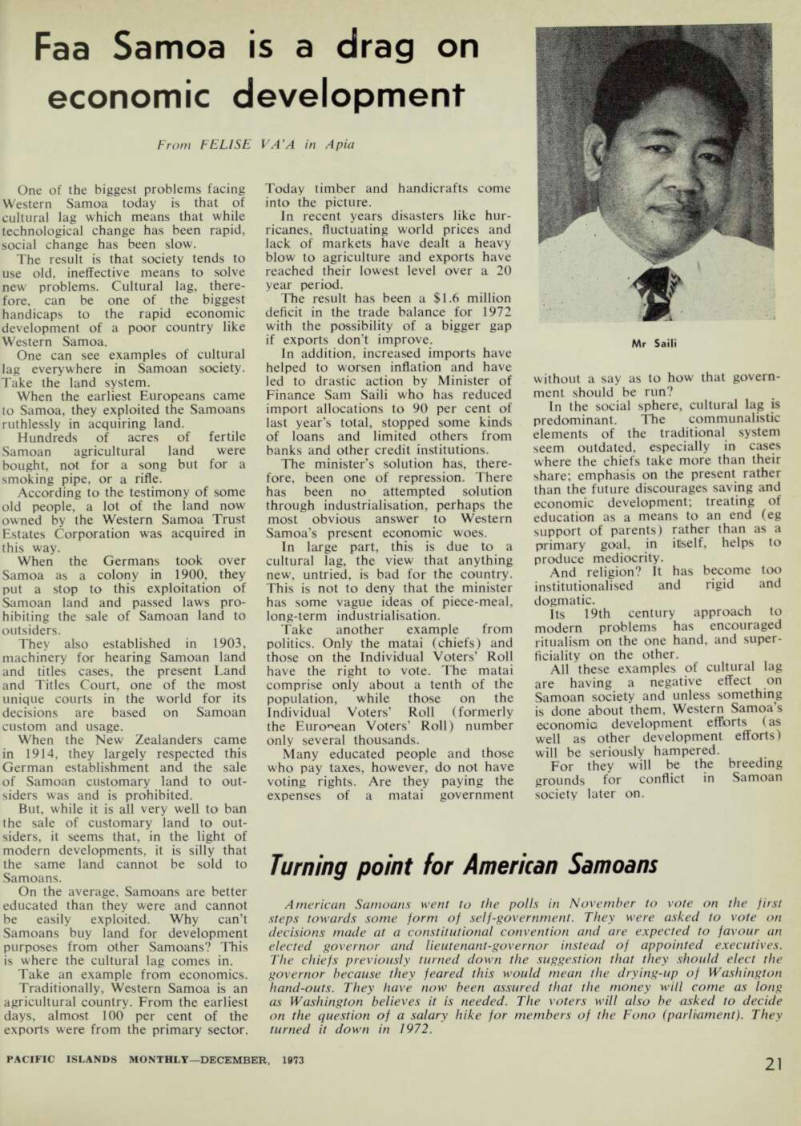
Mr Saili