Tropicalities
pp. 16-18 · Read in the full issue
An English pub in Fiji!
Ask any Englishman and he’ll tell you that the English pub, with its unique atmosphere, can't be exported.
Off Chicago’s Michigan Avenue there’s a pub which describes itself as the genuine English article. It has some English coaching signs inside.
The similarity ends there.
But Fiji’s Prime Minister, Ratu Sir Kamisese Mara, thinks there’s a chance of a pub transplant in Fiji’s suburban areas. At present, Fiji’s public bars are a replica of the New Zealand swill palaces with a notice outside Mamma sa tabu eke (Women not allowed in here). And no woman worth the name would want to drink in them.
There’s no such thing in Fiji as a tavern, used for food and drink only.
A hotel with a bar must also have accommodation, but there’s a change on the way according to Ratu Mara.
He says the government intends amending the Liquor Ordinance to allow the opening of suburban bars without bedroom accommodation. The new bars, to be called taverns, would be in selected residential areas.
The Prime Minister’s ideal, in his own words, is the English pub.
“I am sure many people who have visited the United Kingdom have been impressed, as I have been, by the congenial atmosphere and self-discip line of the local pub,” he said.
“The nearest we have in Fiji is the clubs, where there is control from members themselves but clubs are restricted to members and we would like to see these benefits more widely spread, particularly from the main urban areas.”
He added that some of the bars might operate as open-air beer gar dens.
You never know. We might still see a Rose and Crown in, say, Rai waqa, with the clientele busily play ing dominoes and darts and a gentle man presiding at the piano on top of which will be a row of full glasses donated by a grateful crowd of drink ing listeners.
*Sensassr Noumea
night life
International tourist promotions were finally launched in late October at Noumea’s new Chateau Royal hotel extensions, after French air flights through Australia had been suspended for five months, through nuclear boycott and other industrial troubles.
Once tourist traffic was normalised in the region, UTA French airlines promptly filled up one of their DC 10s with 150 Australian travel agents who were rushed across to sample the new Anse Vata beach facilities.
Also at the end of October, some 20 members of the Melanesian Tourist Federation were able to hold their annual meeting at the Chateau Royal. The federation’s objective is to promote regional tours incorporat ing the chain of Coral Sea islands from New Caledonia through the New Hebrides and Solomons to Papua New Guinea. This was the federation’s first meeting in Noumea and the date had been postponed from an earlier gathering planned in August, when anti-nuclear protests were of course hitting French tourist interests.
During this time, Noumea res taurants and night clubs vied with each other in presenting singers and other performers from Paris or neigh bouring Pacific islands.
One night spot had a novel way of attracting patrons. For the last Saturday of October, the “Tahiti Cabaret”, on Baie des Citrons beach, offered all visitors a “surprise en velope”. The envelopes contained tickets for free drinks or, for luckier patrons, a free bottle of champagne.
Added to the evening’s attraction of a Tahitian dancing troupe, it was, as the French say, all very sensation ally “sensass”.
The tremble
over a Wildcat Solomon Islander Mostyn Norua won a court case, and a World War II vintage Wildcat fighter-bomber.
Australian Barrie Coran lost the air craft and the S5O he paid for it. The trouble all started when Mr Clement Paratobo sold the plane, which he believed was on his land, to Mr Coran for $5O.
Everything was simple till the plane was taken to the BSIP Port Auth
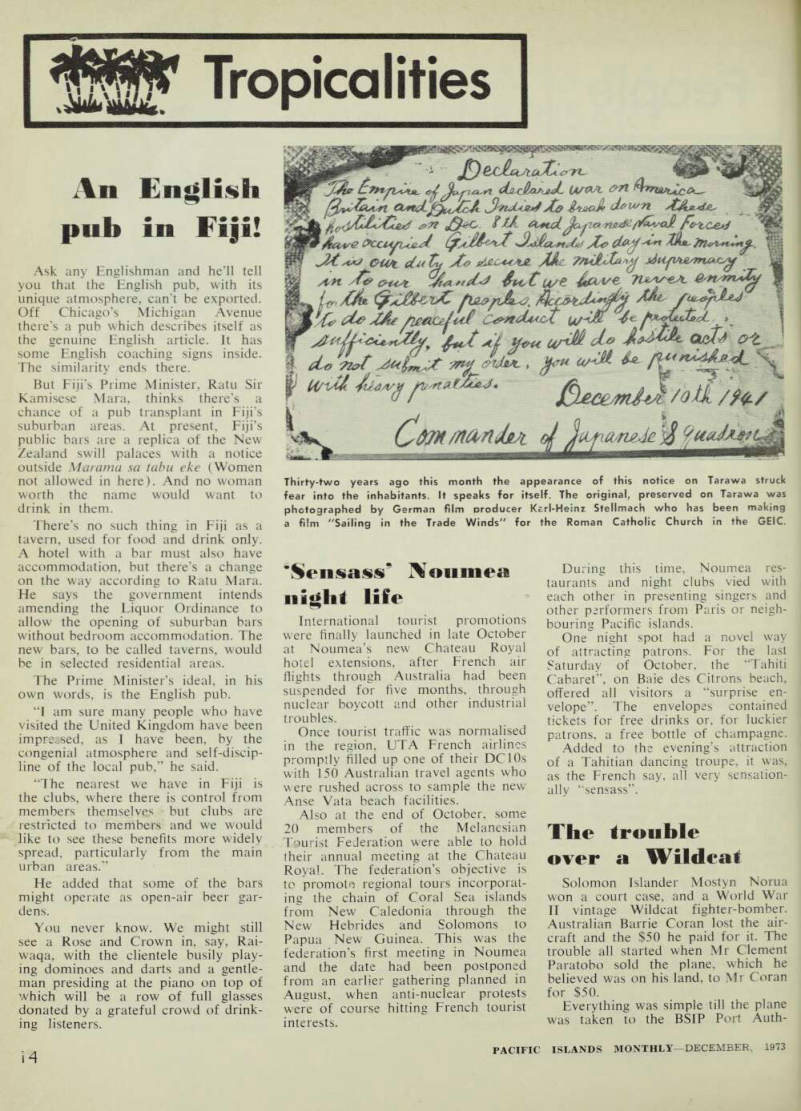
Thirty-two years ago this month the appearance of this notice on Tarawa struck fear into the inhabitants. It speaks for itself. The original, preserved on Tarawa was photographed by German film producer Kerl-Heinz Stellmach who has been making a film "Sailing in the Trade Winds" for the Roman Catholic Church in the GEIC.
ority to await shipment to Australia.
Mr Norua then claimed the land on which the aircraft was found be longed to him. and therefore the air craft was his property. The Native Court found in his favour.
Then the Port Authority told him that storage charges for the Wildcat had reached $3BO, and he could not remove it till the charge was paid.
This time Mr Norua appealed to the High Court, but by the time the case was heard the charges had reached $2,987.90. The High Court ruled the Wildcat must be returned to Mr Norua and the storage charges waived.
This did not satisfy the Port Auth ority, which lodged an appeal, claim ing it was entitled to its money. But it did suggest a compromise—that it would waive the storage charges if the aircraft was given to the BSIP.
The matter rests.
PS: The Wildcat was the best fighter aircraft available to the US Navy at the start of the Pacific war.
It was not as manoeuvrable as the Japanese Zero.
Air terminal
not island-style
There was some frantic head scratching by airport planners of the Cook Islands’ new international airport at the beginning of November when what was planned as a formal look-see at the new terminal buildings by Mr Tupui Henry, the chairman [)f the Cooks Parliamentary Cabinet, misfired.
Mr Henry took one look at the plans. He was expected to murmur ‘Very nice” and pass on, but he took a piece of the planners instead.
He wasn't happy with the layout, be said. Too much emphasis had been p’aced on documentation clearances than on the movement, freedom and :omfort of the people.
“It appears that Cook Islands re sidents would have to welcome their visitors arriving by jet on the foot path as there are no facilities for a proper lounge.” he said. “That’s not the Cook Island’s way of life to welcome visitors on the roadside.”
His point got home to members af the Cook Island Air Facilitations Committee who flew into Rarotonga a few days later. They explained that a covered lounge was provided for in the second phase of the complex to be added at some future date. That was no use to Mr Henry. The com mittee agreed and its New Zealand members promised to recommend that a covered reception lounge would be ane of the first things attended to by the planners.
No ‘pain’ in
the tummy
Ask a Frenchman to go without tea, and he would only think you were depriving him of unpalatable medicine. But take away his pain (bread) and you are denying him part of his life-source.
Still, it did happen that Caledon ians endured four days of abstinence late October, when local bakers went on strike over what was judged to be an inadequate rise in the price of bread. Pure economics eventually forced the bakers to refire their ovens; those selling cakes and pastries could withstand the halt in bread sales, but not those who sold only bread.
The Administration's fixed price of 20 francs CFP (A 17c) was finally accepted for the traditional 10 oz long wife-beater baguete. And so the Caledonians returned to their ritual of collecting hot loaves, fresh from the baker twice daily, seven days per week.
Kwajalein pays
price of peace
Kwajalein in Micronesia faces widespread unemployment because of the US-USSR strategic arms limi tation talks (SALT), claims recen tly-elected Marshall Islands Congress man John Heine. A cutback in acti vities at the Kwajalein missile base has been followed by elimination of overtime.
Mr Heine said the average working week would be cut from six to five days and he thought it would not be long before there would be lay-offs, starting at the top and working down.
He understood that the Vandenberg Air Force base in California would limit its activities because of SALT
agreements. Missiles for Kwajalein are fired from Vandenberg base.
“If there are big cutbacks at Kwa jalein then where will we get the money to pay the taxes talked about in our demands for 50 per cent”, he said. (This was a reference by the Marshalls delegation to the Congress of Micronesia that at least 50 per cent of the taxes generated within a district be set aside for the district generating the tax).
Mr Heine warned against the Mar shalls separating from the rest of Micronesia. He alleged the US was deliberately trying to divide Micro nesia. The dividing tactics were pro bably planned in the State Depart ment in Washington.
“They realise this is the way they can conquer our people”, he said.
The governor’s
grisly job
Governor John M. Haydon of American Samoa, whose official life these days isn’t exactly a bed of roses, had an unusual job to perform early in November —to witness the ex humation on the island of Manihiki in the northern Cooks of the body of an American Samoa fisherman who died there nearly 10 years ago.
It had been decided that it was time to bring the body home.
Governor Haydon, along with his wife and a group of scientists, was on a voyage to Rose Island, a pin point piece of American Samoa in habited by birds and turtles, and Swains Island,, and as Manihiki isn’t far away, it was decided to call there for the fisherman’s corpse. When the governor got to Manihiki it was Sunday and the islanders don’t dig up bodies on Sundays. However, after a meeting between the island council, the church pastor and deacons and the dead fisherman’s brother, it was un animously decided to do the job.
The Cook Islands News reported
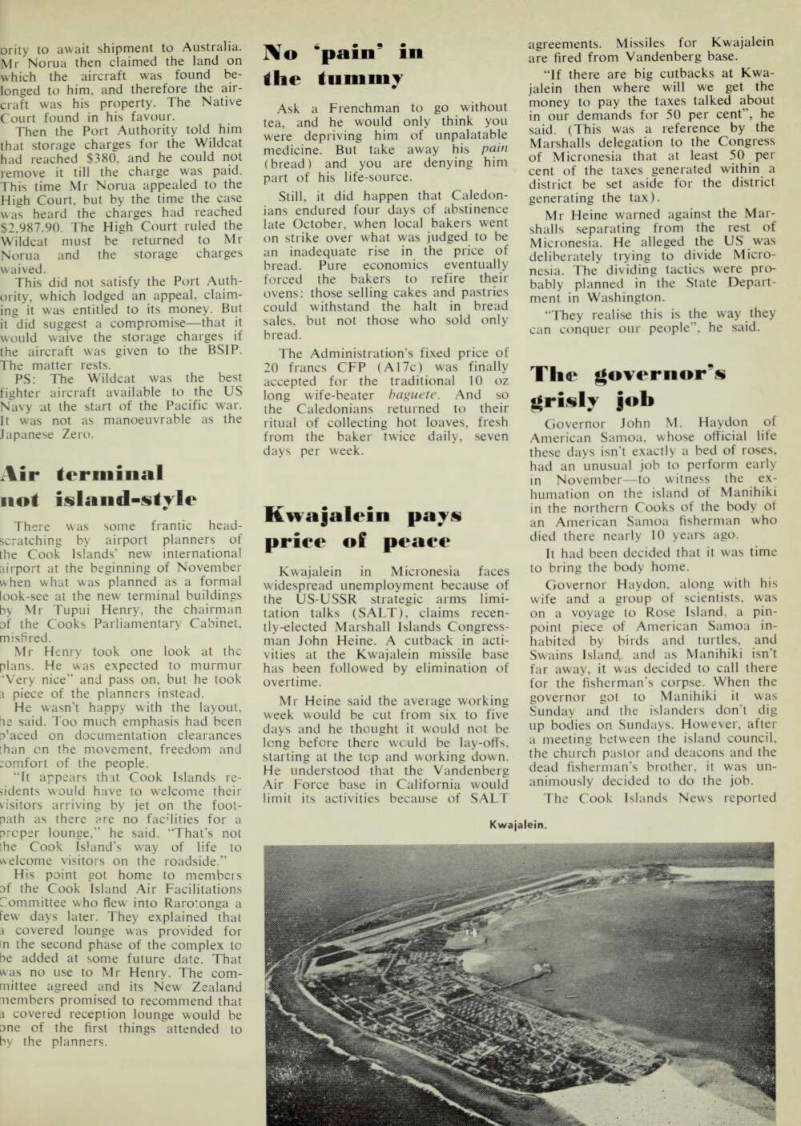
Kwajalein.
that the grave was surrounded by locals when the digging started, all “anxious to see what remained.” Not surprisingly, there were only bones.
Each bone was taken out, wrapped in tapa cloth and placed in a bag which was covered with the American flag, after which the bag was taken on board the American Samoa launch.
Talitiga.
Caledonian§
safer targets
Someone in Paris seems to be making good propaganda out of the recent anti-French nuclear boycott, which ended in October. The French announced that for the world cham pionships in target shooting, scheduled in Australia in November, their con testants would come not from France but from New Caledonia.
According to a reliable Noumea source, the French Shooting Feder ation decided not to send metro politan representatives because they considered that security conditions for the marksmen were not adequate; the Australian ban on French im ports included cartridges. The feder ation also feared unpredictable re actions from hostile spectators.
But it was good news for New Caledonia, which prepared to send five marksmen to Melbourne . . . either they were more expendable, or the metropolitan French were over sensitive to Pacific hostility.
Making room
for a king
The Japanese are nothing if not polite. When King Taufa’ahau Tupou of Tonga and his Queen Mata’aho arrived in Tokyo on November 7 for a two-week friendship and sight seeing tour his hosts realised they had a problem.
The king, at a press conference, stressed the similarities between the two races and said they were both located in the Pacific and belonged to the same Mongolian race.
There the similarities ended.
There’s a big difference in build, and the king, weighing 136.077 kgs (300 lb), accentuated the difference, which is where the Japanese had a problem.
The royal couple was scheduled to take a Shingansen train from Tokyo to Nagoya on November 14. It would have been a tight squeeze for His Majesty but his hosts had a special seat made and installed in the train.
It was his first visit as King of Tonga but his sixth in all. He visited Japan five times as Prince Tungi.
Soaking the
Yap drinker
The drinker will get caught two ways in Yap District through a new sales tax and an alcoholic beverage consumption permit system. The sales tax is 1c a container, regardless of size, on the first sale in Yap of cans and bottles of beer, malt bever ages, soft drinks and non-alcoholic beverages. The money collected will be used to pay individuals or groups for the collection of discarded cans and bottles.
The newly-introduced liquor con sumption permit system, which makes Yap the third district in the Trust Territory to adopt it, applies to both locals and visitors. A regular permit for locals will cost $6; a tourist permit will cost S 2.
Another new tax is a 5 per cent hotel occupancy levy on the rental of hotel rooms.
Transforming the
fare of Vila
A new Intercontinental Island Inn with 200 rooms is scheduled to open early 1975 in Port Vila, New Heb rides. Work is timed to begin by the end of 1973 on the complex set in 35 acres amid the Tassiriki Park Es tate, overlooking the Vila lagoon.
This new Intercontinental, designed by American and French architects, will have a restaurant for 300, snack and coffee bars, together with lux uriant gardens, swimming pool and convention hall.
The Tassiriki Park estate in which the Intercontinental will operate is a combined residential and resort area of 175 acres, being developed by He brida Holdings Ltd, based in Port Vila.
Coinciding with construction of the new hotel, a new shopping block will be built at Port Vila at the corner of Cornwall Road and Rue Colar deau. Dominated by a “Prisunic” su permarket, the new complex will be managed by Hebrida Ltd. The 7-acre site will include boutiques and a swimming pool.
With its population having almost doubled in the past six years, Port Vila is being transformed to meet its new business and touristic career, with French and Anglo-Saxon finance vying to participate.
Meanwhile, the French owners of Le Lagon Hotel at Erakor, Vila, are seeking Japanese finance and patronage to build extra rooms and attract more visitors. The Japanese companies approached are the Tokyu and Seibu groups which are in trans port. departmental stores and hotels.