Yesterday
p. 60 · Read in the full issue
No one really likes paying tax and 20 years ago a BSIP company, R. C.
Symes Pty Ltd, considered income tax regulations were invalid. The company based its challenge on powers con ferred on the Western Pacific High Com mission by the Pacific Order-in-Council of 1893 in five directions, one of which was to legislate for peace, order and good government. The company based its challenge on how far that power could be interpreted as giving the right to tax. The Judicial Commissioner considered him wrong, initially, and lodged an appeal to the Supreme Court in Fiji. But before it was heard the company considered after all, that the regulation was valid, for it withdrew the appeal. One of its legal advisers was Mr C. L. D. Meares QC, of NSW, who is now Mr Justice Meares of the NSW Supreme Court.
Mountaineering is a popular sport in places like Switzerland, Nepal, New Zealand, but somewhat out of place in the tropics. But that convention meant nothing to an intrepid Frenchmen and two French-Tahitians, for as PIM reported in November, 1954, they conquered Tahiti's 7,339 ft pinnacle, Mount Orehena, for the first time. It was regarded as a notable mountaineering feat. The men were L. P. Alphonse Hollands, 46, Marcel Varuamana, 27, and Raymond Tiaore, 22.
There was considerable interest in Papua New Guinea in 1954 when Dr H. C. Coombs, then Governor of the Commonwealth Bank of Australia, and a large party of high bank officials toured the territory in a specially-equip ped plane. Territorians hoped that the visit had something to do with in creased Australian investment there, and the establishment of some kind of institution which would finance private enterprise. Dr Coombs and party left without saying why they were there, and two months later nothing was forthcoming. PIM hoped that Dr Coombs and his financial underlings had been making plans about the best way Australia could help PNG to become a supplier of things tropical to Australia, "which perambulating politicians con stantly assure us PNG is capable of doing".
The Tonga Cook family, which had been sporadic whalers for many years off Nukualofa, had a windfall when it took three whales. The Cooks used only an open surf boat, with oars and sail, and an old-fashioned harpoon. Unlike other Pacific whaling enterprises, the whales caught by the Cook family were not used for oil, but to augment the Nukualofa meat supply.
Each whale was towed ashore and sold in pieces to eager customers. Each realised from £3OO to £5OO before it became too ripe for the removal of further steaks.
A Fijian, known to be well over 100 years old, Ratu Joseteki Tayaga died at Tubou, Lau. He claimed to have known missionaries David Cargill and William Cross, the first missionaries in Fiji, and to have attended some of their meet ings. He was one of Maafu's lieutenants when Maafu was viceroy of the Lau group, and went with him on some of his war expeditions.
The popularity Queen Salote of Tonga won during her visit to England for the June, 1953, coronation of Queen Elizabeth, was not just a passing phase.
After her return there were frequent in quiries made in Sydney from UK newspapers for the latest information about her movements and intentions. A representative of a London and Sydney publisher started to collect material for a book about her and the Tonga Islands. Then there was a request from F. G. Miles Ltd to give her name to a new aircraft, to which she agreed with all the natural grace which came so easily to her. The aircraft was named "Salote, Queen of Tonga".
Fiji and Tonga both suffered shipping disasters which, unfortunately, were to be emulated in the years ahead. In Fiji, a cutter, the Nora, bound for Suva from Gau Island, in Lomaiviti, was struck by a squall and capsized. She was carrying 39 passengers, although licensed to carry only 19. Nine people lost their lives. A cutter on the way from Lifuka to Kao, 30 miles away, in Tonga, foundered, and seven people were reported drowned. Fiji was to know a much worse disaster when the Kadavulevu, on the way from Nairai (near Gau) to Suva, in March, 1964 capsized. Eighty-nine people out of 92 lost their lives. The Kadavulevu was licensed to carry a crew of seven and 22 passengers. A Tonga inter-island ferry. Just David, on June, 19, 1973 foundered in the harbour of Eua Island.
Seven passengers, and a constable who swam from the shore to help, were drowned.
Twenty years ago Fijian soldiers were rout ing the communists in the jungles of Malaya.
But there was criticism of the decision to send the battalion there in the first place and this was strengthened by protests that the pay of a private, 3/9 (38c) a day, and a marriage allowance of 2/- (20c) a day were hopelessly in adequate to support wives in Fiji. There was also bitter criticism of a delay in establishing a rehabilitation scheme for returned men.
Tasman Empire Airways late in 1953 was about to convert its New Zealand- Fiji service to land plane operation, termi nating at Nadi instead of Laucala Bay. In the intervening 20 years a lot has happened to TEAL, now Air-NZ.
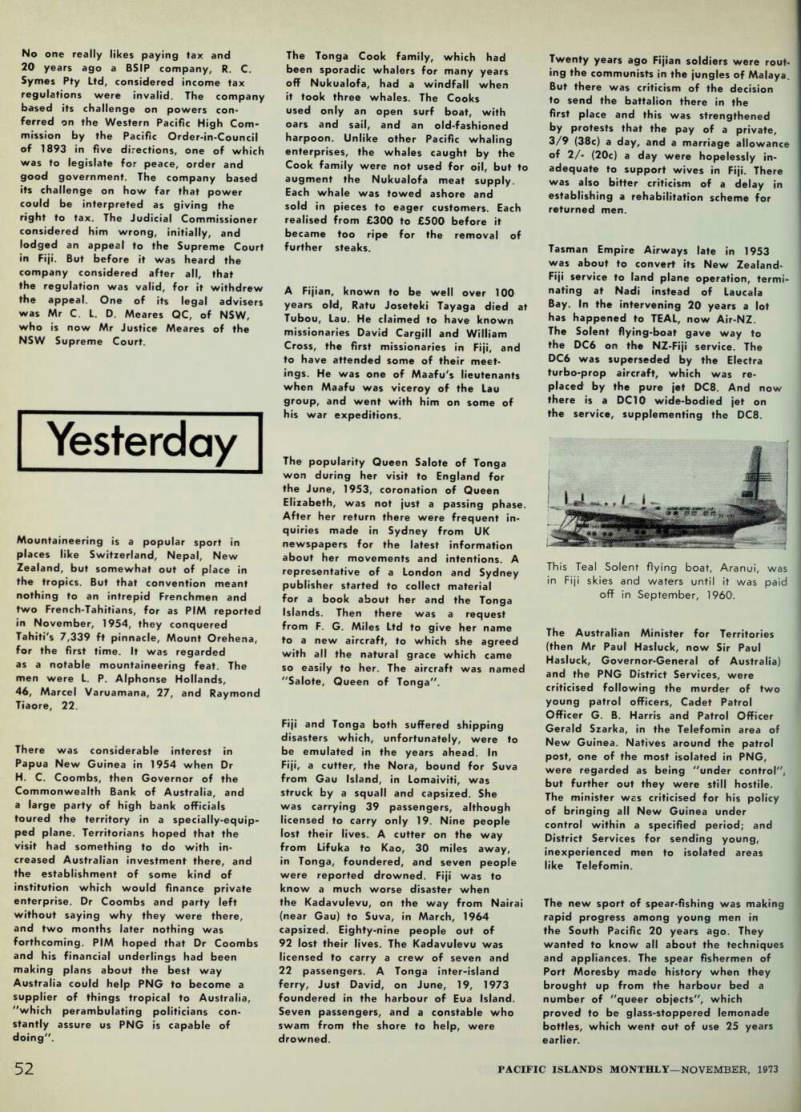
The Solent flying-boat gave way to the DC6 on the NZ-Fiji service. The DC6 was superseded by the Electra turbo-prop aircraft, which was re placed by the pure jet DCS. And now there is a DCIO wide-bodied jet on the service, supplementing the DCS.
The Australian Minister for Territories (then Mr Paul Hasluck, now Sir Paul Hasluck, Governor-General of Australia) and the PNG District Services, were criticised following the murder of two young patrol officers, Cadet Patrol Officer G. B. Harris and Patrol Officer Gerald Szarka, in the Telefomin area of New Guinea. Natives around the patrol post, one of the most isolated in PNG, were regarded as being "under control", but further out they were still hostile.
The minister was criticised for his policy of bringing all New Guinea under control within a specified period; and District Services for sending young, inexperienced men to isolated areas like Telefomin.
The new sport of spear-fishing was making rapid progress among young men in the South Pacific 20 years ago. They wanted to know all about the techniques and appliances. The spear fishermen of Port Moresby made history when they brought up from the harbour bed a number of "queer objects", which proved to be glass-stoppered lemonade bottles, which went out of use 25 years earlier.
This Teal Solent flying boat, Aranui, was in Fiji skies and waters until it was paid off in September, 1960.