painting
p. 59 · Read in the full issue
Prelude to a Pacific painting career
By Mary Edwell-Burke
• |Tello there, you beauty! It’s good to see you again!!” 11 This was my salutation to the “Race to Market” on show at Sydney’s National Gallery after a very long absence from display. I greeted this lovely, lively painting of Tahitians, a canoe, tropical provender and distant rosy mornyig view of Moorea with affection be cause it had played an important part in my life— about a hundred years ago!
When my mother was a little girl there was, on the wall of her country bedroom, a print in colour of that painting. It had been given, as a Christmas supplement, in the Sydney Mail, a periodical published in those days by the Sydney Morning Herald. My mother loved that picture and promised herself that, one day, she would go to Tahiti. She never forgot her promise. One day she came home quite excited and announced, “I have just turned the first spokes in the wheel of our going to Tahiti”. My reaction was a bewildered “Where’s that?”
During my Paris student days I saw an exhibition of paintings of brown-skinned subjects, mainly smiling children, and I exclaimed, “That’s what I want to do, paint people like that.” 1 started to do this in Sydney, finding here and there suitable models and also finding a demand for these paintings. So, going to Tahiti was just meeting my need.
The First World War was on and the big German battleships Scharnhorst and Gneisenau had been to Tahiti. When the people of Papeete saw these grim vessels outside the reef they fired on them with their little guns and tried to block the reef entrance with a ship. It is likely the German warships needed fresh fruit and water, but, seeing it meant a fight, they gave Papeete a broadside or two, sinking a vessel near the wharf and messing up the approach to the wharf for a long time. Then they left.
Before arriving in Tahiti I read about it. Those descriptions stressed the wondrous beauty of its colour, and, doubtless, were written by people from colder climes. But my imagination got busy, so very busy. I pushed aside all mere visions of green trees, blue sky and water. We had plenty of that in Australia.
This Tahiti was going to present something beyond
words. Trees of hitherto unknown grandeur would bend under the weight of exotic blooms wherein birds of hitherto unknown colours and sizes would fill the sky. Phew!!! We are going to see colour, colour, colour.
Little did 1 know that such colour as I imagined would drive us all colour-sick in 10 minutes.
Tahiti was no more colourful than Australia. And, after my first meal ashore at the Hotel Tiare owned by the famous Lovina, I went down the rather mean, gun damaged streets of the waterfront. 1 was one very depressed and disappointed young artist as I sat on the stone wall and looked into the water. 1 saw some coral and the water was clear—but it wasn’t exciting.
Then swarms of tiny fish of a thousand different blues swam into the picture and I cried out for joy.
If there was nothing more of colour in Tahiti those fish were enough to satisfy my colour sense.
My mother was told that Hotel Tiare was not a good place for a young blonde, so an abode over a shop by the waterfront was found and I started to paint. Toto come into my life. He was about six years of age with a longing to earn francs, devour large slices of bread and jam and get leather belts to hold up his long blue pants. His big hat shaded his enormous smile.
I loved to watch him swaggering down the water front after a sitting. One hand handled his fee in his pocket; the other hand held his big slice of bread and jam and the pants were held securely over his bare tummy by one of my leather belts. A day or so later a plaintive bleating of “Mary, Mary” could be heard from a deflated little figure sitting on the bridge in front of the house. Whites of big, brown eyes showed in the gloom under the hat —both hands were needed, in the interests of modesty, to support the pants. Toto was ready for another session of posing, eating, earning and another belt. I hailed him “Haere Mai”. An artist’s career in the Pacific was unfolding.
Later, I held the first art exhibition in Tahiti—by request of the French Governor Monsieur Julien in the home of the British Consul, Dr Williams.
Often, I long to return to Tahiti but I’ve never been back.
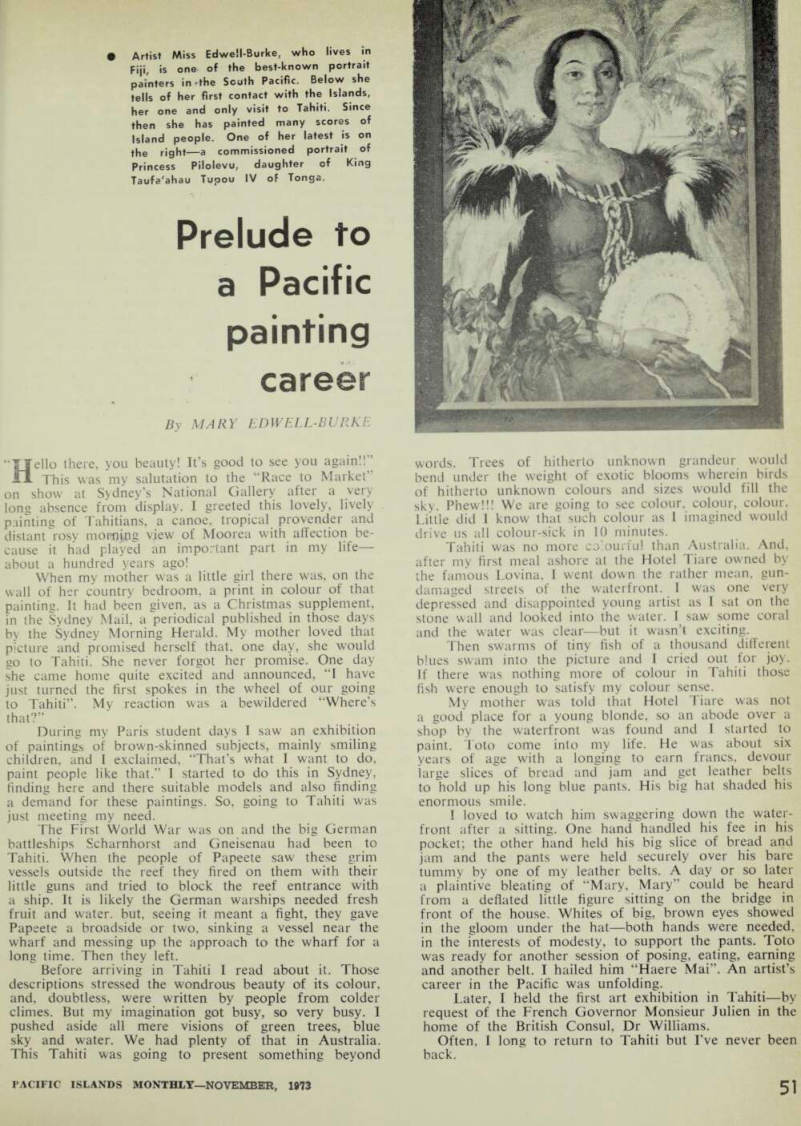
Artist Miss Edwell-Burke, who lives in Fiji, is one of the best-known portrait painters in-the South Pacific. Below she tells of her first contact with the Islands, her one and only visit to Tahiti. Since then she has painted many scores of Island people. One of her latest is on the right—a commissioned portrait of Princess Pilolevu, daughter of King
Taufa'ahau Tupou IV of Tonga.