Magazine Section
pp. 55-57 · Read in the full issue
That Day In 1937 When Vulcan
Island Blew Its Top
Sixteen days after the coronation in Westminster Abbey of King George VI, Rabaul, capital of the Mandated Territory of New Guinea, modernised, with a racecourse, turf club, new swimming pool and other appurtenances which bid fair to make it the most up-and-coming city in New Guinea, was basking in the sun when there was a tremendous explosion from isolated Vulcan Island, three miles from the city centre. Vulcan Island was no longer an island, and what followed is described in a letter written in gutted Rabaul and now recorded in microfilm in the Pacific Manuscripts Bureau in Canberra.
By Robert Langdon
“On Friday the 28th when I was typing in the office we had the most severe earthquake at 20 minutes past one, followed by strong tremors for about half an hour. Nothing hap pened then in Rabaul, only Furter’s' house in Karavia collapsed.
“Everything was quiet until
Saturday morning, 5 o’clock. From then we had severe quakes every 2 minutes with underground noises like rolling thunder. We all worked but I closed works and office at 11 o’clock, we were all to nervous.
“After lunch I worked in my private office preparing the monthly account for June when, at 3 o’clock, I saw natives running, I went to the end of the verandah and saw huge columns of dense smoke rising in the air.
“I got the car ready and left with Kirchner with the intention to go to
the North Coast if necessary. We saw a lot of people on the old Lloyd wharf and went there too.
“It was a terrifying sight, a crater had been formed on Vulcan Island and smoke rose to a great height, thunder and lightning in the air.
The water in the harbour started running backwards and forwards with hissing noises.
“We were all mesmerised, but soon realising our danger, everybody fled in their cars.
“I saw that it would be impossible to reach the North Coast as the smoke came towards the old tunnel.
So I turned back and we went to Namanula, . . .
“Without any warning great black columns of dense smoke came on top of us like a whirling mass. I then thought that our end had come: we all passed through a ghastly time. It
only lasted about half an hour of pitch black darkness. My eyes were full of ashes, we crawled up to Namanula Hospital where I stayed all night, no sleep, the thunder and lightning were frightful. . .
The foregoing paragraphs from a letter written in Rabaul on June 8, 1937, give a vivid idea of the drama that occurred in that tropical outpost during the volcanic eruptions of that year which caused the loss of many lives and the complete evacuation of the town.
The letter was written by J.
Hoogerwerff, the manager of the Rabaul Printing Works, to his em ployer J. B. O. Mouton, who then lived in Sydney. It is one of a long series of letters from Hoogerwerff to Mouton covering the period, March 29, 1936-February 11, 1942. which has come down the years.
The last letter was written a few days after Hoogerwerff was captured by the Japanese. He lost his life a few months later when the Japanese ship Montevideo Maru was sunk by an Allied torpedo while conveying the civilian population of Rabaul to Japan.
The Hoogerwerff-Mouton cor respondence forms part of an ex tensive collection of documents that
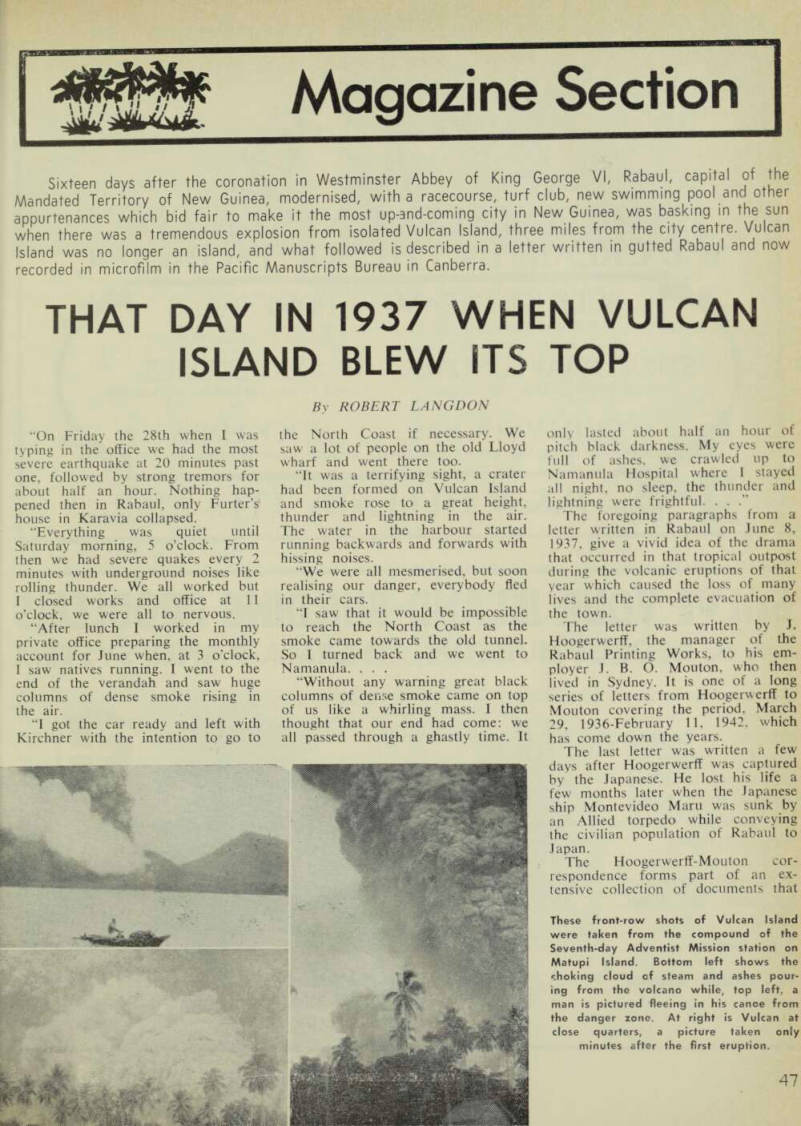
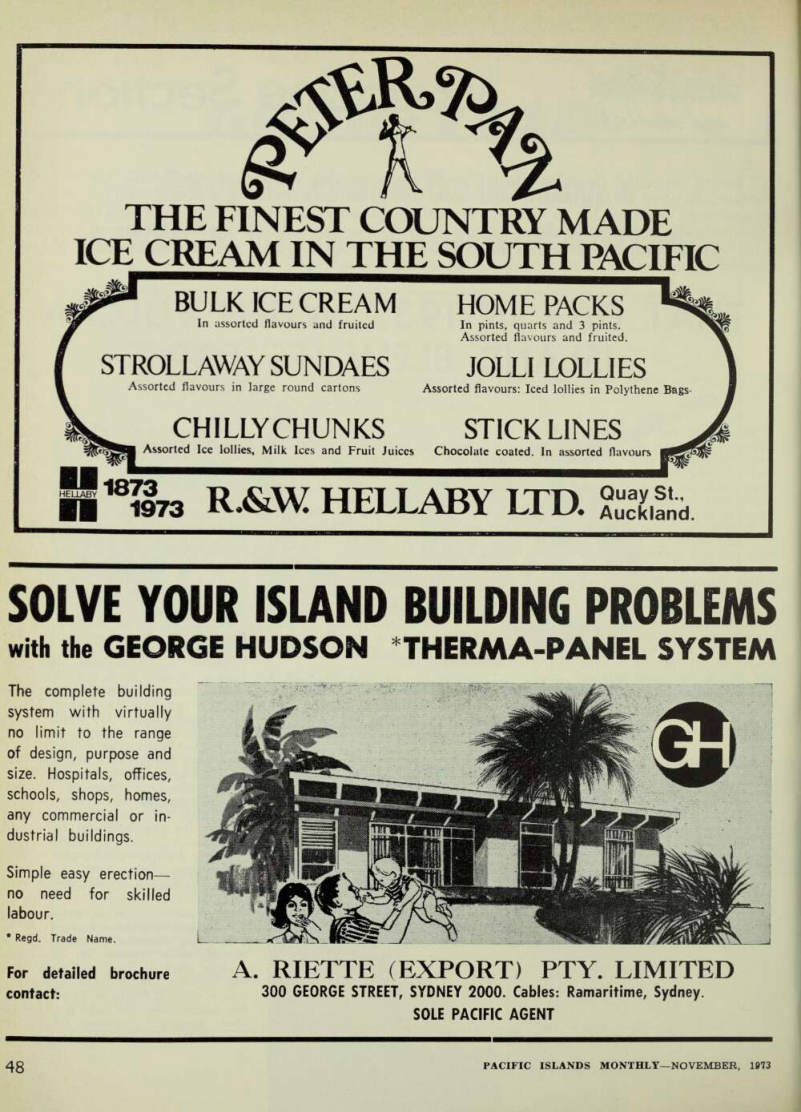
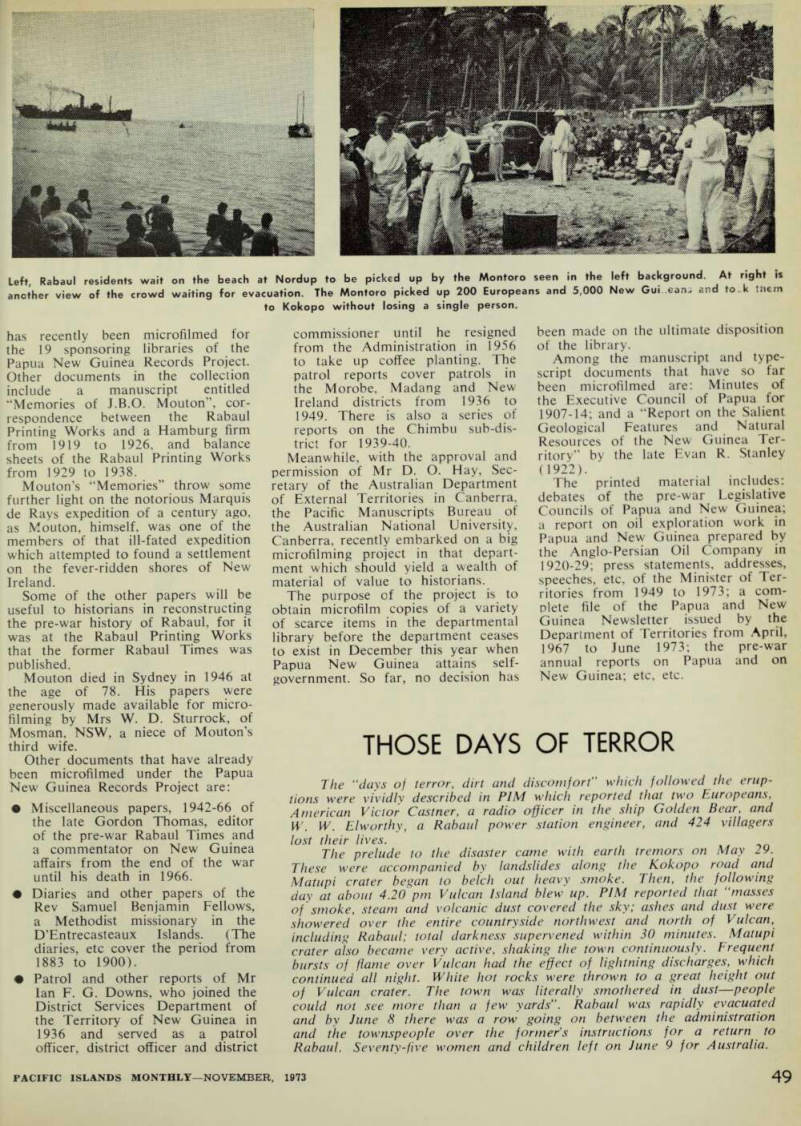
These front-row shots of Vulcan Island were taken from the compound of the Seventh-day Adventist Mission station on Matupi Island. Bottom left shows the choking cloud of steam and ashes pour ing from the volcano while, top left, a man is pictured fleeing in his canoe from the danger zone. At right is Vulcan at close quarters, a picture taken only minutes after the first eruption.
has recently been microfilmed for the 19 sponsoring libraries of the Papua New Guinea Records Project.
Other documents in the collection include a manuscript entitled “Memories of J. 8.0. Mouton”, cor respondence between the Rabaul Printing Works and a Hamburg firm from 1919 to 1926, and balance sheets of the Rabaul Printing Works from 1929 to 1938.
Mouton’s “Memories” throw some further light on the notorious Marquis de Rays expedition of a century ago, as Mouton, himself, was one of the members of that ill-fated expedition which attempted to found a settlement on the fever-ridden shores of New Ireland.
Some of the other papers will be useful to historians in reconstructing the pre-war history of Rabaul, for it was at the Rabaul Printing Works that the former Rabaul Times was published.
Mouton died in Sydney in 1946 at the age of 78. His papers were generously made available for micro filming by Mrs W. D. Sturrock, of Mosman, NSW, a niece of Mouton’s third wife.
Other documents that have already been microfilmed under the Papua New Guinea Records Project are: • Miscellaneous papers, 1942-66 of the late Gordon Thomas, editor of the pre-war Rabaul Times and a commentator on New Guinea affairs from the end of the war until his death in 1966. • Diaries and other papers of the Rev Samuel Benjamin Fellows, a Methodist missionary in the D’Entrecasteaux Islands. (The diaries, etc cover the period from 1883 to 1900). • Patrol and other reports of Mr lan F. G. Downs, who joined the District Services Department of the Territory of New Guinea in 1936 and served as a patrol officer, district officer and district
commissioner until he resigned from the Administration in 1956 to take up coffee planting. The patrol reports cover patrols in the Morobe, Madang and New Ireland districts from 1936 to 1949. There is also a series of reports on the Chimbu sub-dis trict for 1939-40.
Meanwhile, with the approval and permission of Mr D. O. Hay, Sec retary of the Australian Department of External Territories in Canberra, the Pacific Manuscripts Bureau of the Australian National University, Canberra, recently embarked on a big microfilming project in that depart ment which should yield a wealth of material of value to historians.
The purpose of the project is to obtain microfilm copies of a variety of scarce items in the departmental library before the department ceases to exist in December this year when Papua New Guinea attains self government. So far, no decision has
been made on the ultimate disposition of the library.
Among the manuscript and type script documents that have so far been microfilmed are: Minutes of the Executive Council of Papua for 1907-14; and a “Report on the Salient Geological Features and Natural Resources of the New Guinea Ter ritory” by the late Evan R. Stanley (1922).
The printed material includes: debates of the pre-war Legislative Councils of Papua and New Guinea; a report on oil exploration work in Papua and New Guinea prepared by the Anglo-Persian Oil Company in 1920-29; press statements, addresses, speeches, etc, of the Minister of Ter ritories from 1949 to 1973; a com plete file of the Papua and New Guinea Newsletter issued by the Department of Territories from April, 1967 to June 1973; the pre-war annual reports on Papua and on New Guinea; etc, etc.
Left, Rabaul residents wait on the beach at Nordup to be picked up by the Montoro seen in the left background. At right is another view of the crowd waiting for evacuation. The Montoro picked up 200 Europeans and 5,000 New Gui can; and to[?]k tnem to Kokopo without losing a single person.