The Moilbag
pp. 45-50 · Read in the full issue

Murder On Niue
The reference in your September issue to the murder of the Resident Commissioner on Niue Island in 1953 evokes many memories, as I had left the island only three days beforehand, after an inspection visit of a month’s duration, during which I was the guest of the Larsens at the Residency.
After the tragedy I was sent back to Niue to act as Resident Commis sioner, accompanied by a judge and two legal counsel, and can confirm what you say about the speed with which the culprits were brought to trial and sentenced.
Further action had to await the result of an appeal to the Appeal Court in New Zealand, and when this was dismissed the writer found him self in the unpleasant position of having to organise a triple execution on the island.
Orders were orders, and my pro tests were over-ruled, so a scaffold was erected, and a large grave dug in readiness for the grim business.
At the last minute an appeal to the Privy Council in London was lodged by an Auckland legal firm, and this effectively held things up for some months, resulting in the govern ment finally deciding to commute the sentences to life imprisonment.
I have been a reader of PIM since your first issue, as my interest in Island affairs goes back to 1927, when I joined the staff of Sir George Richardson, Administrator of Western Samoa. I retired in 1955 as Assistant Secretary of Island Territories.
C. E. Quin
Paraparaurau, NZ
Tongans In The
'Big Smoke'
I was moved by Mr Slender’s article on Tongans in Sydney (PIM, Aug, p 31) and hereby express my hopes that authorities in Tonga as well as in Australia consider some of his suggested solutions.
The situations which Mr Slender dealt with in his article are very simi lar to those which occur in other cities (in more or lesser extent) such as Auckland, Honolulu, Los Angeles, San Francisco —wherever there is a sizable Tongan population. Further more, the situations are not peculiar
to Tongans; other Pacific Islanders experience similar problems and cause similar troubles. In all cases, however, it stresses the urgent need for education —realistic education — such as one which deals with the harsh realities of city life and the cultural stresses and strains that many Islanders have to face in another country. . „ „ It is sad that the “dollar and “higher education” have drawn so many Islanders away from the rela tive security of their families and friends into an impersonal, money oriented and fast world with which they are neither familiar nor pre pared for. It is about time more Island educators took a closer look at what is being taught in their schools, and make conscious efforts to de emphasise the memorisation of his torical and geographical facts about countries such as Australia, New Zealand, USA, Great Britain, etc, and instead, stress the understanding of differing ways of life in these places; how they may differ from their own island environments.
“Understanding” rather than “rote learning” may help bring about better performances from Tongans overseas, especially students; it may also be one way of minimising the occurrences of troubling and embarrassing events such as those reported in PIM.
Konai Helu Thaman
University of California, Santa Barbara
Arts Festival Filmed
Naturally I am pleased that your correspondent, Claire Slatter (PIM, Sept Mana, p 65) found the First South Pacific Festival of Arts “so magnificent” and that she had “little doubts over the motives of the organisers”. I agree with her when she states: “to have captured this magnificence would be beyond the power of any film”.
However, in the interests of clarifi cation I feel that two observations must be made. In the making of any film there can be a script for the actor to follow and a “shooting” script fol lowing the plans and ideas of the director. In a purely documentary film there is usually a narration script made after the scenes have been filmed and edited. It was such a nar
ration script that I wrote. It was a pre-festival obligation of my position that I did so.
It should have been obvious to all that the Fiji Government was most generous in fulfilling its obligations as the host and producing country.
To have added the high cost of making a film on to this was out of the question. It would not have helped to have given the right to commercial Hollywood and TV in terest. That Pacific Hotels and De velopment and the producing com pany went into the venture knowing full well that they were not making a commercially-viable film is very much to their credit. They donated their time, equipment and cost of film, processing, recording and print ing and by doing so made sure that there would be at least some record of the festival for the peoples of the Pacific to see. They went beyond this and gave to each of the participating countries free copies of the film as a
Victor Carell
Sydney
Solomons History
I was somewhat surprised (and I confess, amused), at John Saunana’s letter (PIM, Aug, p 21) accusing me of going on “to such great length and anxiety” about “ natives being allowed no hand in the documentation” of their own history. How he came to such a conclusion is beyond my imagination. I have never thought any such thing, and would hardly credit Mr Burne, also accused of the same matter, with being likely to think anything so silly and ridiculous. 1 would wish to remind Mr Sau nana, that the important element in history is truthfulness. A philosopher has said that “Truth lies at the bottom of a well.” The same object at the bottom of a well will look completely different to any number of observers, depending on their angle, depth of water, time of day, etc.
No reportage is infallible. There fore everything that can be written needs to be written and studied. In
(letters continued on p 41)
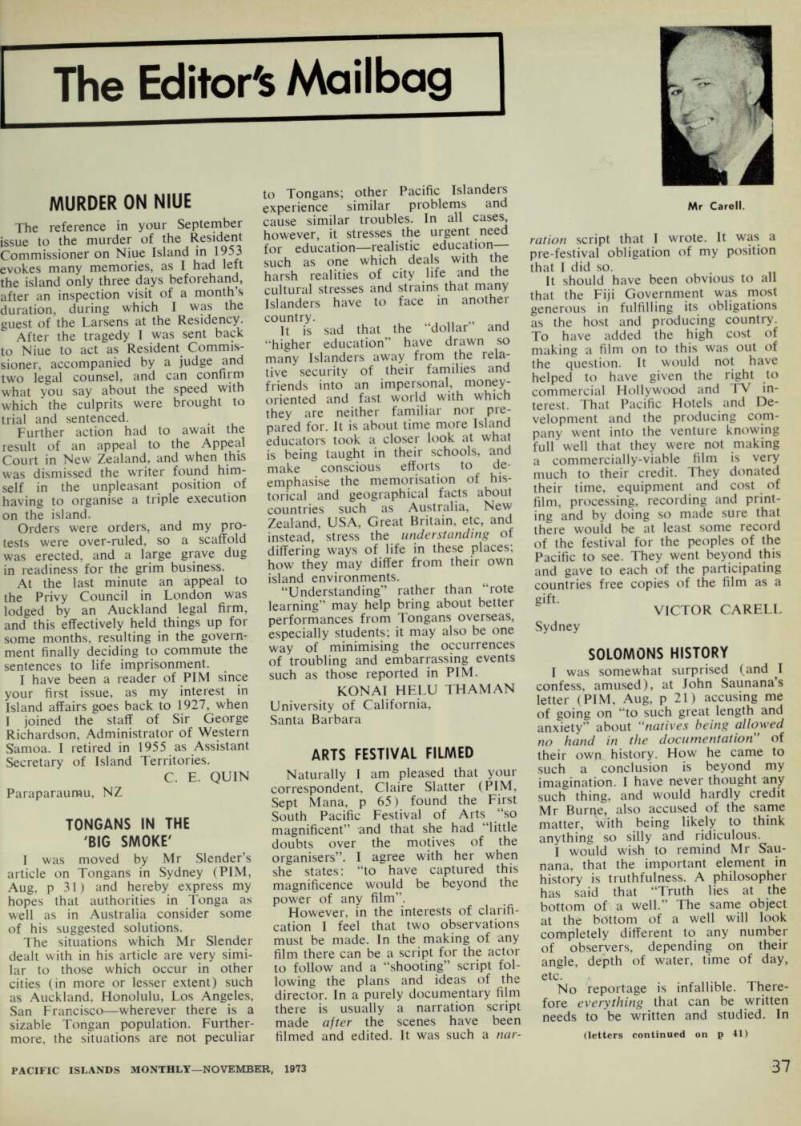
Mr Carell.
this way a student of a particular time or part of social history can draw conclusions from as many sources as are available.
The PIM has made available ample space for writings by the indigenous population on history, native beliefs and typically Melanesian phenomena.
So let the indigenous historians get to work on the space that is available to them.
Accounts of my own ancestors in Britain are to be found in the works of the Roman Historian Tacitus (AD 78) and the monk Gildas (circ 450 AD). They themselves (my ances tors), clad in wolfskins and woad, had no form of writing.
K. W. Seton
New Farm, Queensland.
Air Melanesiae
Air Melanesiae, owned jointly by New Hebrides Airways and UTA-Air France, is the only airline operating air services between the islands of the New Hebrides. It is providing a wonderful service for the people with in the region as PIM (Aug, p 97) pointed out. Transport between islands is much faster and more direct for many people. People are now able to take a bird’s-eye view of their own village and places of settle ment. Many New Hebrideans boast that they have been up in the air. The airline agents are given all the credit for the services and opportunities they initiated in this somewhat less sophisticated group of islands (from the point of view of western civilisa tion), or as tourist agents call it, the “Last paradise in the Pacific”.
But who really benefits from the airline and the services it provides?
Perhaps the other side of the coin would give us a fairer picture of the situation than what we learn in PIM.
“The airline feels that the New Heb rides is the best air-served archi pelago in the Pacific.”—“Many of the ground support staff are New Hebrideans.”—“The airline is a good example of Anglo-French co operation.”
Wow! New Hebrides must be quite fortunate to have this airline!
Personal experience denies full jus tification of these sweet statements.
The New Hebridean members of the ground staff referred to are a few indigenous people who help to load or unload the aircraft and operate the airline buses in Vila and Santo coupled with one or two who manage two airstrips—all of whom make up
about 20 or less per cent of the ground staff. The office staff and pilots are all expatriates—Europeans together with the British and French subjects from other territories.
The fares charged by the airline are beyond anything within the writer’s experience. For example, it charges $l9 (one way) for a distance of 60 miles (Vila-Norsup); $23 for 80 miles (Vila-Longana, Aoba). Of course this is nothing for an expatriate who receives wages of $3OO- $6OO a month; but it is something to an indigenous person of no regular income to an income of about $9O a mont h Apart from the emergency cases for which the services of the airline
are very essential, who really benefits from Air Melanesiae? are ' the New Hebridean people spoken of in PIM? “The Anglo-French co operation” m the airline is often maintained at the expense of the non whites. An incident is recalled when a European lady insulted an islander member of the ground staff by spit ting at him. The latter in retaliation sent her outside by physical force. He was fined for ‘causing an insult and the lady was counted innocent.
Readers can judge for themselves which party is guilty of the insult. As far as the two heads are concerned a good diplomatic relationship be tween them is more important than fairness between individuals. Two
other incidents have been known of by the author, and many more have been reported where New Hebridean passengers have been put off the air craft so that some Europeans or government officials may get in.
Has the unfair dealing exercised by the airline arisen because there is no other airline operating in the region to compete with Air Melanesiae and so keep watch over it? It is self deception on the part of Air Melan esiae and being false to the public to make statements as those in the August PIM, while behind the screen the airline is making unjust gains at the expense of the other sector of the community.
Sethy John
Suva, Fiji
Reaction To Fiji
I am writing in reply to the letter from Mr Colyer (PIM, Aug, p 25).
I don’t know what Mr Batten said in his letter in July, but I agree with Mr Colyer’s comment that Fiji is a truly wonderful place.
However, 1 want to correct in correct information contained in Mr Colyer’s comments concerning prices at the Nadi Airport duty-free store in respect of electronic calculators.
The reason why prices for calcula tors at the airport—and in fact right throughout Fiji are higher than Singa pore, is very simple. Electronic calcu lators are not duty-free in Fiji; they are in Singapore.
In case other readers of your ex cellent magazine gain the same in correct impression as I did initially— that the airport store is trying to make a huge profit—l hope you will pub lish my letter.
J. N. Walmsley
Sydney
Gilbertese Spelling
Spoken words with their correct pronunciation are very important, therefore the written word should as nearly as possible reflect the correct sound of the spoken word. The Gilbertese language and vocabulary keep the distinctive form of expres sion which is understandable and clear to the Gilbertese themselves.
Nei Wiwinna (Vivienna), (Letters, PIM Aug, p 23), says that she is right with her spelling bangota because she was told (e wiwinnaki?) that this is correct. However, she fails to explain why it should be correct. Perhaps the following examples will help Nei Wiwinna to understand how long
sounds are written in Gilbertese with a double letter. For instance: Mangko with one o means a con tainer —a cup.
Mangkoo with double or long o. is mango-mango tree, mango fruit.
Te kai with a single or short a, means tree; stick; a curse.
Te kaai with a double or long a, is a heron.
Mane with a single or quick m, is money.
M’ane with an apostrophe, which represents the other m (mmane) and indicates the correct pronunciation of the double or long m, is man.
These illustrations show why the sound of the long a in Gilbertese word for ancestral shrine is most clearly shown in the spelling of baangota. The original spelling of baangota is correct. Nei Wiwinna's ‘bangota’ is a mistake by those (Euro peans?) who write it down in diction aries. It is important to maintain our original Gilbertese spelling and cor rect pronunciation in our daily con versation at home and in school.
Maunaa Itaia
Pacific Theological College.
Suva.
Rotuma's Home-Brew
As a Rotuman 1 was glad to see Bruce Walkley’s article on Rotuma (PIM, Sept, p 47). However, I am disappointed to find so many factual mistakes in it. Let me mention but one. What he calls the “island’s ‘home brew’ ” we call tehroro and you can no more get drunk on it than you can on Heinz’s vegetable soup! For tehroro is our national dish—as a soup or as part of a variety of dishes.
Rotuma has made the Sydney papers several times (most recently in connection with hurricane Bebe) —on the front pages, too. It is not altogether an unimportant island in the Pacific so if Pitcairn can make it on your regular map, why not Rotuma?
Saumaru Foster.
Moore Park, NSW.
Coastwatchers
Walter Lord, American author of A Night to Remember, Incredible Victory, and other books you may know, is trying to locate people who were Coastwatchers —or who assisted Coastwatchers —in the Solomon Is lands during World War 11. He will be in Australia in October and November and hopes to talk with Coastwatchers living in this part of the world. Can any of your readers help him find them, through me?
Myrick E. Land,
Lecturer in Journalism.
University of Queensland.
St Lucia, Qld. 4067.