On Png's Legislative Menu
pp. 29-31 · Read in the full issue
The Common Man Comes Last
From Percy Chatterton
in Port Moresby
The second half of the Budget leeting of Papua New Guinea’s louse of Assembly provided few reworks. Budget debates, unless an ttempt is being made to unseat the overnment, are a somewhat tedious nd profitless exercise, though I sup ose that they are useful as a sound ig board for public opinion.
The main criticism levelled at this ear’s Budget by the Opposition, and Iso by government front-bencher father John Momis, was that it loesn’t in fact do much towards pro noting the egalitarian society blue tinted in the government’s eight loint development plan.
The same criticism might well be evelled at the legislative menu which nembers were asked to work their vay through. Most of the bills which vere carried to completion were con :erned with power and prestige rather han with the common man. Some vere introduced in order to formalise jefore December 1 the transfer of lowers which in fact the Somare government is already exercising.
No doubt Mr Somare’s ministers feel that it is very important that they should be able to exercise these powers in their own right rather than by delegation, but the average citizen, and particularly the average villager, will not notice much difference be tween November 30 and December 1, and is probably not very interested in how and from where those who exercise authority over him derive the power to do so.
Other measures which passed through all stages were those de signed to promote national prestige by creating a national airline and a national banking system. Here again the impact on the common people will be negligible. Few Paguineans can afford to travel by air; and pro vided there is a reliable savings bank in which they can tuck away their meagre savings few care who operates it.
On the other hand, two bills which will vitally affect the daily lives of almost all Paguineans, the Village Courts Bill and a bill to implement the recommendations made nearly two years ago by the Commission of Inquiry into Alcoholic Drink, were introduced and commended to an attenuated House on the afternoon of the last day of the meeting, and then adjourned to the next meeting. Such adjournment, to give thorough time for their consideration and to gauge public reaction to them, would of course have been necessary anyway.
But, if these very important bills had been introduced earlier in the four week-long meeting, at least a larger number of members would have heard the movers’ second reading speeches, and would have gone back to their electorates knowing what the bills were about and therefore able to consider them and discuss them with their constituents before coming back to Port Moresby in November to debate on them.
The Air Niugini Bill touched off more controversy over the name chosen by Cabinet for the country’s new airline. The choice had already received some criticism from the public (what choice wouldn’t?), and it was clear that some MHAs re sented the fact that Cabinet had not referred its choice to the House for consideration.
One member wanted it to be called
Air Kumul (Kumul being the Pidgin name for the Bird of Paradise). But perhaps, with the presage of in dustrial storms ahead of our infant airline, it would be more appropriate to call it Air Muruk, symbolising the difficulty it is likely to have in get ting off the ground. (Muruk is the Pidgin name for the flightless casso wary.) The Westminster system has been taking another bashing from some of our parliamentarians, who have been calling for a one-party system.
But it seems clear that some of these calls come from politicians who don’t really know what a one-party system is, and who, in fact, are advocating a no-party system such as we had in the first House.
The argument that a country as drastically short of able politicians as Papua New Guinea is cannot afford to have some of its ablest men sitting in comparative idleness
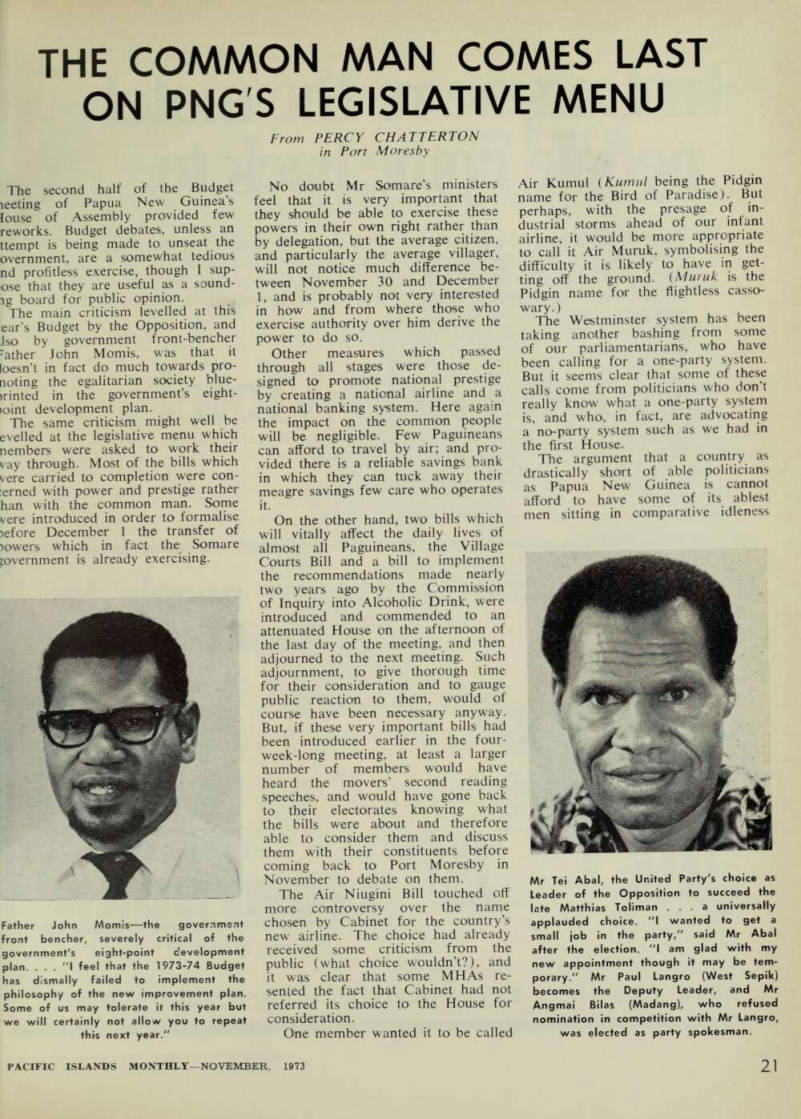
Father John Momis —the government front bencher, severely critical of the government's eight-point development plan. ... "I feel that the 1973-74 Budget has dismally failed to implement the philosophy of the new improvement plan.
Some of us may tolerate it this year but we will certainly not allow you to repeat this next year."
Mr Tei Abal, the United Party's choice as Leader of the Opposition to succeed the late Matthias Tollman ... a universally applauded choice. "I wanted to get a small job in the party," said Mr Abal after the election. "I am glad with my new appointment though it may be tem porary." Mr Paul Langro (West Sepik) becomes the Deputy Leader, and Mr Angmai Bilas (Madang), who refused nomination in competition with Mr Langro, was elected as party spokesman.
One Way To Unity
on the Opposition benches is a sound one. But the belief that, if we abolish parties, disunity in the House will fade away and everyone will think alike seems to me to be unfounded.
It is differences of opinion on how the country should be run which give rise to parties, not parties which give rise to differences of opinion.
If there were no parties at all in the present House, its members would still disagree with one another as violently as they do now, and as we did between 1964 and 1968 in the party-less first House. There is only one way in which perfect parliamentary “unity” can be achieved, and it is this: call new elections, outlaw all parties except one, and debar any candidates, who don’t belong to that party, from standing for election. You will then get a perfectly united parliament.
This is an increasingly common blue print for national unity in the third world. Is this what the opponents of the Westminster system want?
The Constitutional Planning Com mittee has tabled an interim report.
This report contains no recommenda tions, but attempts to summarise the general trends of public opinion as they have emerged during the com mittee’s grand tour.
Roughly, these are a widespread demand for a system of strong dis trict government with powers greater than those of the present area authorities, and calls for the abolition of regional electorates and the adop tion of first-past-the-post voting instead of the present optional pre ference system.
The committee’s final report and recommendations are scheduled for November.
The United Party’s choice of Tei Abal as Leader of the Opposition in succession to the late Matthias Toliman has been universally ap plauded. Tei Abal was elected to the first House in 1964 as member for Wabag in the Western Highlands.
One of a number of members who entered the House at that time with no formal schooling behind them, he quickly emerged as a man deter mined to overcome this handicap, and by sheer hard work and dedica tion to the job made himself an able parliamentarian, capable of holding his own against more highly-educated opponents.
Though as a fellow member of the first and second House I rarely found myself in agreement with him, I liked him enormously and respected his complete sincerity. He is a worthy successor to Matthias Toliman.