Tropicalities
pp. 22-24 · Read in the full issue
Holster for
patriots
New Caledonia’s main festival day, celebrating the French taking of possession in 1853, received a new slant this year when the date was allied with Caledonian patriotism in the two world wars.
The island festival day of Septem ber 24 is traditionally celebrated with sporting events such as the end of the feverish 11-day Tour de Cale donie bicycle trial around the island, petanque bowls and Melanesian women’s cricket championship. In addition, as on most patriotic occas ions, there is the march past of troops along the Anse Vata beach promenade—gendarmes joining with infantry, paratroopers and navy de tachments.
This year is the 120th anniversary of the French taking of possession and for the first time it was an nounced that this festival day would also commemorate the September, 1940, rallying of Caledonians to fight for France. This way, the double anniversary honours pioneers, mis sionaries and soldiers.
The new interpretation of the island festival day was described by the Nickel Co press as “We shall unite all those who made New Cale donia a French land, better still, a French province”.
I'XG coins
going local
When New Guinea gets its own currency “not before December, 1974”, it will have little resemblance to Australian notes and coins. The Finance Minister, Mr Julius Chan, has agreed that the notes and coins should be distinctive and clearly PNG
in character. Papua New Guineans will be able to submit designs for the new money.
Australia’s revalued, but rapidly inflating dollar note will be replaced by a coin. Altogether there will be six coin and three note denomin ations. The notes will be of $2, $5 and $lO, and the coins of 1,2, 5, 10 and 50 cents, plus the $1 coin.
Initially, there will be no 50c coin, or an equivalent of the $2O note. Mr Chan made no mention of anything equivalent to Australia’s new $5O note.
The PNG coins will be similar to Australian coins in one respect—they will have the same diameter, to re duce the possibility of confusion while two currencies are circulating to gether. The $1 coin will be slightly larger than the Australia 50c.
And some financial experts, look ing a long way ahead, are tipping that PNG will devalue its currency against Australia to help recover some of the losses, not disastrous by any means, suffered by primary producers through Australian revalu ations.
On Bikini
kv Christmas
The “victims” of the United States nuclear tests off Bikini Atoll in the late 40’s and early 50’s may be back on their island by Christmas. Forty Bikini families, living on Kili Island in the Marshalls, were scheduled to go to Bikini late in October to inspect houses under construction for them.
They were taken to Kili Island to make way for the testing programme.
Two houses are finished, 38 are nearly finished. The people them selves will decide if they are accept able. If they like them the Trust Territory Government will go ahead and finish them and fix a definite date for the people to return to Bikini to live. The date will be before Christmas.
The Bikini rehabilitation pro gramme started several years ago.
The Bikini people, like the Pitcairn Islanders after two evacuations in the 19th century, always wanted to return to their own island. Their dreams seem near fulfilment.
Fiji festival
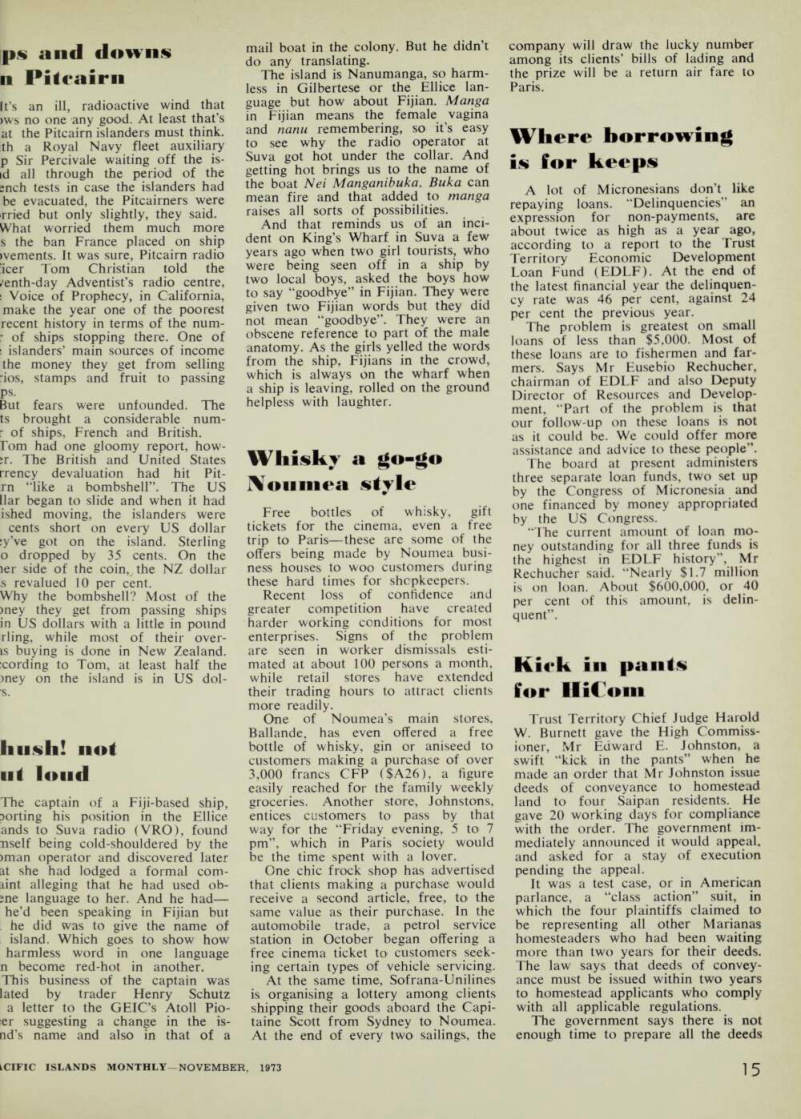
Of the making of stamps, like books, there is no end. October saw the appear ance of several series of stamps in the Islands, one of the most picturesque sets to be issued being those reproduced above—four Fiji "Festivals of Joy" stamps commemorating the festivals of the main races, the Christian Christmas, Hindu Diwali festival, the Muslim Id-ul-Fitar festival and the Chinese New Year.
Western Samoa issued four new Christ mas stamps on October 15. A commemo rative issue for the 75th anniversary of stamps in Papua New Guinea appeared on October 24 —all reproductions of earlier stamps issued by the German and British administrations. Another October issue was three Christmas stamps from the Solomons. The Cook Islands scored a first with the issue in September of a set of seven stamps, claimed to be the first to commemorate the original explora tion and peopling of the Pacific Islands.
The stamps all feature canoes.
p§ and downs
n Pitcairn
It’s an ill, radioactive wind that >ws no one any good. At least that’s at the Pitcairn islanders must think, th a Royal Navy fleet auxiliary p Sir Percivale waiting off the is id all through the period of the ;nch tests in case the islanders had be evacuated, the Pitcairners were rried but only slightly, they said.
What worried them much more s the ban France placed on ship wements. It was sure, Pitcairn radio ; icer Tom Christian told the /enth-day Adventist’s radio centre, ! Voice of Prophecy, in California, make the year one of the poorest recent history in terms of the num * of ships stopping there. One of : islanders’ main sources of income the money they get from selling :ios, stamps and fruit to passing ps.
But fears were unfounded. The ts brought a considerable num r of ships, French and British.
Lorn had one gloomy report, how ir. The British and United States rrency devaluation had hit Pit rn “like a bombshell”. The US liar began to slide and when it had ished moving, the islanders were cents short on every US dollar ;y’ve got on the island. Sterling o dropped by 35 cents. On the ler side of the coin, the NZ dollar s revalued 10 per cent.
Why the bombshell? Most of the )ney they get from passing ships in US dollars with a little in pound rling, while most of their over is buying is done in New Zealand, cording to Tom, at least half the )ney on the island is in US dol s.
linslil not
ut loud
The captain of a Fiji-based ship, porting his position in the Ellice ands to Suva radio (VRO), found nself being cold-shouldered by the rnian operator and discovered later at she had lodged a formal com aint alleging that he had used ob jne language to her. And he had— he’d been speaking in Fijian but he did was to give the name of island. Which goes to show how harmless word in one language n become red-hot in another.
This business of the captain was lated by trader Henry Schutz a letter to the GEIC’s Atoll Pio er suggesting a change in the is nd’s name and also in that of a
mail boat in the colony. But he didn’t do any translating.
The island is Nanumanga, so harm less in Gilbertese or the Ellice lan guage but how about Fijian. Manga in Fijian means the female vagina and nanu remembering, so it’s easy to see why the radio operator at Suva got hot under the collar. And getting hot brings us to the name of the boat Nei Manganibuka. Buka can mean fire and that added to manga raises all sorts of possibilities.
And that reminds us of an inci dent on King’s Wharf in Suva a few years ago when two girl tourists, who were being seen off in a ship by two local boys, asked the boys how to say “goodbye” in Fijian. They were given two Fijian words but they did not mean “goodbye”. They were an obscene reference to part of the male anatomy. As the girls yelled the words from the ship, Fijians in the crowd, which is always on the wharf when a ship is leaving, rolled on the ground helpless with laughter.
Whisky a go-go
Noumea style
Free bottles of whisky, gift tickets for the cinema, even a free trip to Paris—these are some of the offers being made by Noumea busi ness houses to woo customers during these hard times for shopkeepers.
Recent loss of confidence and greater competition have created harder working conditions for most enterprises. Signs of the problem are seen in worker dismissals esti mated at about 100 persons a month, while retail stores have extended their trading hours to attract clients more readily.
One of Noumea’s main stores, Ballande, has even offered a free bottle of whisky, gin or aniseed to customers making a purchase of over 3,000 francs CFP (SA26), a figure easily reached for the family weekly groceries. Another store, Johnstons, entices customers to pass by that way for the “Friday evening, 5 to 7 pm”, which in Paris society would be the time spent with a lover.
One chic frock shop has advertised that clients making a purchase would receive a second article, free, to the same value as their purchase. In the automobile trade, a petrol service station in October began offering a free cinema ticket to customers seek ing certain types of vehicle servicing.
At the same time, Sofrana-Unilines is organising a lottery among clients shipping their goods aboard the Capi taine Scott from Sydney to Noumea.
At the end of every two sailings, the
company will draw the lucky number among its clients’ bills of lading and the prize will be a return air fare to Paris.
Where borrowing
is (or keeps
A lot of Micronesians don’t like repaying loans. “Delinquencies” an expression for non-payments, are about twice as high as a year ago, according to a report to the Trust Territory Economic Development Loan Fund (EDLF). At the end of the latest financial year the delinquen cy rate was 46 per cent, against 24 per cent the previous year.
The problem is greatest on small loans of less than $5,000. Most of these loans are to fishermen and far mers. Says Mr Eusebio Rechucher, chairman of EDLF and also Deputy Director of Resources and Develop ment, “Part of the problem is that our follow-up on these loans is not as it could be. We could offer more assistance and advice to these people”.
The board at present administers three separate loan funds, two set up by the Congress of Micronesia and one financed by money appropriated by the US Congress.
“The current amount of loan mo ney outstanding for all three funds is the highest in EDLF history”, Mr Rechucher said. “Nearly $1.7 million is on loan. About $600,000, or 40 per cent of this amount, is delin quent”.
Ki«*k in pants
lor HiCom
Trust Territory Chief Judge Harold W. Burnett gave the High Commiss ioner, Mr Edward E. Johnston, a swift “kick in the pants” when he made an order that Mr Johnston issue deeds of conveyance to homestead land to four Saipan residents. He gave 20 working days for compliance with the order. The government im mediately announced it would appeal, and asked for a stay of execution pending the appeal.
It was a test case, or in American parlance, a “class action” suit, in which the four plaintiffs claimed to be representing all other Marianas homesteaders who had been waiting more than two years for their deeds.
The law says that deeds of convey ance must be issued within two years to homestead applicants who comply with all applicable regulations.
The government says there is not enough time to prepare all the deeds
in the 20 days. Lack of surveys caused a delay in issuing deeds in the first place, and without the surveys there would be disputes over boundaries.
The government now plans to hire outside surveyors to speed up the work of surveying homestead land in the Marianas.
If the government wins the appeal the outside surveyors will still be retained, but if it loses and the gov ernment is forced to issue the deeds in a short time, they will be prepared without survey, and any future prob lems would have to be dealt with by the Land Commission or the courts.
Which poses the question: Why were the surveys not done years ago?
Mr Samuel Withers, who repre sented the plaintiffs, opposed the government request for a stay of execution of the order. He said that would simply give the government the same advantage it originally sought through trying to have the case delayed.
'Rush 9 doctors
under x-ray
Traditional medicine still means a lot to the Samoan and other Is landers and often he’ll seek the services of the “bush doctor” rather than resort to the private medical practitioner or the government medical service. Now, in Ameri can Samoa, one-year study has started to try to sort the good from
the bad in “bush medicine” Samoan style.
Finance for the programme has come in the form of a SUS 1,551 grant from the South Pacific Com mission. The assistant to the gover nor of American Samoa, Palauni M.
Tuiasosopo, says that the medical De partment will be calling on the advice of Dr Fred Dunn of the School of Public Health at the University of Hawaii, a world-renowned authority on indigenous medicine.
Said Mr Tuiasosopo of Samoa’s “bush doctors”: “Some are specialists, some generalists and some are down right quacks. It is important that more be learned about the indigenous practice of medicine ... to determine the extent of its use and what re lationships if any can be developed between the two medical care ‘sys tems’.”
A fislir tale
from BSIP
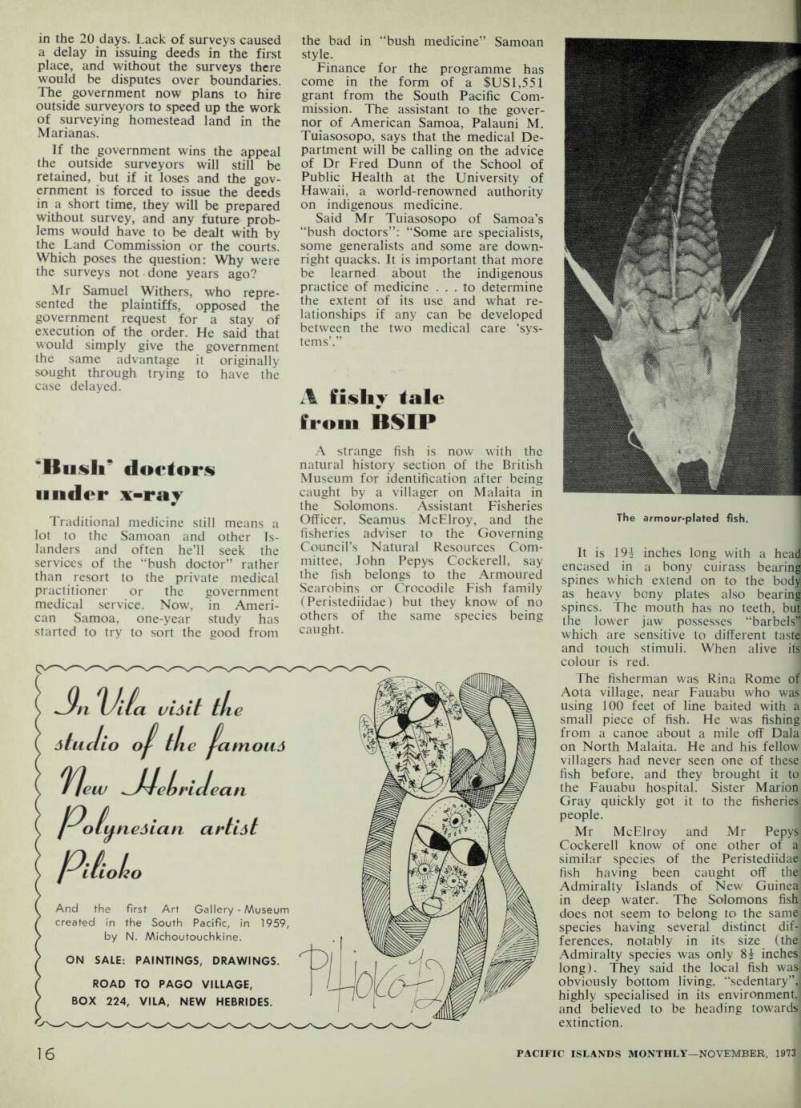
A strange fish is now with the natural history section of the British Museum for identification after being caught by a villager on Malaita in the Solomons. Assistant Fisheries Officer, Seamus McElroy, and the fisheries adviser to the Governing Council’s Natural Resources Com mittee, John Pepys Cockerell, say the fish belongs to the Armoured Searobins or Crocodile Fish family (Peristediidae) but they know of no others of the same species being caught.
It is 19i inches long with a head encased in a bony cuirass bearing spines which extend on to the bods as heavy bony plates also bearing spines. The mouth has no teeth, but the lower jaw possesses “barbels’] which are sensitive to different tastd and touch stimuli. When alive its colour is red.
The fisherman was Rina Rome of Aota village, near Fauabu who was using 100 feet of line baited with a small piece of fish. He was fishing from a canoe about a mile off Dala on North Malaita. He and his fellow villagers had never seen one of these fish before, and they brought it to the Fauabu hospital. Sister Marion Gray quickly got it to the fisheries people.
Mr McElroy and Mr Pepys.
Cockerell know of one other of a similar species of the Peristediidae fish having been caught off the Admiralty Islands of New Guinea] in deep water. The Solomons fish; does not seem to belong to the same] species having several distinct dif ferences, notably in its size (the Admiralty species was only 8i inches long). They said the local fish was! obviously bottom living. “sedentary”,! highly specialised in its environment,! and believed to be heading towardsj extinction.
The armour-plated fish.