Off The Beaten Track At
pp. 23-27 · Read in the full issue
The Bird And The Pap
By Judy Tudor
According to the United Nations, tourist is anyone who spends a ht away from home. And what’s )d enough for the UN, is good nigh for Papua New Guinea when :omes to counting heads. Anyone, er than a resident, who spends a ht in PNG, automatically gets inted and by this method the local urist Board reckons that there were 734 tourists in 1972.
Fhat’s what the Tourist Board says. e local Bureau of Statistics says nething different. According to it, y 19,940 people arrived in PNG 1972 for a holiday; the rest of the , es t fn rm mtad iValS haVing ° ther However, as a casual observer in ; country, you could conclude that th the Tourist Board and the itistician are wide of the mark.
New Guinea doesn’t feel like a irist country, doesn’t act like one, ;mingly doesn’t care a damn about irists and obviously doesn’t need ;m. Unless you look hard for them ;re are few signs that homo irisimo is abroad in the land at , and you are forced to the conision that many of those 19,940 liday makers are visiting relatives d are quick to take on local lourisation.
No swarms of blue-rinsed Pasadena dows or pale skinned Mid-Westem lies in funny shorts and little sox, itooned with Polaroid and movie meras; no great piles of luggage in tel lobbies as parties move in and it—all of which are part of the
scene in other, less boisterous, more touristy parts of the Pacific.
Yet, as everyone in Papua New Guinea is fond of telling you, the country has a great deal going for it.
It is bigger than, different from, more varied than anything else in the Pacific. The scenery is spectacular, from offshore islet to 14,000 ft mountain peak. You can chug up the Sepik River in a house-boat; or go see naked villagers, mud covered vil lagers or villagers with 18-inch long gourds on their penises. (Although you will have to travel far and look hard for all three categories, as most people now disappointingly wear pants). In a sentence, Papua New Guinea is great for those tourists who want to see something different; for people who really want to get off that beaten track they talk about.
For the other 99i per cent of tourists, who want things to be dif ferent but, at the same time, just like back home. Papua New Guinea is something else again. Stroll along the beach in the moonlight? Not on your life, say the locals. You could be bashed, robbed or raped.
Hire a car? Certainly, if you are well-heeled, but if someone walks in front of you and gets knocked, go for your life. Report to the nearest police station, but don’t stop. If you do, the car could be overturned and you could get beaten to death by the mob that will materialise apparently from nowhere.
Dress and undress behind locked doors and drawn blinds otherwise
you’ll encourage P**JW to j5 s - ** female, don t be su P make obscene gestures i street, proposition you with rude four letter words or hack at * he r thl^ k mesh on your window to try to get a y °u during th.e iig . yoi J g 9 ,1 t g r ;^? d^ ar y nr could get mixed up in a tn a drunken orgy " ot 8 European man and his wife were stoned, beaten, f st ’ d picturesque bit of all,^ g was stolen, killed versus New involved in a r £ ap “f l in iffiv “Sle town seems to have spent two day s sheltering loC ft£ doors. (Astral an Externa! Terntones says it was exaggerated and factions) antag °9 lsm b iYnkp n th it ?«,nossibleto in Thtcountnf and have spend weeks in the , none of these e^^X ng tb ngs b b^ pen to you ’ a [ th( ?^ gh t - d antly clear that they so, Ao happen to o woman public s er
iocalnewspaperthus
nTehtlv
subjected to attacks almos. n igh tly as we leave our cars to return to our rooms we all *tand toe mJt oi serious ! n^ ry - Eacb to are advised yet nothing protect us. whh neonle a^er , dark ’ sb ®, sa ,’ P P scared to leave their homes.
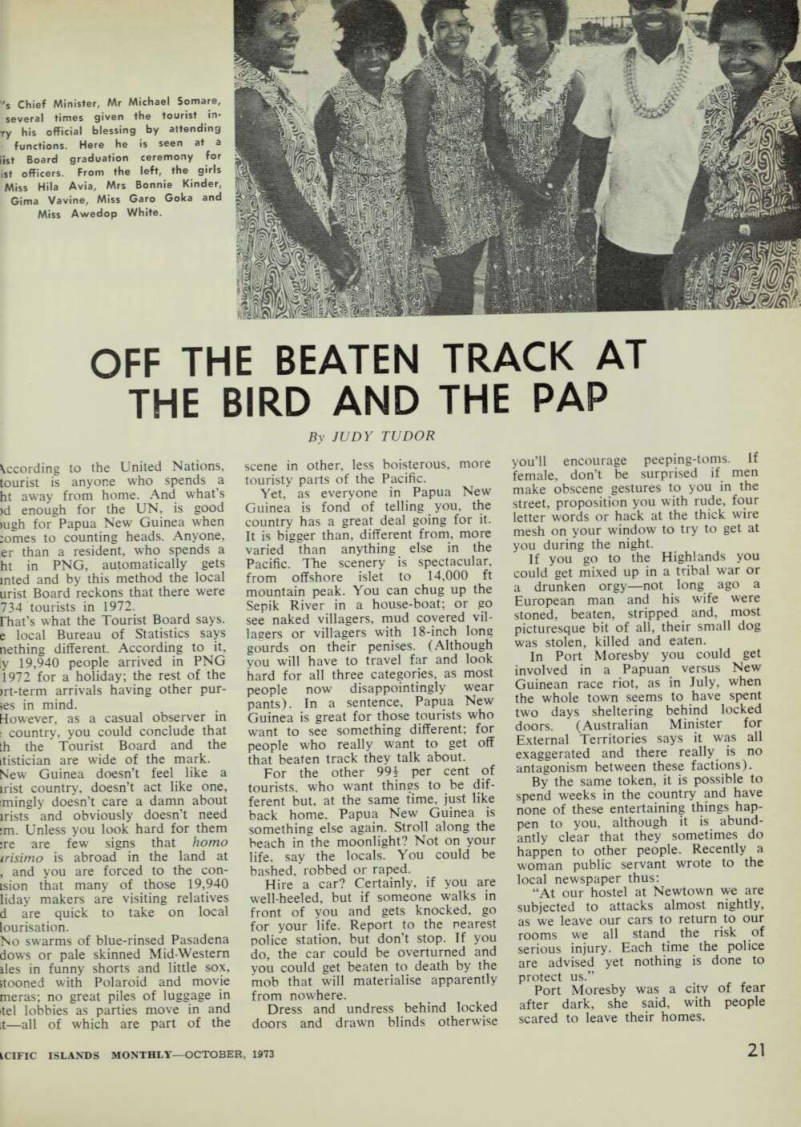
"s Chief Minister, Mr Michael Somare, several times given the tourist ln- T y his official blessing by attending functions. Here he is seen at a list Board graduation ceremony for ist officers. From the left, the girls Miss Hila Avia, Mrs Bonnie Kinder, Gima Vavine, Miss Garo Goka and Miss Awedop White.
Ejecting A Png Image
i>he ended her letter: “Bring irists to Port Moreby? They must joking . . \ lot of residents agree with her the local Tourist Board has gone :ough the motions of fostering an erest in tourism in the face of :at government indifference in the t and what are likely to be other acuities in the future, including fragile feelings of local politins.
Recently Minister for Interior John .ise took tourist associations to task “projecting Papuans and New lineans as objects of curiosity.” low should they be projected? As ive westernised intellectuals? He to be joking. Of course, the local )ple are objects of curiosity to irists not in any unkind way, but ause many of them are so difent from the people the visitor dws back home.
Once they are all reduced to being thed suburbanites, with office is, and this process has proceeded ite a long way already, what will the point of spending all that Ligh getting to New Guinea in the ;t place? According to the Tourist ard the average visitor spends $55
a day while in PNG and my own experience suggests that in this the Board is only too terribly right.
Whether it’s the tall, elegant and disdainful Mekeo, a rampaging High lander or a snotty-nosed child grovel ling in the grime of the floor of Port Moresby’s airport while his mother sits, natters and waits for God-knows what, it is these and all the thousands like them, sophisticated or savage, all the way from Daru to Vanimo or Lae to Wabag who are the focus of attention of every visitor.
There are plenty of countries with scenery, better beaches and more tolerable climate. PNG has no fabulous hotel resorts or jet-set hide aways, although accommodation available has improved a hundred fold since the days when I used to write articles on the theme that “a Tudor never slept here.”
But in spite of the improvements you would never mistake most PNG hotels for similar establishments in a more tourist-orientated country.
The atmosphere is different, more attuned to the eating and drinking habits of local people than to inter national travellers. The resident guests are more likely to be ter
ritorians on the move, travelling salesmen or experts up from South, with the genuine tourists taking a minor and unobtrusive role.
Hotels and motels can be full of exuberant noises or have strange architectural devices like the Bird of Paradise Hotel at Goroka where to get to one lot of bedrooms you have to climb one set of stairs and then immediately go down another in an up-and-over exercise. No doubt the original owners named that place in good faith but in true New Guinea fashion the name has been lopped down to size and the establishment is now popularly and unfortunately known as The Bird.
Some PNG hotel operators have an informal approach to their clients’ clothing although with most the favourite bete noir is rubber thongs. These are out in all but public bars, where only wild tribesmen go anyhow. Other mores, the subject of printed notices outside public rooms in a few hotels, concern the wearing of long trousers and ties after 6 pm, although the Papua in Port Moresby breaks it down and stipulates ties and long pants for gentlemen in the evening or native dress.
Native dress? A Red Indian in
Modernisation
skskin, maybe; or a Swiss in a mdl? Or even a New Guinea High ider in a bark belt and a couple of others? Somehow you get the idea nt it is really meant as an insurance ainst some possible occasion when lief Minister Michael Somare mes to dinner wearing one of his /ourite bula shirts.
The Papua has had several face ts since the days when you were pected to share a room with one more strangers, but still retains jch that is typical of PNG.
It has several new drinking places, carpeted foyer and dining room lere music is supplied nightly by a an who plays an organ with one nd and a piano with the other. ;ry versatile, and appreciated, pecially by the waiters who alone long that fraternity in PNG, who iw come dressed in anything from xedos to red mess jackets, still wear >or-length white lap-laps.
The Papua (sometimes in col quial speech referred to as The ip), has a newish wing of bed oms which, due to some misplaced al on the part of the booking ent, I did not get to see. I was r a while in June allocated what e receptionist said was a room just
as good except that the airconditioner was “rather noisy”.
Time was when I never went to New Guinea without a packet of bobby-pins to cobble up holes in the mosquito nets and a can of pres surised insecticide to kill off those insects already inside. These days a manual on airconditioning is much more to the point but in this case someone with malice aforethought had removed all the knobs from the machine. Above the promised noise that sounded like a mix-master let loose in a tin of ball-bearings, it emitted nothing but warm, humid air into the small room with its fixed, non-opening windows.
The following morning a Papuan mechanic and I attacked the machine together and, among other things, washed out the filter, whereupon the monster started to emit air so mar row freezing in intensity it was guaranteed to reduce even an Eskimo to a shivering wreck.
I asked the housekeeper for a blanket but she was sorry. There were only four blankets in the establishment and these were all “out”. She offered an extra bed quilt as a substitute.
I ended with three bed quilts and my legs thrust into the sleeves of a wool sweater and thus survived suf
ficient of the arctic night for the public bar to be cleared out under neath and the noise of the last truck to rumble past and fade into the distance. It was then time to switch off and in the small hours till dawn, gradually to thaw out and get the blood circulating again.
No one can say that Papua New Guinea isn’t different, unusual, curious and very much itself. And you can say that the local Tourist Board does its best in a conventional way on the $170,000 allowed it by a not over-enthusiastic government. It has produced some interesting propa ganda films and posters, and more recently a very elaborate tourist manual at a cost of about $35 per book, designed primarily for over seas travel agents.
But you can still wonder why the big talk of a bigger and better tourist industry continues in a country which has so many other economic strings to its bow; where tourism can never be No 1, as in Fiji, Tahiti or Hawaii; where the mood of the country is not particularly favourable to it; and where only a tiny minority of the total population benefit from it.
Why not leave Papua New Guinea to the real, off-the-beaten-track travel lers and cut all the other cackle?