Tropicalities
pp. 16-18 · Read in the full issue

Tough For
Big Fish
Big fish in little American pools don’t have the constitutional defences that US President Richard Nixon has been able to resort to in his fight to convince people that he’s not the rogue some would make him out to be over the Watergate kerfuffle.
Two US colonial executives, High Commissioner Edward E. Johnston of the US Trust Territories, and Governor John Haydon Jr of American Samoa, have found themselves, directly or in directly, in the firing line of the people they are looking after.
Hicom Johnston, as Trust Terri torians know him, is reported to have had a “class action suit” filed against him by four residents of Saipan. The plaintiffs were demand ing that Johnston issue deeds of con veyance for their homestead land.
One plaintiff, according to the Pacific Daily News, said she had waited for nine years for a deed to her homestead site even though she had fully complied with TT homestead laws.
In American Samoa things looked grimmer for Governor Haydon. He was charged by the Civil Service Commission, allegedly as a result of complaints by Samoans including members of the legislature, of having used his position to influence the territorial election in 1972.
It is alleged that Governor Haydon had used the government radio and television on election day and the day before to “propagandise against a ballot proposition that Samoans elect their own governor”.
Another charge was that Haydon had urged Samoans not to vote for a white businessman arguing that palangi —white foreigners—should not be in the Fono (legislature).
Haydon was charged under the Hatch Act which forbids Federal
employees and territorial governors from involving themselves in elec tions. The trial opened in Pago Pago on September 11 but was adjourned when the trial judge. Judge John J.
McCarthy, was taken ill.
Saving Pitcairn
from the drain
Two Royal Engineers and Britain’s sense of “romance” and “history” could mean revival rather than evacu ation for the people of Pitcairn Island.
Before British High Commissioner in NZ D. A. Scott, who doubles as Gov ernor of Pitcairn, visited the island recently, Tom Christian was sounding glum on his weekly hook-up with the Seventh-day Adventists’ radio station, the Voice of Prophecy, in California.
Tom said: “There has been some talk about either taking the people from Pitcairn or opening the island up to outsiders. We don’t know that our Governor is going to talk to us
about these questions but it is reason able to think that he might. What th« response of the people here will b( of moving from Pitcairn or bringinj outsiders to the island, as suggested I don’t know.”
What he was talking about was thi dwindling Pitcairn population—dowi to 73 plus nine “foreigners”—whid is making it difficult to find enougt manpower to keep the island’s serf vices running, particularly the long boat service to passing vessels.
When Governor Scott returned from his four-day visit his tone was upbeat: two Sappers (engineers) had come up with ideas for improving Pitcairn Harbour facilities and he was very keen to see the Pitcairn popula tion built up again to around 150.
Agreeing that Britain’s determina tion to maintain the island was due mainly to its romantic and historical associations, Governor Scott said] “Pitcairn is a small, independently minded community we don’t want to see go down the drain.”
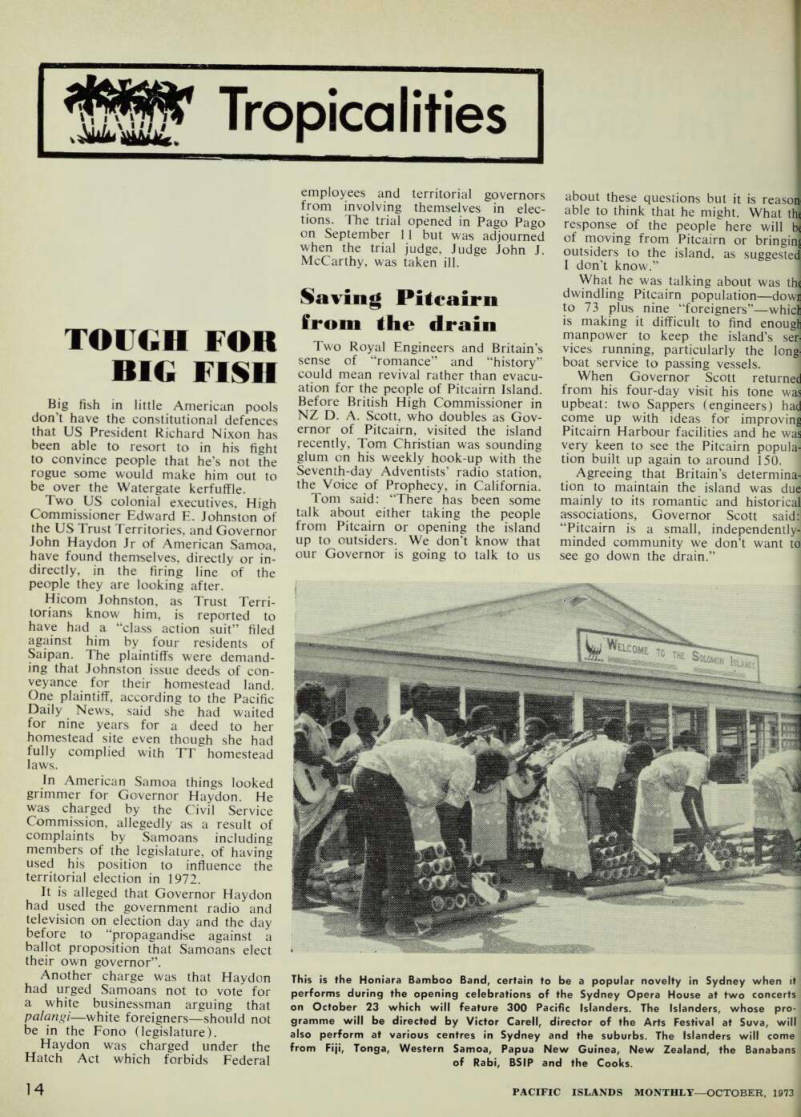
This is the Honiara Bamboo Band, certain to be a popular novelty in Sydney when it performs during the opening celebrations of the Sydney Opera House at two concerts on October 23 which will feature 300 Pacific Islanders. The Islanders, whose pro gramme will be directed by Victor Carell, director of the Arts Festival at Suva, will also perform at various centres in Sydney and the suburbs. The Islanders will come from Fiji, Tonga, Western Samoa, Papua New Guinea, New Zealand, the Banabans of Rabi, BSIP and the Cooks.
i> art bargains
i the Islands
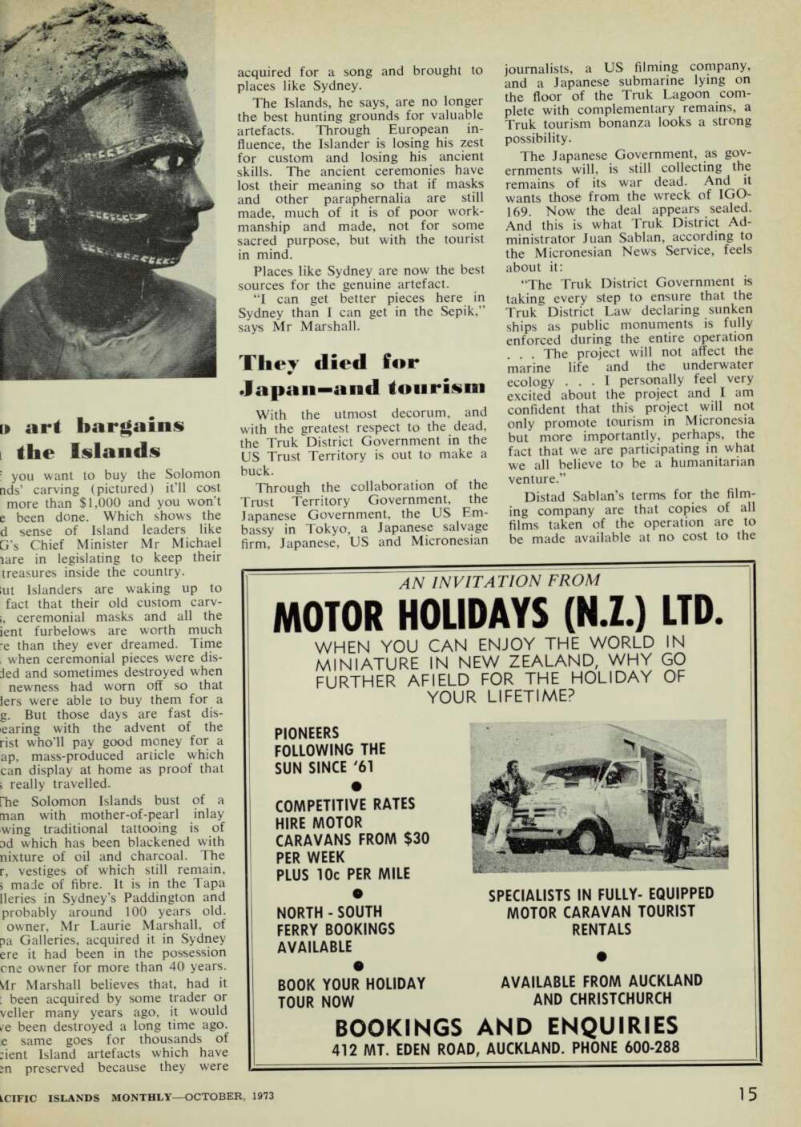
: you want to buy the Solomon nds’ carving (pictured) it’ll cost more than SI,OOO and you won’t e been done. Which shows the d sense of Island leaders like G’s Chief Minister Mr Michael lare in legislating to keep their treasures inside the country, iut Islanders are waking up to fact that their old custom carv ceremonial masks and all the lent furbelows are worth much 'e than they ever dreamed. Time , when ceremonial pieces were dis led and sometimes destroyed when newness had worn off so that lers were able to buy them for a g. But those days are fast dis earing with the advent of the rist who’ll pay good money for a ap, mass-produced article which can display at home as proof that ► really travelled. fhe Solomon Islands bust of a man with mother-of-pearl inlay wing traditional tattooing is of ad which has been blackened with nixture of oil and charcoal. The r, vestiges of which still remain, 5 made of fibre. It is in the Tapa lleries in Sydney’s Paddington and probably around 100 years old. owner, Mr Laurie Marshall, of pa Galleries, acquired it in Sydney ere it had been in the possession one owner for more than 40 years.
Vlr Marshall believes that, had it : been acquired by some trader or veller many years ago, it would /e been destroyed a long time ago. e same goes for thousands of :ient Island artefacts which have ;n preserved because they were
acquired for a song and brought to places like Sydney. fluence, the Islander is losing his zest for custom and losing his ancient skills. The ancient ceremonies have lost their meaning so that if masks and other paraphernalia are still made, much of it is of poor workmanship and made, not for some sacred purpose, but with the tourist in mind.
Places like Sydney are now the best sources for the genuine artefact.
“I can get better pieces here in Sydney than I can get in the Sepik,’’ says Mr Marshall. ma J. J «
ft Itey died tor
Japan-and tourism
With the utmost decorum, and with the greatest respect to the dead, the Truk District Government in the US Trust Territory is out to make a Through the collaboration of the Trust Territory Government, the Japanese Government, the US Embassy in Tokyo, a Japanese salvage firm, Japanese, US and Micronesian
journalists, a US filming company, and a Japanese submarine lying on possibility.
The Japanese Government, as gov ernments will, is still collecting the remains of its war dead. And it wants those from the wreck of 1GU U 169. Now the deal appears sealed, And this is what Truk District Ad ministrator Juan Sablan, according to the Micronesian News Service, feels about it: “The Truk District Government is taking every step to ensure that the Truk District Law declaring sunken
ships as public monuments is fully
enforced during the entire operation ... The project will not affect the marine life and the underwater “°|° g d y about Ihe^prolect 7 and' iTm confident that this project will not only promote toumm
but more importantly, perhaps,
fact that we are participating in what we all believe to be a humanitarian venture.
Distad Sablan s terms for the filrn ing company are that copies of all films taken of the operation are to be made available at no cost to the
TT Government for official and non commercial use. The films will b t distributed to anyone who wants their —in Japan, the US, Europe, any where.
The silent occupants of IGO-169 of course, have no say in the matter It would be interesting to know 1 they share the same sense of honoui as Distad Sablan—or whether thei would prefer to remain untouchable by Truk Government proclamation like all other Japanese warriors en tombed in watery graves in Truk. I
Unfriendly
rugby in Fiji
Sydney and Fiji secondary school boys in August and September gavi a couple of practical examples 0: how rugby football should not b( played. Some of their punchinj would have made Muhammad A 1 (Cassius Clay) envious. But official were so fearful of further violent that they cancelled the last matcl of the tour. The Sydney team wa from the Mid-West Metropolitai Zone.
The tour started innocuousl] enough with St John’s College Cawaci, beating the visitors 17-7 a Levuka, and then Sydney beat Rah Kadavulevu School 13-10. In th< third match at Buckhurst Park, Suva the home team, a Fiji secondary school’s team, showed it was read] to take part in any sort of violence Brawls marred the game right fronj the start. One melee in the seconc half lasted almost five minutes befon referee Nacanieli Vosarogoci regainec control.
Three days later, the Sydney boyi met a Nausori team. Right from th< start it was apparent there was \ hangover from the previous match Tension gradually built up and in th< second half there were several fights The referee, Father Brian, broke ug the contestants each time, but die not send anyone off. Sydney wot 10-0.
The visiting team’s coach, Mr Bruc< Mason, and local officials then go together and decided to cancel the lasi scheduled match against a Suv* secondary school’s team. Mr Masoi considered the trouble might have started from the different styles oj football the two teams played Sydney played largely a forward game, with the emphasis on winning possession, while the Fiji style wat to throw the ball about freely.
Ovalier, the Fiji Times rugby columnist, made no bones about the cause of the trouble —aggressive and provocative tactics by the visitors, he maintained.