hangover
p. 10 · Read in the full issue
PNG's tax hangover for soft drinkers
From Percy Chatterton
in Port Moresby
Again, as in 1972, PNG’s House of Assembly’s Budget meeting has straddled the celebration of National Day on September 15. Consequently, after a two-week run of sittings which began on August 27, members dispersed for a week’s break in their electorates, to return for a further stint of legislative activity on Sep tember 17.
One of the “firsts” scored at this meeting has been the broadcast by the Australian Broadcasting Commis sion of Finance Minister Julius Chan’s Budget speech on the evening of August 28, and of the opening Opposition speech in reply to it, de livered by the United Party’s shadow Finance Minister, John Middleton.
The delivery of both these speeches was of a calibre which could hold its own with that of similar performances in most sophisticated legislatures.
The 1973 PNG Budget may take its place in history as the “Lolly Water Budget”. Taxes on alcoholic beverages are a commonplace of budgetry, but a tax on soft drinks is something of a novelty, and might indeed be a “first” worthy of a place in the Guiness Book of Records.
In addition to an increase in import duty on soft drinks from 50 cents to 75 cents a gallon, an excise duty of 10 cents a gallon is to be levied on the locally-manufactured product.
And this was about the only sur prise the Budget did spring.
In the field of income tax, people earning $5,000 a year or more will pay 4i per cent more in tax. This increase will mainly hit expatriate taxpayers, since less than 1 per cent of tax-paying Paguineans are in this income bracket. Some concessional deductions are also being abolished or reduced; this again will affect mainly expatriate taxpayers. On the other hand, company tax will not be increased.
Other imposts are a S 2 tax on out going international air passengers, in cluding those going to Australia, and an increased fee (from $2 to $5) for drivers’ licences.
On one issue Mr Chan had to admit himself stymied. It is fairly easy to make sure that wage and salary earners pay their income tax, but in this country it is very difficult to ensure that indigenous producers of cash crops such as coffee, cocoa and copra, and villagers who sell their produce in local markets, do so. Some of these people earn very substantial incomes, but few are sufficiently literate to keep records of their trans actions, and the Finance Minister has reluctantly decided that, while it would be possible to plug this loop hole, it would be too costly an opera tion to justify itself.
On the same day on which the Budget was brought down, the gov ernment tabled an eight-point “Im provement Plan” for 1973-74, which it described as its “first step towards building the kind of society that meets the needs of our people”. The plan focuses on a greater share in the economy by local people, and more equal development of the resources of areas and regions.
Altogether, it was a low-key budget, and the Opposition’s attack on it was also low-keyed.
Mr Middleton understandably criti cised the government’s continuing failure to simplify the tax structure on the lines proposed in a White Paper tabled in the last House but never implemented, and pointed out that the complexity of the present system was holding up localisation, that is, the replacement of expatriates by indigenous officers, in the taxation division of Mr Chan’s department.
The shadow minister drew attention to the danger of relying too heavily
for revenue raising on the dwindli expatriate sector, and urged less e phasis on increased taxation and me on increasing the gross national pi duct.
Finally, he pointed out that mii of the proposed expenditure was] be on power transferals needed 1 independence but not necessarily j self-government, a fact which led party to suspect that the governmi was, like Mr Whitlam, trying hustle the country into an early iru pendence which the majority of t people did not want.
Mr Tollman's death As the two weeks of sittings dn to a close, tragedy struck. Opposite leader Matthias Toliman was tak ill in the precincts of the House a: was rushed to hospital, but si cumbed to a heart attack shortly afl admission. The Speaker annound his death to a stunned House, ai the sittings came to an abrupt ei 24 hours earlier than had been e pected.
Matthias Toliman was a man great sincerity and integrity, with genius for friendship. The respon bilities of leadership, shouldered conscientiously, took a heavy to and, by temperament a man of pea( the bitter dissensions which hi divided his Tolai people in rece years must have weighed heavily I his spirit. His passing represents J incalculable loss to Papua Ne Guinea at a moment when tl qualities he displayed are so mui needed.
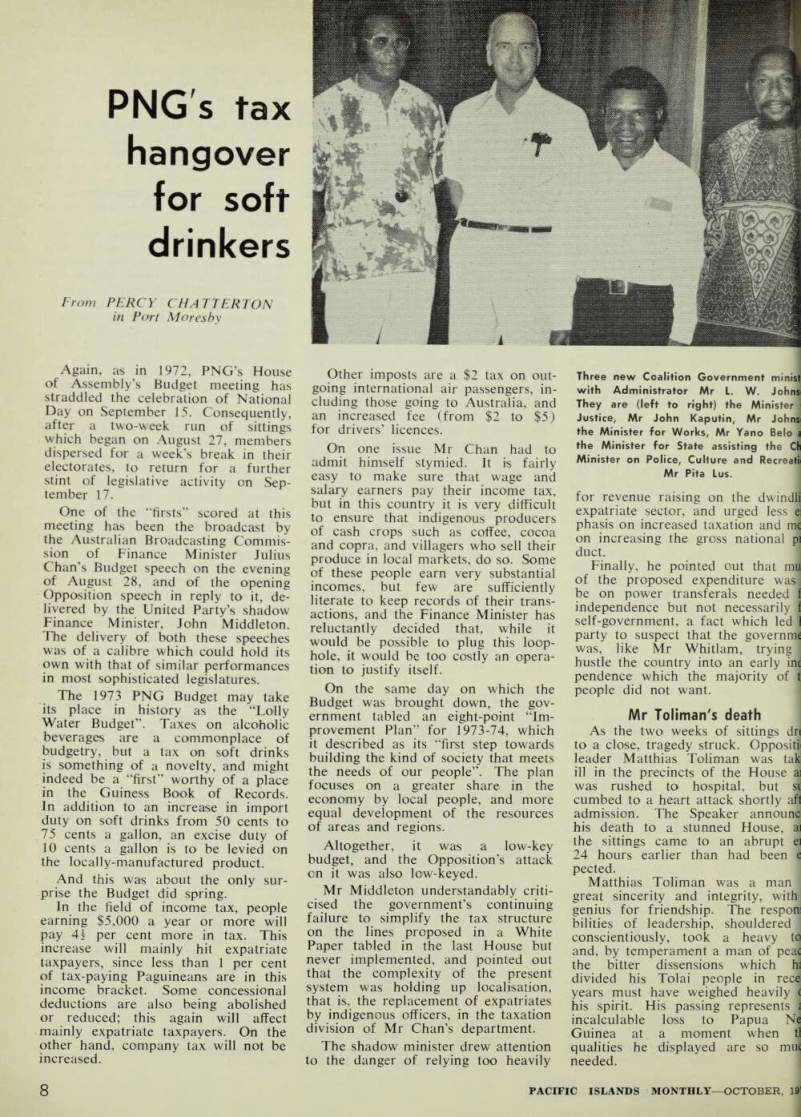
Three new Coalition Government minist with Administrator Mr L. W. Johnsi They are (left to right) the Minister I Justice, Mr John Kaputin, Mr Johnsi the Minister for Works, Mr Yano Belo a the Minister for State assisting the Ch Minister on Police, Culture and Recreatii Mr Pita Lus.