All—except France—agog for change
pp. 8-9 · Read in the full issue
in South Pacific Commission
From DICK WILLIAMS, of UPI, and PIM special correspondents in Guam
Isolated and without a friend in the room, France, in the person of her senior commissioner Mr Henri Nettre, walked out of the 13th South Pacific Conference at Guam on the fifth day when France was arraigned by resolution for her nuclear tests.
French Polynesian delegate Alfred Grand and the French-speaking New Hebrides delegate walked out with him. This was even before the reso lution, tabled by the Cook Islands Dr Joseph Williams, was put to the vote.
When the conference did vote on it, on the sixth day, and named France as the offender, Guy Champmoreau of New Caledonia, who had stayed as France’s only champion, joined his compatriots on the outside.
The walkout was inevitable. All had been sweet reason for the first couple of days but the Islanders in particular had been spoiling for a fight with France over the tests.
The Cook Islands resolution con demned France by name and this was something New Caledonian Champmoreau tried to fight. He did not object to the resolution that would condemn the nuclear testing.
He objected to naming France.
The Cook Islands was just as adamant in its insistence that France be named since that country was the only Power that has been testing in the Pacific of late. Dr Williams even suggested that the conference would be composed of hypocrites if the resolution was to be adopted elimi nating France’s name.
Cooks Premier Albert Henry, who was absent, was even more forthright in a message he sent to the con ference. “If France walks out of the conference,” he wrote, “it is our duty to help France walk out, not only of the conference, but also of the Pacific.”
When the conference adopted the resolution, Champmoreau announced, “I can no longer take part in dis cussions by this body which has just condemned one of its members. I was born in what was known as the French Union, and I shall never turn against France.
“I bid you farewell and I hope you don’t have nightmares about what you have done,” the Frenchman con cluded, and with that he walked out of the conference room. This left the conference with no French repre-
sentation with three more days of business to conduct, including the all important report of the future status committee appointed to study methods for implementing Australian sugges tions for changing the SPC setup, and proposals from Guam.
Mr Champmoreau returned the fol lowing day, however, saying that he was deeply touched by the delegates’ pleas for him to return. The New Caledonian glossed the whole thing over by adding that, had he not come back, there would be no French dele gate so that the interpreters would be out of a job. But, he was alone.
Mr Nettre and his companions did not return.
Australia had earlier circularised her suggestion for sweeping changes in the commission and conference and, surprisingly, because Australia had anticipated some opposition, everybody, with some reluctance from France over some matters, was all for the proposals.
Australia proposed that the SPC be financed on a part-voluntary basis and that there be a de facto merger of the commission and conference sessions.
Australia believed that a substantial extension of voluntary financing could lead to a significant increase in the
commission’s income. What was I visaged was that administrative s vices be financed on the present hi of fixed percentage shares amd commission governments, but that] part covering the work progranJ should be financed on a volj tary basis. It would be entirely! to the governments concerned asl how much they would want to pi vide for the programme.
Australia also argued that such merger could result in saving in] unduly long time now given to session and the conference sitt separately.
Australian delegation leal Senator Don Willesee, Sped Minister of State, told the confereij a merger would also more fully] volve all conference members in i whole operations of the SPC a conference and would increase thj interest and feeling of participation.
The Australian senator’s spel was delivered in a mild, low-key a conciliatory manner. There was] evidence that Australia was issuj an ultimatum to the SPC or seek! a fight with France, which has seem less enthusiastic about reforming t SPC than some others.
Friday, September 14, w scheduled for discussion of the Ai tralian proposal and for other ii provements to the SPC suggested] Guam.
The discussion began positive; Already a strong spirit of co-operati was developing among delegates, ai the previous two days had seen qui a bit of give and take on all sides.
Australia’s senior commission* Mr C. E. Reseigh, taking over tl detailed work from the senator, e plained at length the advantages th Australia saw in bringing the coi mission and conference togethe stressing that the rationalisath would permit better control of a ministrators and allow governmer to become more committed to tl organisation.
Mr Reseigh had hardly finish* when Mr Nettre wanted to spea and it appeared battle was about i begin. But there was no showdow France’s critique was cautious ar considerate.
France, as the conference ha already learned, agreed with Au tralia’s suggestion for part-voluntai financing, and herself produced j
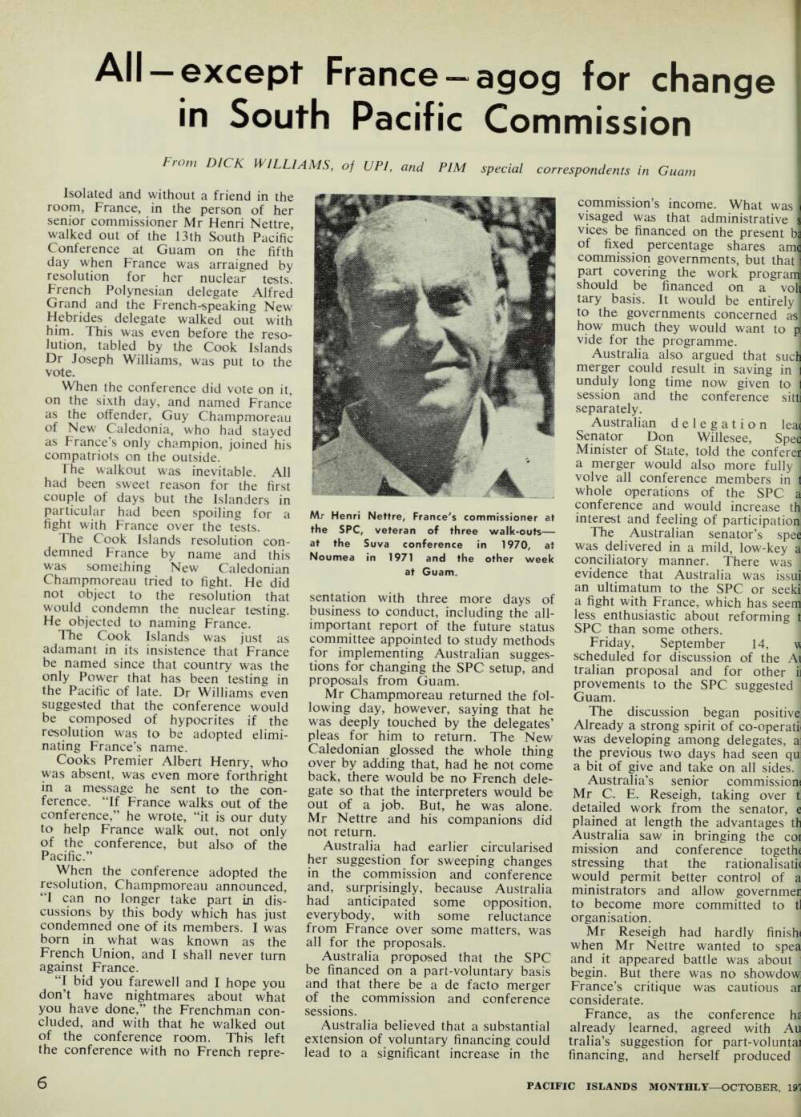
Mr Henri Nettre, France's commissioner at the SPC, veteran of three walk-outs— at the Suva conference in 1970, at Noumea in 1971 and the other week at Guam.
lintary contribution of 5A50,000. nough not large in comparison to half million dollar contribution in Australia and New Zealand übined, France’s showing was er than Britain’s and America’s, > produced nothing. ;ut France was less certain about idea of merging. Mr Nettre thought light inhibit the freedom of the 1s- Jers with the work programme if metropolitan governments had the 3 at the annual conferences. He > implied that the conference uld not involve itself in commis i “housekeeping”; as donor govern its should control input and the nders the output. tot all of Mr Nettre’s old fire was He made the most of three asions to remind delegates that, ler the present arrangement, the iference could not decide. Only commission session could. All conference could do, Mr Nettre sssed, was “to express a wish”, lis comments provided some dele ss with the chance to attack the inch position. Mr Albert Maori :i of Papua New Guinea told the ference that it was time for the ;gates from colonial governments “shut up” and let the Pacific aiders get on with their job. fhe delegate from the Gilbert and ice Islands, Isakala Paeniu, ob ed to France reminding the con ;nce that after all it was the com >sion session which must decide, j SPC must come under the con . of the Islands’ governments, he 1.
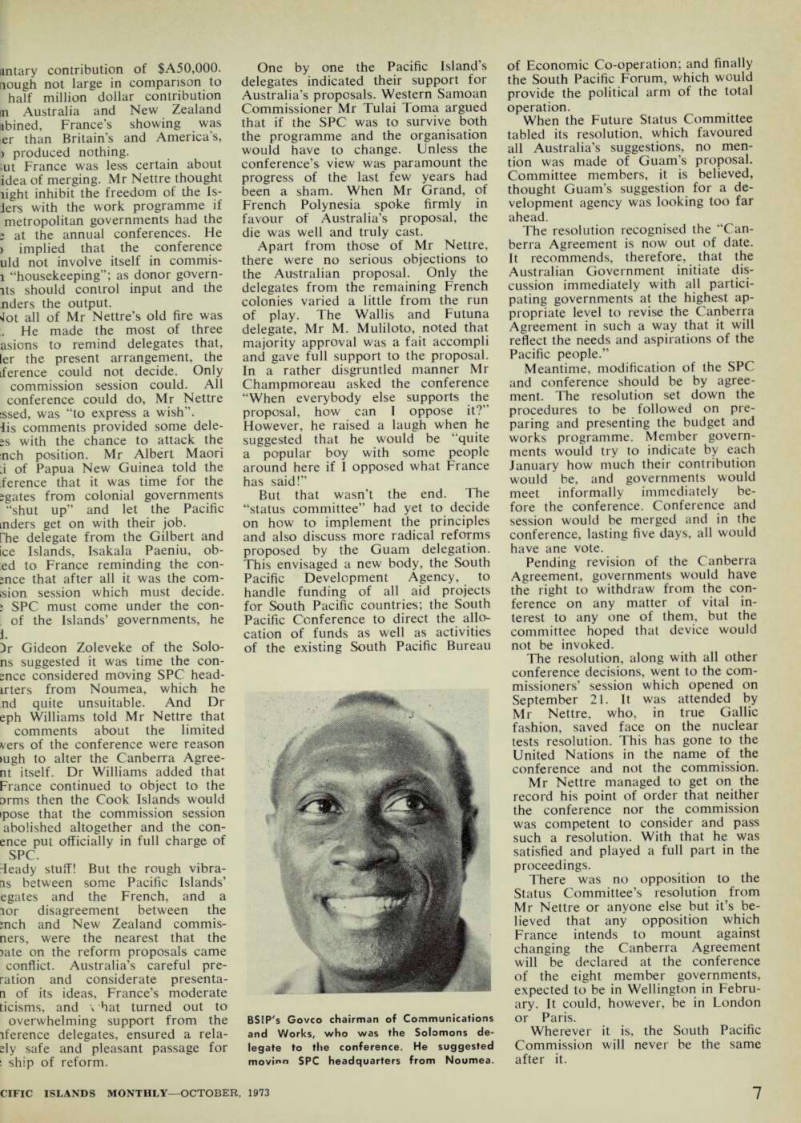
Dr Gideon Zoleveke of the Scio ns suggested it was time the con duce considered moving SPC head irters from Noumea, which he nd quite unsuitable. And Dr eph Williams told Mr Nettre that comments about the limited vers of the conference were reason ►ugh to alter the Canberra Agree nt itself. Dr Williams added that France continued to object U> the arms then the Cook Islands would ipose that the commission session abolished altogether and the con ence put officially in full charge of
Spc.
rleady stuff! But the rough vibra [is between some Pacific Islands’ egates and the French, and a lor disagreement between the mch and New Zealand commis ners, were the nearest that the late on the reform proposals came conflict. Australia’s careful pre ration and considerate presenta n of its ideas, France’s moderate ticisms, and \ hat turned out to overwhelming support from the iference delegates, ensured a rela sly safe and pleasant passage for : ship of reform.
One by one the Pacific Island’s delegates indicated their support for Australia’s proposals. Western Samoan Commissioner Mr Tulai Toma argued that if the SPC was to survive both the programme and the organisation would have to change. Unless the conference’s view was paramount the progress of the last few years had been a sham. When Mr Grand, of French Polynesia spoke firmly in favour of Australia’s proposal, the die was well and truly cast.
Apart from those of Mr Nettre, there were no serious objections to the Australian proposal. Only the delegates from the remaining French colonies varied a little from the run of play. The Wallis and Futuna delegate, Mr M. Muliloto, noted that majority approval was a fait accompli and gave full support to the proposal.
In a rather disgruntled manner Mr Champmoreau asked the conference “When everybody else supports the proposal, how can I oppose it?”
However, he raised a laugh when he suggested that he would be “quite a popular boy with some people around here if I opposed what France has said!”
But that wasn’t the end. The “status committee” had yet to decide on how to implement the principles and also discuss more radical reforms proposed by the Guam delegation.
This envisaged a new body, the South Pacific Development Agency, to handle funding of all aid projects for South Pacific countries; the South Pacific Conference to direct the allo cation of funds as well as activities of the existing South Pacific Bureau
of Economic Co-operation; and finally the South Pacific Forum, which would provide the political arm of the total operation.
When the Future Status Committee tabled its resolution, which favoured all Australia’s suggestions, no men tion was made of Guam’s proposal.
Committee members, it is believed, thought Guam’s suggestion for a de velopment agency was looking too far ahead.
The resolution recognised the “Can berra Agreement is now out of date.
It recommends, therefore, that the Australian Government initiate dis cussion immediately with all partici pating governments at the highest ap propriate level to revise the Canberra Agreement in such a way that it will reflect the needs and aspirations of the Pacific people.”
Meantime, modification of the SPC and conference should be by agree ment. The resolution set down the procedures to be followed on pre paring and presenting the budget and works programme. Member govern ments would try to indicate by each January how much their contribution would be, and governments would meet informally immediately be fore the conference. Conference and session would be merged and in the conference, lasting five days, all would have ane vote.
Pending revision of the Canberra Agreement, governments would have the right to withdraw from the con ference on any matter of vital in terest to any one of them, but the committee hoped that device would not be invoked.
The resolution, along with all other conference decisions, went to the com missioners’ session which opened on September 21. It was attended by Mr Nettre, who, in true Gallic fashion, saved face on the nuclear tests resolution. This has gone to the United Nations in the name of the conference and not the commission.
Mr Nettre managed to get on the record his point of order that neither the conference nor the commission was competent to consider and pass such a resolution. With that he was satisfied and played a full part in the proceedings.
There was no opposition to the Status Committee’s resolution from Mr Nettre or anyone else but it’s be lieved that any opposition which France intends to mount against changing the Canberra Agreement will be declared at the conference of the eight member governments, expected to be in Wellington in Febru ary. It could, however, be in London or Paris.
Wherever it is, the South Pacific Commission will never be the same after it.
BSIP's Govco chairman of Communications and Works, who was the Solomons de legate to the conference. He suggested moving SPC headquarters from Noumea.