Remarkable, Turbulent
pp. 101-102 · Read in the full issue
Dylan Thomas
The happiest years in the turbulent ife of Dylan TTomas were spent in i place called Laughame (pronounced L,arne), a timeless oasis remote from he world, beautiful in its setting, urogant in its insularity, and at once he haven to which this remarkable foung man, possibly the most gifted 3oet of the century, could quietly md unobtrusively escape.
Perhaps because of its different tess the town seems to exert an Mnotional pull, an assumption of sroprietorship over visitors that could 5e even a little sinister if it were not simply its way of expressing wel come. I felt it strongly the moment [ arrived here. Dylan Thomas once said about Laughame: “And some, ike myself, just came, one day, for :he day, and never left, got off the 3us, and forgot to get on again.” He stayed for 15 years, sometimes roistering back to the turmoil of cities, to London, America and Italy, sut always returning in the end. He s there now, in the churchyard of 5t Martin’s at Laughame.
Thomas’s unfortunate enjoyment 3f sometimes drinking to excess might lave strained the tolerance of the leople around him. But there is ;vidence neither of wild, undisciplined aunts about the town nor any re nembrance other than an amused acknowledgement of his having latronised all seven pubs impartially n the evenings, and Brown’s Hotel, ;he Corporation Arms and the Cross House Inn more earnestly in the rnornings. Arthur Jenkins, a one :ime barman at Brown’s, and a close Tiend, told me: “When he was down lere he only drank half-pints >f mild—never the hard stuff. No whisky, just beer or cider.” There vas a moment’s silence. “He hadn’t Duch money, of course,” he added, spoiling the effect.
It is certainly true that a man with Dylan’s reach of mind, eager for continuing recognition but cursed with ill-health, a giant in the per formance of his work but basically weak in the management of himself, should never have been exposed to
the rigours of high living that were so soon to engulf him. It is also true that such a man, for all the con tentment he found at Laughame, would be restless for wider audiences to spear on the point of his in satiable wit.
Under Milk Wood , the play for voices he left incomplete, but which made him famous, is supposedly the result of his ironic, cruel and some times deeply compassionate obser vation of life in Laughame itself.
The medieval castle dominating the shoreline is his “.. . castle brown as owls”. When the Second Voice says “. . . tall as the town clocktower . ..” it is the white tower of the old Town Hall that is meant. The people in all their complexities are the people he saw beneath the skin. The whole is a play of which the com munity at the time of its startlingly successful radio launching were both proud and vaguely resentful. “We thought he was like everyone else,”
Billy Thomas informed me. But he was not like everyone else. He was Dylan Thomas.
The house he and Caitlin lived in, with the children, Llewellyn, Colum and Aeronwy, is a white, square built cottage perched grandly on the undercliff, overlooking the vast glorious sweep of the Taf Estuary, a tidal magnificence of sea and wind swept grassy islands, bordering on
Pendine Sands. It is known as the Boat House, and this and the plain wooden hut he used for his work may be reached from the hilly streets of the hinterland by a narrow, wind ing, tree-lined lane which after his death in 1953 was renamed Dylan’s Walk.
The ancient craft of poetry making goes well with the romantic character of the town he adopted.
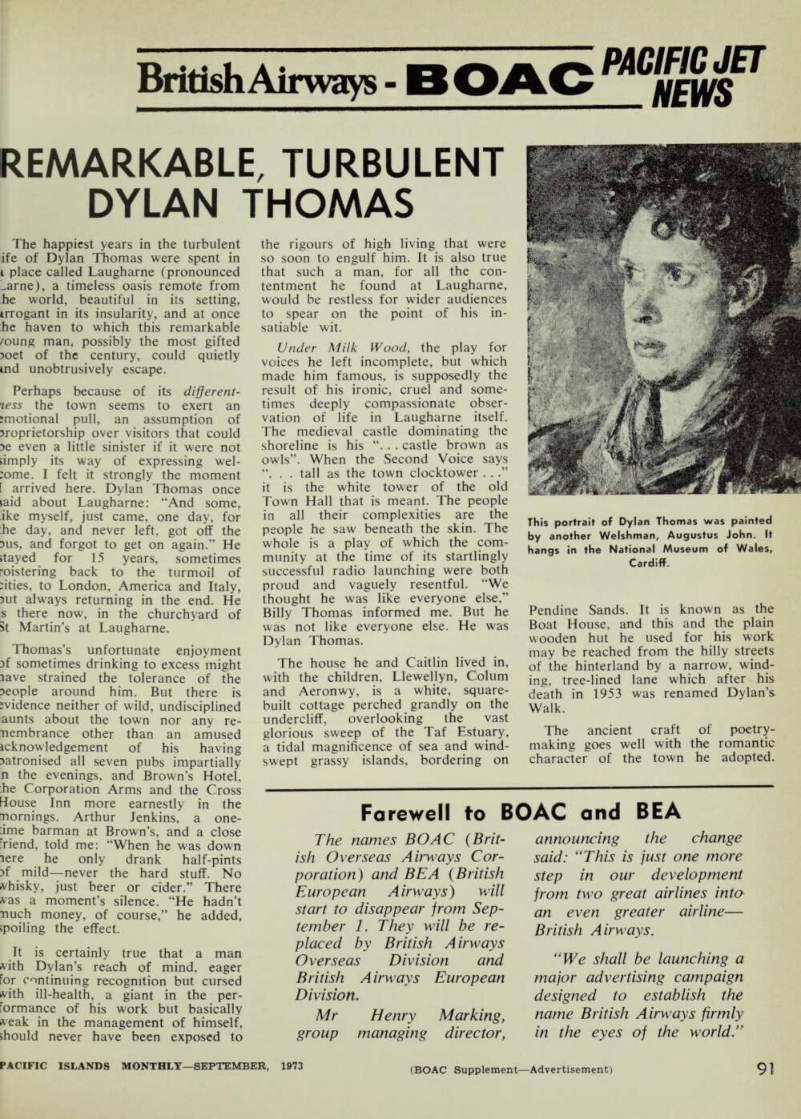
This portrait of Dylan Thomas was painted by another Welshman, Augustus John. It hangs in the National Museum of Wales, Cardiff.
The landlord of the Corporation Arms, Emrys Davies, is the Portreeve of Laugharne, an office instituted by the charter, undated, and with no •seal, which was granted to a Sir Gwydo de Brione in the reign of Edward the First. It carries the right that no man shall be called to military service except in defence of the outer walls. A previous Portreeve, now an Alderman is Douglas Bradshaw MA, who in his capacity as Headmaster of Laugharne Voluntary Controlled School taught Dylan and Caitlin’s two younger children. “I knew Dylan for many years,” he told me. “And yet,” and here he smiled wryly, “I don’t think I really knew him at all.” This rather sums it up. The truth behind the legend was never revealed; it remains as a chapter in a book never Only the talk goes on, the talk and the speculation and the stream of visitors. This is the place the magic came from, and these are the paths he trod.