"Look Out Over The
pp. 112-113 · Read in the full issue

Gate And Smile!"
By John Arlott
Village cricket is peculiarly English: an entirely natural growth which has become an institution. Cricket, simply described as “casting a ball at three straight sticks and defending the same with a fourth” is, at its highest level, the most profound game in the world.
An international (Test) match may last for five six-hour days without reaching a result.
Village cricket is less sophisticated.
Often, a match does not last its allotted four hours. It was, and is, a spontaneous growth, more ancient than records can show—a kind of warfare without bloodshed. It should not be treated solemnly, for it is fundamentally fun—but serious fun.
Some have seen it superficially, as bucolic farce, but it is more than that.
Only those who have played village cricket realise how serious, though not grave, a matter it is. Only a student of cricket understands its place in the growth of the game, only a social historian fully appre ciates its influence on English country life.
Its standard of performance can be low; yet it remains compelling—and free— specta tor entertainment. It was J. M.
Barrie who wrote “It has been said of the unseen army of the dead, on their everlasting march, that when they are passing a rural cricket ground, the Englishman falls out of the ranks for a moment to look over the gate and smile”. Part
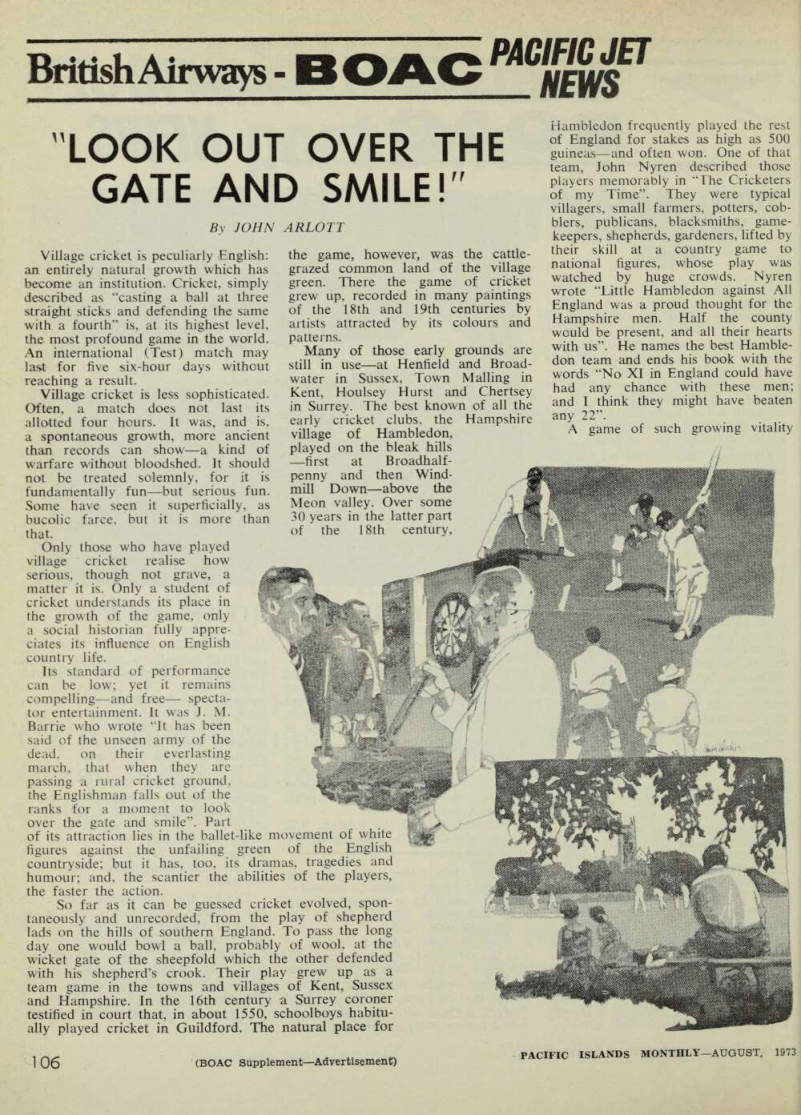
of its attraction lies in the ballet-like movement of white figures against the unfailing green of the English countryside; but it has, too, its dramas, tragedies and humour; and, the scantier the abilities of the players, the faster the action.
So far as it can be guessed cricket evolved, spon taneously and unrecorded, from the play of shepherd lads on the hills of southern England. To pass the long day one would bowl a ball, probably of wool, at the wicket gate of the sheepfold which the other defended with his shepherd’s crook. Their play grew up as a team game in the towns and villages of Kent, Sussex and Hampshire. In the 16th century a Surrey coroner testified in court that, in about 1550, schoolboys habitu ally played cricket in Guildford. The natural place for
the game, however, was the cattle grazed common land of the village green. There the game of cricket grew up, recorded in many paintings of the 18th and 19th centuries by artists attracted by its colours and patterns.
Many of those early grounds are still in use—at Henfield and Broad water in Sussex, Town Mailing in Kent, Houlsey Hurst and Chertsey in Surrey. The best known of all the early cricket clubs, the Hampshire
village of Hambledon, played on the bleak hills —first at Broadhalf penny and then Wind mill Down—above the Meon valley. Over some 30 years in the latter part of the 18th century.
Hambledon frequently played the rest of England for stakes as high as 500 guineas—and often won. One of that team, John Nyren described those players memorably in ‘The Cricketers of my Time”. They were typical villagers, small farmers, potters, cob blers, publicans, blacksmiths, game keepers, shepherds, gardeners, lifted by their skill at a country game to national figures, whose play was watched by huge crowds. Nyren wrote “Little Hambledon against All England was a proud thought for the Hampshire men. Half the county would be present, and all their hearts with us”. He names the best Hamble don team and ends his book with the words “No XI in England could have had any chance with these men; and I think they might have beaten any 22”.
A game of such growing vitality
(BOAC Supplement—Advertisement)
could not be confined to the Wealden village commons. It spread all over England and its great matches were taken from the bare hills of Hamp shire to the fashionable London grounds of the Marylebone and White Conduit clubs, leaving the country men to less famous but satisfying games on the green.
Further north, the game took root a little later but grew more fiercely.
There are some spectacular Pennine village grounds in Derbyshire and the tiny village of Lascelles Hall once had seven players in a Yorkshire XL A whole aspect of English country life was shaped by cricket. The manor house, church, vicarage and tavern formed the core of the village, about the green where the squire, the parson, the farmers, the publican, blacksmith, shoemaker and farm worker came together in the nearest they could attain to equality—in their cricket matches. Anyone who has played village cricket has encountered an Old Etonian, a Cambridge blue and a scion of the peerage in the same team as a furious hitting, hard drinking publican, and perhaps a notorious poacher with a surprising gift for accurate off-break bowling.
It is difficult to assess the effect of that relationship—which uniquely breached the social barriers of rural England—on history; certainly one of the causes of the French Revolution was the lack of any such common ground between landowners and peasantry.
Urban growth and the increase of weekend cottagers have diluted local blood-matches and added sophistica tion to technique in some villages. In many more, however, traditions run deep and competition is as savage as ever. Drive out from any town in Southern England on a summer Satur day or Sunday and, within a few minutes, you will find cricket in pro gress on a ground 200 years old.
Mitcham in Surrey is more ur banised now than in 1685, the date of its first recorded match; but they still play on the original green, where the batsman must cross the main road on his way from the pavilion to the crease. In Sussex, the village of Storrington was the original “Tilling fold” of Hugh de Selincourt’s “The Cricket Match” which Barrie de scribed as “the finest novel ever written about cricket—or any other sport”. It is, too, still the ambition of every batsman who plays there to hit the ball into the pond.
In the New Forest it is not at all uncommon for a stroke made on Swan Green at Lyndhurst to land in the main Southampton to Bournemouth road. Further north, at Nomansland, the county boundary passes through the middle of the cricket pitch so that a batsman can be caught in Wiltshire from a ball bowled in Wiltshire with out leaving Hampshire.
Some of the old greens have been swallowed up by towns, while others have survived quite surprisingly—like Tumham Green, now deeply im bedded in metropolitan London yet still, in itself, the village green it was.
At Oakley and Worting in Hamp shire it is possible to catch a brief intriguing glimpse—generally no more than a single ball—of the play from the train. Meopham; Leigh, near Tonbridge; Bearstand, encircled by village houses; and the Vine at Sevenoaks are picturesque settings in Kent; Balmer Lawn another in Hamp shire.
Last year a National Village Cricket competition was launched; and the final, played at Lord’s, was won by a professional-looking team with at least five minor counties’ players.
That is not what village cricket is about. It is a local matter of close loyalties and close rivalries. Monk Sherborne against Sherborne St John, Tadley against Silchester, the matches that have been played ever since the players had to walk to them: it was created by companionship and its history is told by word of mouth.
(BOAC Supplement—Advertisement)
London's new Penta Hotel in Kensington.