Where have all the young men gone?
p. 76 · Read in the full issue
young men gone?
By Venantius Tapin
Grandfather was warming himself at a flaming hot fire. He stared at the angry flames, deep in thought.
The red fire set him thinking of the past, of the good days he had spent hunting wild pigs and cassowaries.
He had been the best hunter in his New Guinea village.
Now he was old. “Who will be the next good hunter?” he wondered. “There’s little hope.”
He was still remembering the past when his 13-year old grandson, Tom Bali, rushed into the house and sat beside him. He had just come back from the next village where he had played the popular evening game Hide and Seek. It was always so exciting that Tom Bali could not wait to tell his grandfather about it.
“Tata (grandfather),” Bali remarked breathlessly.
“They couldn’t find me. I had a good hiding place.”
Grandfather nodded three times in response. He never took his eyes off the fire nor did he say a word. Tom Bali turned to him with a concerned expression on his face. “Tata, dave (what is it)?” Tell me, anything wrong? Why are you sad?”
“There’s nothing wrong, my son.” Grandfather leaned forward and pushed a piece of half-burnt coconut husk back into the fire. “Bali, get me my basket from my bed and some betelnuts from your grandmother’s basket.”
“Yes, Tata,” Tom Bali got up and disappeared into
the darkest part of the room. He reappeared with a basket and two betelnuts and handed them over. Grand father took the skin off and put the betelnuts into his mouth. He then produced from his basket a tobacco tin in which he kept his lime. He took a very long piece of mustard and started to chew it with the lime and betel nut.
The fire was starting to die out so Bali put some more firewood in. It burst into flames again. "Bali,” grand father sighed and patted the boy on the shoulder as he called him.
After a short pause the old man burst out. “I am sad. Today our village is losing young men. Young peo ple like you go away to high school or to find work in towns. They never think back to their parents nor send money to support them.”
“Tata,” Bali interrupted, “I will always send you money when I find work. I shall not be selfish like other boys.”
Grandfather put his hands around his knees. He spat, almost spoiling the half of his laplap that was lying loose as he sat, half-naked, on the mat. Faintly, he be gan as if something was in his throat. “Yes, our ener getic young men have gone. The village is now almost deserted by them. There’s no one to work the gardens.
Only we old men and women are left behind. Only young children love the village in the childish manner.”
Tom Bali listened attentively. He shared the feeling of his grandfather despite his young age.
“I’m not blaming these young men alone. The responsi bility also lies in the hands of the whites.” Grandfather’s teeth grumbled like an angry dog’s. ‘These foreign birds! they’ve stolen our land, the land of our ancestors. Now they’re stealing our young people to work for them, to help their businesses to earn more.
They teach our young men foul ideas so that they come home on holidays and boast and say we are stupid.”
Grandfather looked over his shoulder to find Bali nodding his head as if to an unseen companion. The boy’s eyes were heavy.
“My son, you may go to bed now. It’s late and you have school tomorrow.” Bali lay himself down on a mat near the fire opposite his grandfather.
The flames died out. Grandfather sat cross-legged.
He stared at the fire’s remains, glittering in the darkness.
"Poor people,” he muttered. “They don’t understand.
They’ve been indoctrinated by the whites. They smell their bright lights like hungry rats.”
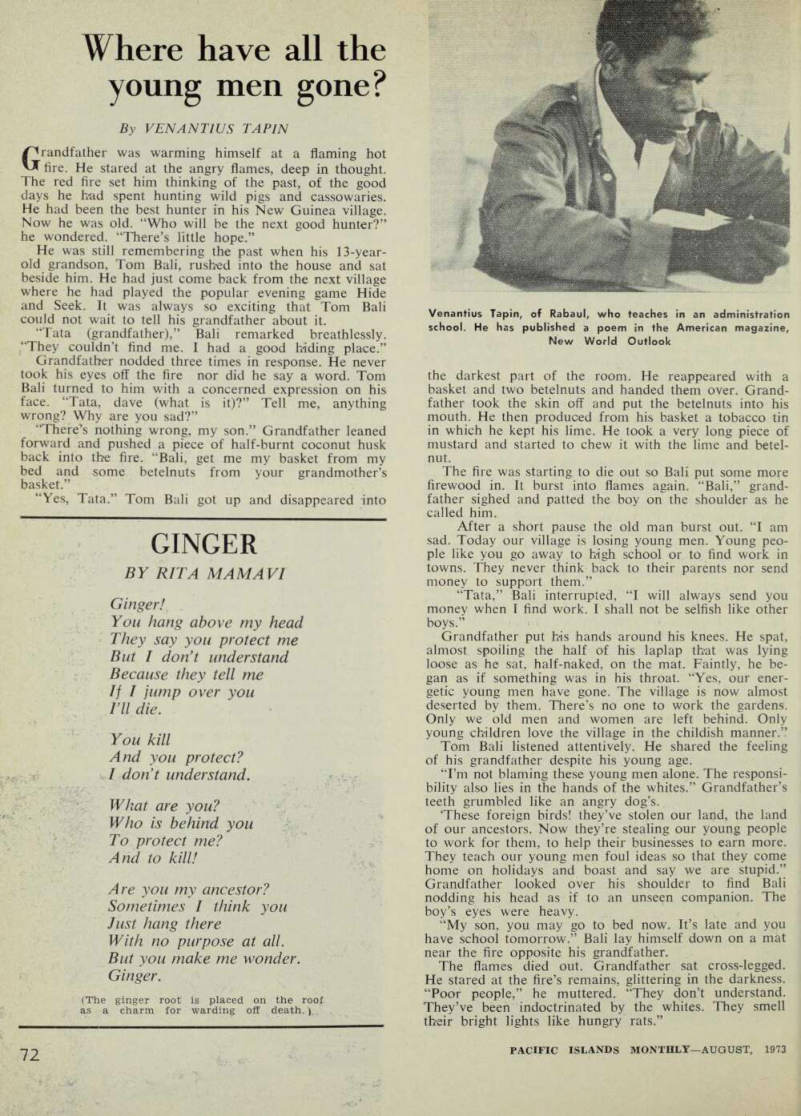
Venantius Tapin, of Rabaul, who teaches in an administration school. He has published a poem in the American magazine, New World Outlook