Indian Cultural Centre, Suva
pp. 74-75 · Read in the full issue
DR ISHWAR CHAUHAN, Director of the Indian Cultural Centre, in an interview with MARJORIE
Crocombe
M.C. What is the purpose of the Cultural Centre? Is it for the whole Pacific, or just for Fiji?
I.C. The main objective is to strengthen the existing ties of friendship between India and Fiji, as well as the other Islands of the Pacific. We want to present the Pacific peoples with a realistic, holistic and balanced image of India’s cultural heritage, her achievements during the last quarter of a century since independence, and her aspirations.
The Centre runs classes in Indian dance and music, and occasionally arranges performances by its teachers and students. The Library at the Centre includes books on various aspects of life in India, and the latest periodi cals. We also propose to build up libraries of films, re cords, tapes, and cassettes on different aspects of life in India. We organise public lectures every week on life in India or on items of topical interest to Fiji and the Pacific. There are also exhibitions of books, and paintings by Islands artists as well as those from India.
At least once a week we have a film evening. These are the ways we are attempting to spread knowledge about India in Fiji.
M.C. How did the Indian Cultural Centre come to be set up?
I.C. When Ratu Sir Kamisese Mara, the Prime Minister of Fiji, was on a visit to India in 1971, he and Mrs Gandhi, the Prime Minister of India, agreed to the setting up of an Indian Cultural Centre in Fiji. The Indian Council for Cultural Relations was asked to make plans for the Centre and a team of young enthusiastic workers set to work to translate the cherished desires of the two Prime Ministers to concrete reality. Their efforts have borne fruit and the Centre was inaugurated on August 15, 1972.
M.C. Does your group travel out of Suva and beyond Fiji?
I.C. Yes, we have just come back from a visit to Tonga. Our aim is to travel widely and go and present live performances to as many people as we can. Since we have classes here in Suva five days a week, we can’t
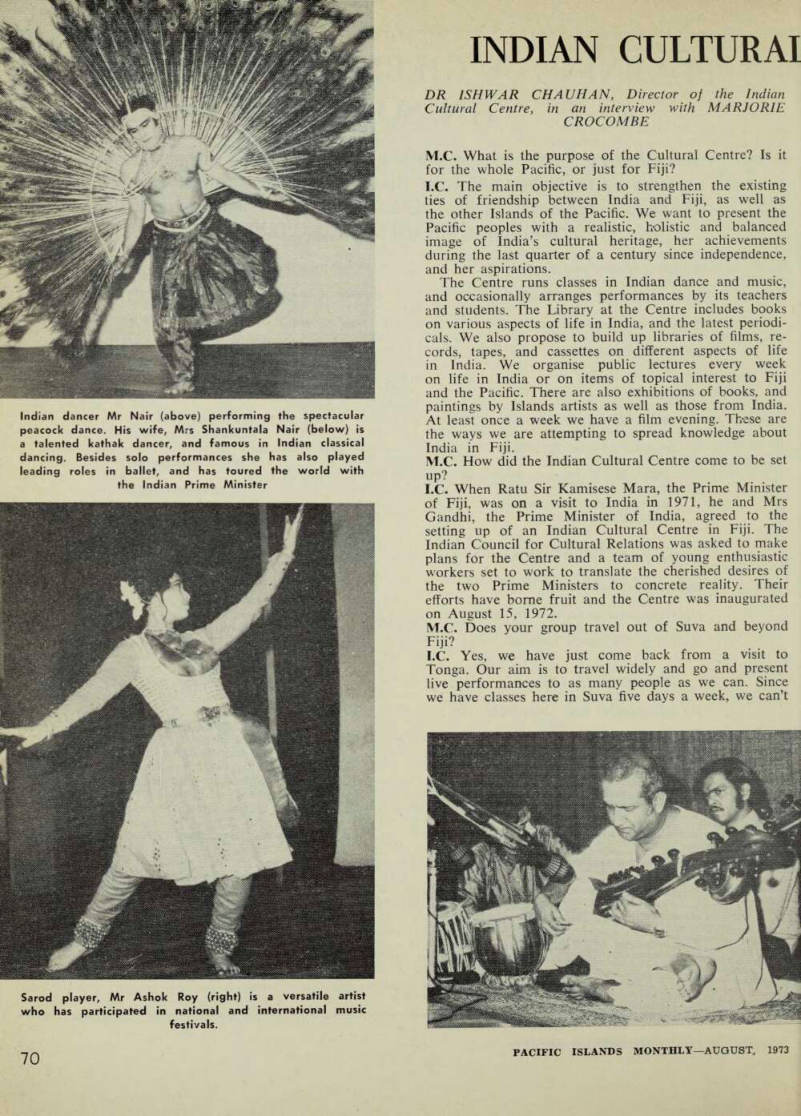
Indian dancer Mr Nair (above) performing the spectacular peacock dance. His wife, Mrs Shankuntala Nair (below) is a talented kathak dancer, and famous in Indian classical dancing. Besides solo performances she has also played leading roles in ballet, and has toured the world with the Indian Prime Minister
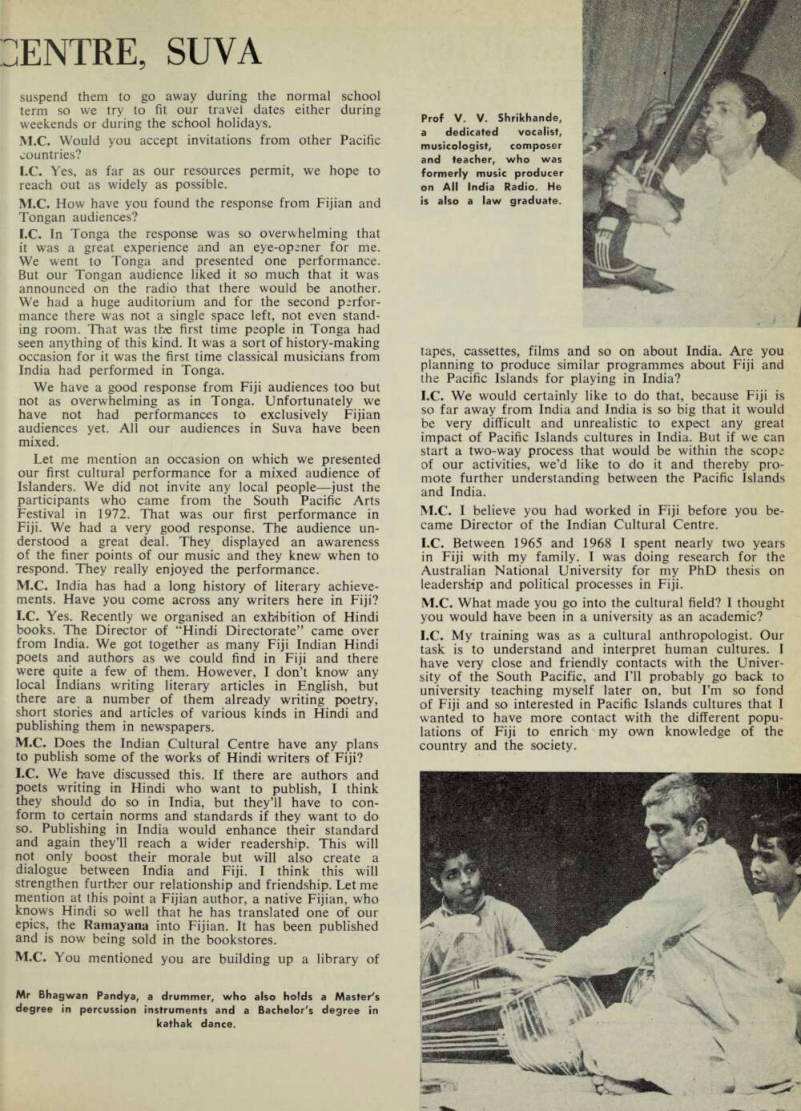
Sarod player, Mr Ashok Roy (right) is a versatile artist who has participated in national and international music festivals.
suspend them to go away during the normal school term so we try to fit our travel dates either during weekends or during the school holidays.
M.C. Would you accept invitations from other Pacific countries?
I.C. Yes, as far as our resources permit, we hope to reach out as widely as possible.
M.C. How have you found the response from Fijian and Tongan audiences?
I.C. In Tonga the response was so overwhelming that it was a great experience and an eye-opener for me.
We went to Tonga and presented one performance.
But our Tongan audience liked it so much that it was announced on the radio that there would be another.
We had a huge auditorium and for the second perfor mance there was not a single space left, not even stand ing room. That was the first time people in Tonga had seen anything of this kind. It was a sort of history-making occasion for it was the first time classical musicians from India had performed in Tonga.
We have a good response from Fiji audiences too but not as overwhelming as in Tonga. Unfortunately we have not had performances to exclusively Fijian audiences yet. All our audiences in Suva have been mixed.
Let me mention an occasion on which we presented our first cultural performance for a mixed audience of Islanders. We did not invite any local people—just the participants who came from the South Pacific Arts Festival in 1972. That was our first performance in Fiji. We had a very good response. The audience un derstood a great deal. They displayed an awareness of the finer points of our music and they knew when to respond. They really enjoyed the performance.
M.C. India has had a long history of literary achieve ments. Have you come across any writers here in Fiji?
I.C. Yes. Recently we organised an exhibition of Hindi books. The Director of “Hindi Directorate” came over from India. We got together as many Fiji Indian Hindi poets and authors as we could find in Fiji and there were quite a few of them. However, I don’t know any local Indians writing literary articles in English, but there are a number of them already writing poetry, short stories and articles of various kinds in Hindi and publishing them in newspapers.
M.C. Does the Indian Cultural Centre have any plans to publish some of the works of Hindi writers of Fiji?
I.C. We have discussed this. If there are authors and poets writing in Hindi who want to publish, I think they should do so in India, but they’ll have to con form to certain norms and standards if they want to do so. Publishing in India would enhance their standard and again they’ll reach a wider readership. This will npt only boost their morale but will also create a dialogue between India and Fiji. I think this will strengthen further our relationship and friendship. Let me mention at this point a Fijian author, a native Fijian, who knows Hindi so well that he has translated one of our epics, the Ramayana into Fijian. It has been published and is now being sold in the bookstores.
M.C. You mentioned you are building up a library of
tapes, cassettes, films and so on about India. Are you planning to produce similar programmes about Fiji and the Pacific Islands for playing in India?
I.C. We would certainly like to do that, because Fiji is so far away from India and India is so big that it would be very difficult and unrealistic to expect any great impact of Pacific Islands cultures in India. But if we can start a two-way process that would be within the scope of our activities, we’d like to do it and thereby pro mote further understanding between the Pacific Islands and India.
M.C. I believe you had worked in Fiji before you be came Director of the Indian Cultural Centre.
I.C. Between 1965 and 1968 I spent nearly two years in Fiji with my family. I was doing research for the Australian National University for my PhD thesis on leadership and political processes in Fiji.
M.C. What made you go into the cultural field? I thought you would have been in a university as an academic?
I.C. My training was as a cultural anthropologist. Our task is to understand and interpret human cultures. I have very close and friendly contacts with the Univer sity of the South Pacific, and I’ll probably go back to university teaching myself later on, but I’m so fond of Fiji and so interested in Pacific Islands cultures that 1 wanted to have more contact with the different popu lations of Fiji to enrich my own knowledge of the country and the society.
Mr Bhagwan Pandya, a drummer, who also holds a Master's degree in percussion instruments and a Bachelor's degree in kathak dance.
Prof V. V. Shrikhande, a dedicated vocalist, musicologist, composer and teacher, who was formerly music producer on Ail India Radio. He is also a law graduate.