* Footnotes
pp. 30-31 · Read in the full issue
OAPUA New Guinea’s Chief Minister recently A put the cat among the pigeons when, open ing a display of artifacts at the PNG Museum and Art Gallery, he referred to the destruction of traditional values by “a western cult known as Christianity”.
I think that fair-minded readers of PIM will agree that, during almost seven years as a PIM columnist, I have not obtruded religion on this page, though I must admit that 1 have sometimes had a good deal to say about the mission contri bution to education. But a bait as tempting as this one is just too hard to resist. I will try not to be tedious.
The first thing I would say is this: that if the four Galilean fishermen who became Jesus’ first disciples, and for that matter Jesus himself, were to re-appear on earth at this moment, they would find themselves far more at home in a Paguinean fishing village than in London, New York,
Sydney, or even Port Moresby.
And if they did turn up in Port
Moresby, they would probably
make for one of the shanty settle ments rather than for the Gateway Hotel.
Naturally so. For the life-style and the traditional values of Galilean fishermen and carpenters in the first century AD had far more in common with the Mela nesian life-style and traditional values than with those of the 20th
century western technological culture. By the same token, the message of Jesus is more readily understood by, and certainly more acceptable to, Melanesians than to people of the technological West.
Indeed it is not hard to envisage a time in the not-too-distant future when the islands of the Pacific will be the last foothold on earth of Christian values, which most people in the West have either renounced or pay merely lip service to. At that point, one hopes, the Pacific will start sending missionaries to re-christianise the West.
But all this is, of course, not what Mr Somare
With Percy Chatterton
in Port Moresby
Mini-skirts, beer and other cults
was talking about. He was talking about institu tional Christianity, as brought to Papua New Guinea by 19th century European missionaries.
And it is true that their activities did have a destructive effect on traditional values. Some oi these were perhaps values that the missionaries could hardly be expected to live with, and which were not much loss anyway. But others were values that could have been, and should have been, preserved.
It is attractive to speculate on what might have been if the early missionaries had been content
to proclaim Christian beliefs and Christian values, and leave Pagui neans to build their own “cult” around them. Attractive, but nol at this stage very useful.
Substituting drums and conch shells for organs and harmoniums, translating western rites intc Paguinean languages, and build ing churches that look like ham tambaran (ancestral spirit house) are poor palliatives at best.
I think, though, that it is fail
to point out that Christianity is not the only western cult to bring its impact to bear upon traditional Paguinean values. The western cult of individualism, the western cult of affluence and western concepts of law’n’order have all left their mark, as has, above all, the western cult of beer.
This last-named cult, completely foreign tc the Melanesian way of life, has probably wrought more havoc among traditional values in 10 years than Christianity has done in 100. Yet on this destructive western cult our national leaders are strangely silent, and continue to drag their feet in implementing the recommendations of the Com
mission of Inquiry into Alcoholic Drink which ;turned in its report in 1971.
No, this is not a temperance lecture. All I ask is that our nationalists be honest with themselves :and with us, and recognise impartially the western origin alike of the cults they criticise and the suits they embrace.
The Chief Minister has expressed himself in favour of freedom of religion, adding that it ■should include traditional religion.
The short answer is that it does. Section 17 of Ithe Human Rights Ordinance, 1971, which I sponsored and Mr Somare helped to put on the statute book, reads as follows: (1) All persons have the right to freedom of conscience, thought and religion, including free dom to change their religion or belief, and freedom, either alone or in community with others and in public or in private, to manifest and propagate their religion or beliefs in worship,
teaching, practice and observance.
So that there shall be no doubt about it at all, the Section continues: (2) References in Subsection (1) of this section to religion and to beliefs include references to traditional religious beliefs of the indigenous inhabitants of the Territory.
I am glad that this point was spelt out so clearly. But it is open to question whether many Paguineans really want to perpetuate traditional religion. Among one of the two groups I know best, the Motu people of the Central District, there is currently a revival of interest in tradi tional dancing, a revival which I personally welcome. But the dances are being danced as entertainment, not as the religious ritual they once were.
Or take Mr Somare’s special interest —artifacts.
In some parts of Papua New Guinea, and especially in Mr Somare’s Sepik homeland, there are artifacts which had religious significance. I can well understand Mr Somare’s anger that some of these sacred objects have been either destroyed by fanatics or exported by rapacious entrepreneurs. Let us by all means preserve and respect those which are left. But it does not seem realistic to suppose that future generations of Paguineans will continue to believe in their sacred properties.
The word “traditional” is being sadly over worked and misused these days. There is a good deal of what may be called “instant tradition” abroad in the land. A “tradition” is thought up overnight to bolster an argument or turn a quick dollar, and next morning is proclaimed to have been “the custom of our people from time im memorial”.
The radio announcers are the worst offenders.
Not long ago I heard a song made up and sung by one of our local string bands (another western cult destructive of traditional values!) described by an enthusiastic announcer as “traditional”, for no better reason, apparently, than that the words, redolent of the sentiment and sentiment ality of Nashville, Tennessee, were in a kind of Motu which would have given the performers’ grandparents the horrors.
We badly need more traditional tradition.
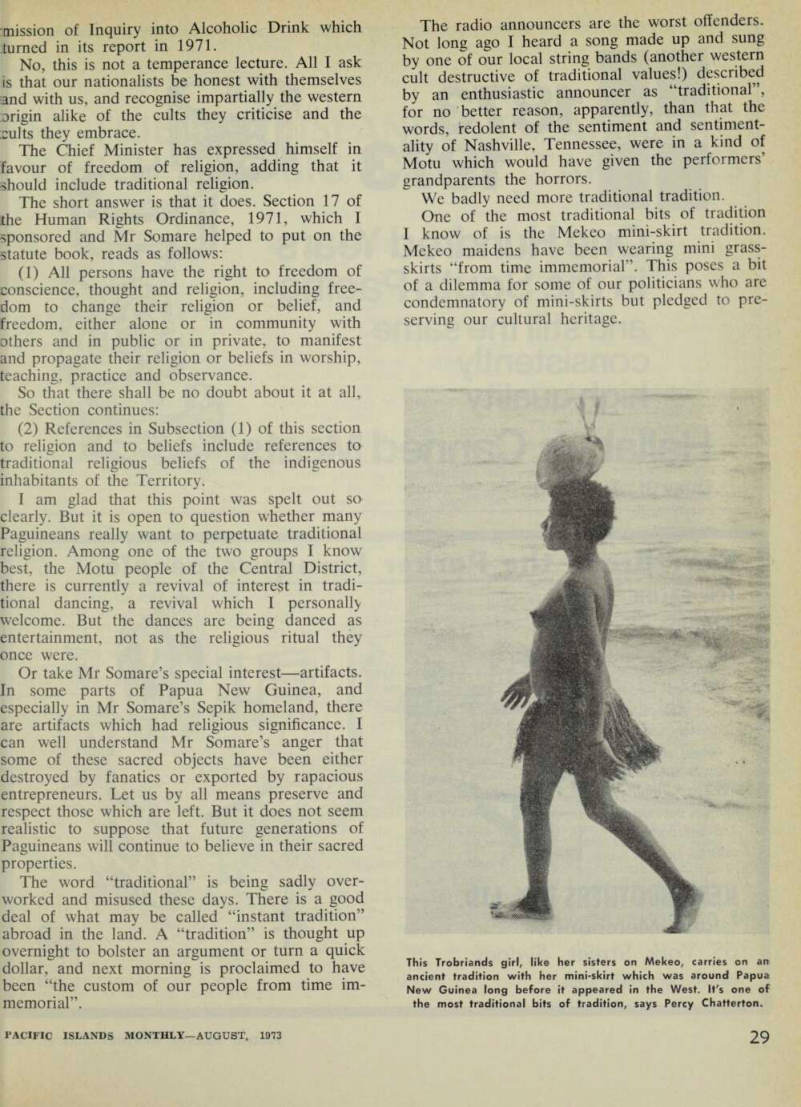
One of the most traditional bits of tradition 1 know of is the Mekeo mini-skirt tradition.
Mekeo maidens have been wearing mini grass skirts “from time immemorial”. This poses a bit of a dilemma for some of our politicians who are condemnatory of mini-skirts but pledged to pre serving our cultural heritage.
This Trobriands girl, like her sisters on Mekeo, carries on an ancient tradition with her mini-skirt which was around Papua New Guinea long before it appeared in the West. It's one of the most traditional bits of tradition, says Percy Chatterton.