The Editor's Mailbag
pp. 23-27 · Read in the full issue


Solomons History
I read with great interest your (correspondent, Mrs Seton’s letter in tthe March issue of PIM. As a native ISolomon Islander, I’d very much like ito add my voice to hers in what I feel is an opportune warning against ithe apparent laxity with which we Solomon Islanders in particular, view ithe possibility of developing our own history.
One of the reasons for this negli gence, I personally feel, has to do with the way our past and present educational and national planners so far seem to have offered no favour able incentives for the development of this field. Mrs Seton has indeed outlined a great deal, which to my mind provides a rare dish of highly nutritious food for the thinking mind.
Personally, I feel and would hope that our people realise the urgency Df the need to collect and compile ;he unwritten history of our country md its people. Further, I wish our people knew that it was about time ve Solomon Islanders started re jecting our thinking inwards, as far is history is concerned generally, to survey our past, both prior to and since the coming of the white man; md to begin to have serious respon sibility for its documentation and jossible utilisation in the school’s mrriculum.
So far so good. However, my one egret about Mrs Seton’s letter was hat she presumably had entertained i very grim view of the very essential ole which I think we Solomon slanders, particularly our potential listoriographers, could very well play n writing as well as in teaching our >wn history. Thus, to me it was rather infortunate to find both Mrs Seton md the archivist Mr Burne (May, 973) going on to such great length md anxiety about what to them yould be an irrelevant and invalid istory if the natives were allowed a and in its documentation, I am fearful of the fact that the listory so advocated by Mrs Seton yould, in this regard, fall short of he kind of history which I would all, to use her terms, “Solomon His ary”. If one were to be particularly asty about it, one could very well ay: “It is no history of the Solo ion Islands”, as it would be, quite rankly, only the history of the Good Colonial Samaritans in the )ark Solomons”. One of course
should not always believe in the notion that all government reports, missionary documents and the per sonal reminiscences of the expatriate community in the Solomons are necessarily infallible. We do need to know that even the most capable of foreign researchers have their short comings as far as interpreting native beliefs, concepts and actions and other typically Melanesian phe nomena are concerned.
I feel that we Solomon Islanders, who have the necessary foresight, must do all we can to avoid the de velopment of a corruptible, foreign oriented literature which others as sume to be the “History of the Solo mons”. As I said, such history can never be really ours without equal collaboration by native historio graphers in its compilation, especially in this day and age. Gone must be the days in which all we were good for was to act as informants, inter preters or carriers for foreign re searchers.
Develop our history by all means.
But it is high time we Solomon Islanders saw a genuine and unbiased piece of literature about the Solo mons and its people for a change. In many African countries, where the change came about too late, African historiographers have had, and are having, to rewrite the works of their foreign counterparts. We can not afford the time and the money to do the same in the Solomons.
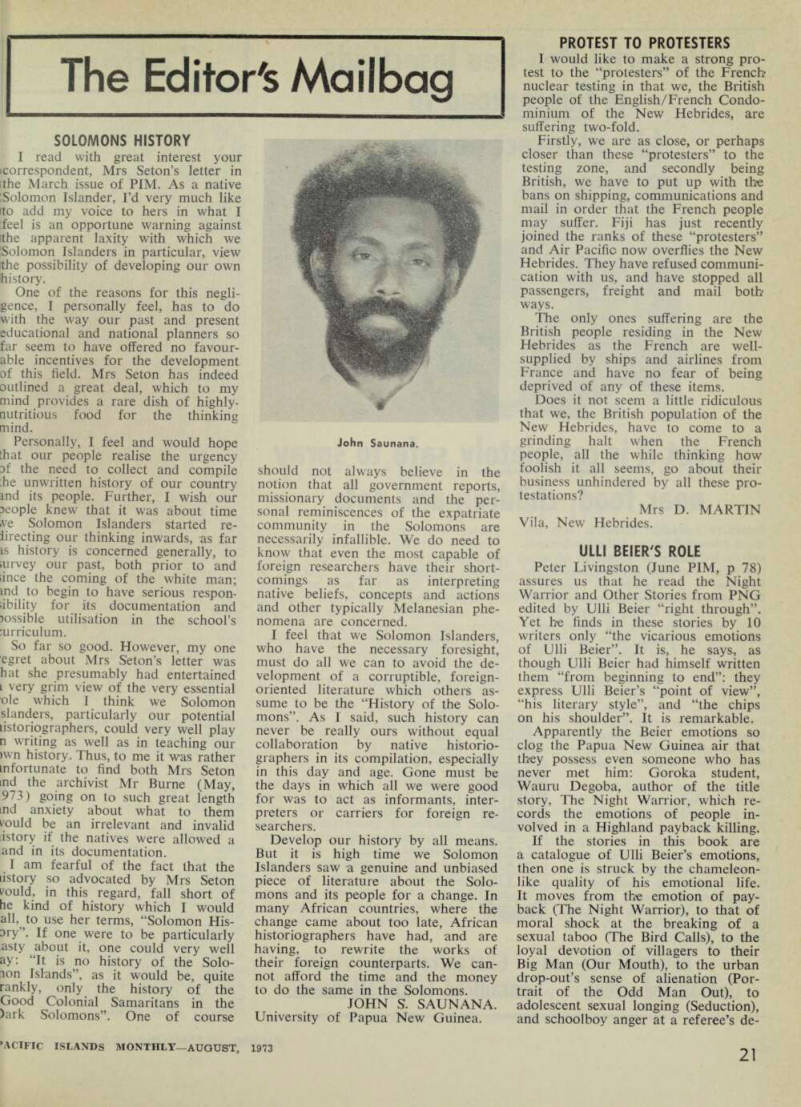
John S. Saunana.
University of Papua New Guinea.
Protest To Protesters
I would like to make a strong pro test to the “protesters” of the French nuclear testing in that we, the British people of the English/French Condo minium of the New Hebrides, are suffering two-fold.
Firstly, we are as close, or perhaps closer than these “protesters” to the testing zone, and secondly being British, we have to put up with the bans on shipping, communications and mail in order that the French people may suffer, Fiji has just recently joined the ranks of these “protesters” and Air Pacific now overflies the New Hebrides. They have refused communi cation with us, and have stopped all passengers, freight and mail both ways.
The only ones suffering are the British people residing in the New Hebrides as the French are well supplied by ships and airlines from France and have no fear of being deprived of any of these items.
Does it not seem a little ridiculous that we, the British population of the New Hebrides, have to come to a grinding halt when the French people, all the while thinking how foolish it all seems, go about their business unhindered by all these pro testations?
Mrs D. Martin
Vila, New Hebrides.
Ulli Beier's Role
Peter Livingston (June PIM, p 78) assures us that he read the Night Warrior and Other Stories from PNG edited by Ulli Beier “right through”.
Yet he finds in these stories by 10 writers only “the vicarious emotions of Ulli Beier”. It is, he says, as though Ulli Beier had himself written them “from beginning to end”: they express Ulli Beier’s “point of view”, “his literary style”, and “the chips on his shoulder”. It is remarkable.
Apparently the Beier emotions so clog the Papua New Guinea air that they possess even someone who has never met him: Goroka student, Wauru Degoba, author of the title story, The Night Warrior, which re cords the emotions of people in volved in a Highland payback killing.
If the stories in this book are a catalogue of Ulli Beier’s emotions, then one is struck by the chameleon like quality of his emotional life.
It moves from the emotion of pay back (The Night Warrior), to that of moral shock at the breaking of a sexual taboo (The Bird Calls), to the loyal devotion of villagers to their Big Man (Our Mouth), to the urban drop-out’s sense of alienation (Por trait of the Odd Man Out), to adolescent sexual longing (Seduction), and schoolboy anger at a referee’s de-
John Saunana.
Letters
cision (Riotous Soccer), to fierce anti white and anti-colonial feeling (Be tel Nut is Bad Magic for Aeroplanes), and so on.
And the point of view. Can anyone who has read Russell Soaba’s very urban stories, with their Camusian discontent, their, at times, almost Swiftian protest against humanity, seriously confuse their point of view with that of a self-conscious Yega traditionalist like Arthur Jawodimbari, whose story, The Bird Calls, is written from within the context of a tribal society with its complex tissue of in terdependence, its taboos, its keen awareness of the presence of the spirits?
As for style, I presume that what makes Peter Livingston doubt whether the stories should be described as “English literature” (whatever that is), is the final story, written by Tro briand Islander, John Kasaipwalova.
John Kasaipwalova said once; “When I think in plestok (Pidgin for ‘mother tongue’) and write in English, that is ‘Niuginian English’.” By using two kinds of English—a some what caricaturish Niuginian English, and a rather highflown, academic English in his story—he is saying some thing about the twofold orientation of the student characters: towards their traditional culture on the one hand, and towards western culture on the other.
It’s unfortunate that Peter Living ston cannot understand these admit tedly artificial languages. However, the language of Kumalau Tawali’s story is less eccentric, but also illustrates the phenomenon, Niuginian English.
In this case, it is, I suspect, a language forged from the idioms of Manus speech. It is not hard to under stand. The plain fact of the matter is of course, that English is now “set loose in the world”, and old colonia lists and paternalists may rant and rage as they will: it’s independent now.
It is difficult in the compass of a short story to express the essence of a personality, a culture, a point of view. The writers of these stories come from eight culturally distinct areas of Papua New Guinea, and from two other parts of Melanesia, namely BSIP and the New Hebrides (although all the stories were actually written in PNG). Collectively, they capture something of traditional life and of colonial life; of village, and of urban life. If one reads them at tentively even small clues can give
insight into the differences (and the similarities) of these diverse back grounds.
Lazarus Hwekmarin, a Sepik, sees the river at sunset turned into “boiled sago floating in a pool of water”.
Arthur Jawodimbari, from the Nor thern District, hears the warning of the spirits in the cry of the Koenana bird. Maurice Thompson’s New Hebri dean English contains fragments of French and of his own mother tongue.
John Saunana’s Solomon Island schoolboys wage their own brand of tribal warfare. Russell Soaba’s Niuginian urban young man plays Simon and Garfunkel and shouts against “blind conformist slobs”.
Peter Livingston says the stories “can by no stretch of imagination . . . be described as Melanesian liter ature.” I think there is beginning to be something which I would be pre pared to call Niuginian literature, and I suspect that something that may come to be called Melanesian literature (written literature, as dis tinct from the literature of oral tradi tion) may be emerging. When the history of Niuginian and of Melanesian literature comes to be written, Ulli Beier’s role will come up for scrutiny.
Should that role be seen as catalytic, or determinative; as a phenomenon of the last days of colonialism, or of the first days of independence? It is not a question to be answered by an emotional broadside; it can only be answered by someone sen sitive to the diverse voices of Melanesians. Peter Livingston reminds us of a deaf man who hears only a confusion of sound, or of the white man who complains that all black men look the same.
Kirsty Powell
University of Papua New Guinea
Gilbertese Writing
And Mana
1 completely accept Te Maunaa Itaia’s reply to my letter (June, PIM, p 29); but I feel that the comments made by Mrs Crocombe and Mr Garrett contain some rather unclear thinking on an important matter of principle, so perhaps you will allow me a short come-back.
No-one would deny that folklore may be treated as common property or that a writer may properly express his own emotional response to some thing he has read. But the matter to which I sought to draw attention— in an inevitably over-long letter— was not folklore (like the legend of Nareau) or even a general discussion of the destruction of bangota, but a specific, personal anecdote of which
Letters
20 sentences appeared without acknowledgement in another man’s 37-line poem, not “reworked” but still in the very distinctive style of their author. In fact, it has now been stated that Maunaa Itaia did originally acknowledge his debt to Grimble; it is a pity, in fairness to him, that this was not made clear at the time.
As to the question of copyright, II should have thought that this was not some nasty, sophisticated, West ern imposition which Pacific writers could not be expected in their in nocence to understand, but rather an internationally-accepted legal guarantee of every man’s right to be credited with his own work, and as such of great value to all writers, Pacific or otherwise.
Finally, I am happy to be corrected an the spelling of bangota since I’m not a Gilbertese. You might be interested to hear that, as a result nf part of my original letter being broadcast in Gilbertese on Radio Parawa, several people have told me ;hat they consider I’m right. (There may well be more who think I’m vrong, but they haven’t said so.) \nd sorry, but your picture really ioesn’t show a bangota. Sacred re gains kept in a basket or shell in iide a house are not bangota accord ng to my informants. I understand he term can only refer to shrines in he open air marked by a circle of :oping stones to warn people from iccidentally desecrating them by reading on them. They are quite :ommon.
(Mrs) Vivienne Hayward.
farawa, GEIC.
Funafuti Cyclone
When I was supercargo in the jilbert and Ellice Islands, 1902-14, ve used to call at Funafuti some four »r five times a year.
While there I used to make a point if walking to look at the grave of ten Hird and nearby the plaque bowing the position where Professor Ldgeworth David (later Sir Edge /orth) drilled down in the coral to rove or disprove some Darwinian heory in or about the year 1898.
Vhat I would like to find out is /ere those “Historical Landmarks”
/ashed away?
Neville Chatfield.
Irafton Nursing Home, 2 Bent Street, ►outh Grafton, NSW 2461.
Changing Society
Congratulations to Tautalatasi Malifa for his thoughtful article, The Change, in Mana (PIM, June, p 69).
It was comprehensive and well pre sented. The issue he considers is crucial to the stabilising of any society in change.
There is a big danger of bi-polarisa tion in Pacific societies: many tradi tional-oriented people fail to see the benefits of even selective change, and many change-oriented people are apparently blind to the beneficial aspects of traditional ways. Obviously what the thinking person is looking for is neither one extreme nor the other, but a judicious balance of the old and the new.
It is also vital that the issues of change and the effects of it should be widely discussed, because it needs more than an educated elite to ensure a satisfying balance of the old and the new. Unfortunately it has to be pointed out that all new things, all Western things are not good per se, nor are all indigenous, old things necessarily bad. And vice versa to the conservative elements.
Perhaps many palangi don’t con sider their cultural arrogance in sweeping aside the old ways as “primitive” and “irrelevant”. No society can stand up when its institu tions are under total attack, with often alien structures offered in place.
Package-deal modernisation is an insult to any society’s culture, and a tolerable impact of modernisation can surely be seen only in terms of
a fusion of ideas. The post-indepen dence political system in Western Samoa is an excellent example of such a fusion.
I hope that Tautalatasi will con tinue to write on the issues of his society today, and that many people will be spurred to thought and action by the contributors of PIM, and MANA in particular.
Roger C. Cowell.
Auckland, NZ.
Reaction To Fiji
I am inspired to write supporting some of the remarks in a letter by Mr M. Batten in PIM (June, p 34).
Like Mr Batten, I recently took my family to Fiji for a holiday and we had a most enjoyable time. It is a truly wonderful place for a vacation and I strongly support Mr Batten’s recommendation of Namale Planta tion Resort. Additionally, Castaway resort, where I have stayed on several occasions, is excellent.
I must, however, join Mr Batten in warning intending visitors to Fiji that if they are looking for moderate priced, duty-free goods, buy them elsewhere than at the Nadi Airport duty-free store. A few months ago I purchased an electronic calculator in Singapore for the equivalent of SAI47. I wished to purchase another of these but was disappointed to find the identical model in the Nadi Air port store for 5F275.
Killara, NSW.