Civil War Fear Over
Papua Movement
From a Pert Moresby correspondent
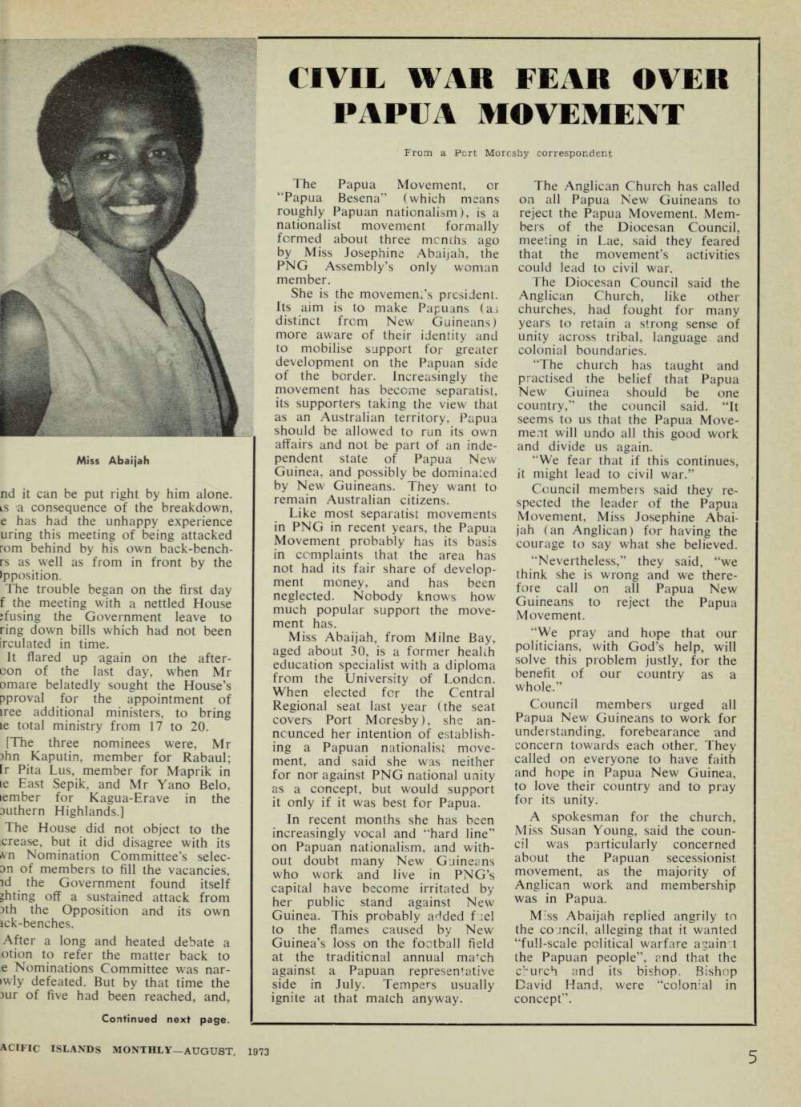
The Papua Movement, or “Papua Besena” (which means roughly Papuan nationalism), is a nationalist movement formally formed about three me mbs ago by Miss Josephine Abaijah, the PNG Assembly’s only woman member.
She is the movement’s president.
Its aim is to make Papuans (as distinct from New Guineans) more aware of their identity and to mobilise support for greater development on the Papuan side of the border. Increasingly the movement has become separatist, its supporters taking the view that as an Australian territory, Papua should be allowed to run its own affairs and not be part of an inde pendent state of Papua New Guinea, and possibly be dominated by New Guineans. They want to remain Australian citizens.
Like most separatist movements in PNG in recent years, the Papua Movement probably has its basis in complaints that the area has not had its fair share of develop ment money, and has been neglected. Nobody knows how much popular support the move ment has.
Miss Abaijah, from Milne Bay, aged about 30, is a former health education specialist with a diploma from the University of London.
When elected for the Central Regional seat last year (the seat covers Port Moresby), she an nounced her intention of establish ing a Papuan nationalist move ment, and said she was neither for nor against PNG national unity as a concept, but would support it only if it was best for Papua.
In recent months she has been increasingly vocal and “hard line” on Papuan nationalism, and with out doubt many New Guineans who work and live in PNG’s capital have become irritated by her public stand against New Guinea. This probably added fuel to the flames caused by New Guinea’s loss on the football field at the traditional annual ma f ch against a Papuan representative side in July. Tempers usually ignite at that match anyway.
The Anglican Church has called on all Papua New Guineans to reject the Papua Movement. Mem bers of the Diocesan Council, meeting in Lae, said they feared that the movement’s activities could lead to civil war.
The Diocesan Council said the Anglican Church, like other churches, had fought for many years to retain a strong sense of unity across tribal, language and colonial boundaries.
“The church has taught and practised the belief that Papua New Guinea should be one country,” the council said. “It seems to us that the Papua Move ment will undo all this good work and divide us again.
“We fear that if this continues, it might lead to civil war.”
Council members said they re spected the leader of the Papua Movement, Miss Josephine Abai jah (an Anglican) for having the courage to say what she believed.
“Nevertheless,” they said, “we think she is wrong and we there fore call on all Papua New Guineans to reject the Papua Movement.
“We pray and hope that our politicians, with God’s help, will solve this problem justly, for the benefit of our country as a whole.”
Council members urged all Papua New Guineans to work for understanding, forebearance and concern towards each other. They called on everyone to have faith and hope in Papua New Guinea, to love their country and to pray for its unity.
A spokesman for the church, Miss Susan Young, said the coun cil was particularly concerned about the Papuan secessionist movement, as the majority of Anglican work and membership was in Papua.
Miss Abaijah replied angrily to the council, alleging that it wanted “full-scale political warfare again:! the Papuan people”, and that the c’-urch and its bishop. Bishop David Hand, were “colonial in concept”.