Student peacemakers in city riots
pp. 6-8 · Read in the full issue
When angry Papuan villagers and New Guineans clashed on July 23 in one of the worst riots Port Moresby has seen, hundreds of Papua New Guinea University students cooled the tribesmen’s tempers. The students marched for 10 miles around the city appealing for calm and unity.
It was the second day of the riots which were sparked off by a Papuan win in a football match against New Guineans. The students’ march, said Chief Minister Michael Somare, had “turned a time of violence into an
expression of unity and peace.” Blame for the violence, which caused damage to houses, shops and cars, was divided between Josephine Abaijah’s Papua Separatist Movement and the football match. Schools closed and public transport stopped, and Mr Somare, who threatened over the radio that anyone who caused trouble would re gret it, said he was considering im posing a curfew. Miss Abaijah called for the removal of all New Guineans from Port Moresby. For a closer look at the Papua Movement, see page 5.
nd it can be put right by him alone, is a consequence of the breakdown, e has had the unhappy experience uring this meeting of being attacked rom behind by his own back-bench rs as well as from in front by the Opposition.
The trouble began on the first day f the meeting with a nettled House jfusing the Government leave to ring down bills which had not been irculated in time.
It flared up again on the after oon of the last day, when Mr omare belatedly sought the House’s pproval for the appointment of tree additional ministers, to bring le total ministry from 17 to 20. [The three nominees were, Mr ihn Kaputin, member for Rabaul; lr Pita Lus, member for Maprik in le East Sepik, and Mr Yano Belo, lember for Kagua-Erave in the authern Highlands.] The House did not object to the crease, but it did disagree with its vn Nomination Committee’s selec an of members to fill the vacancies, id the Government found itself ?hting off a sustained attack from ath the Opposition and its own ick-benches.
After a long and heated debate a otion to refer the matter back to e Nominations Committee was nar iwly defeated. But by that time the aur of five had been reached, and,
Continued next page.
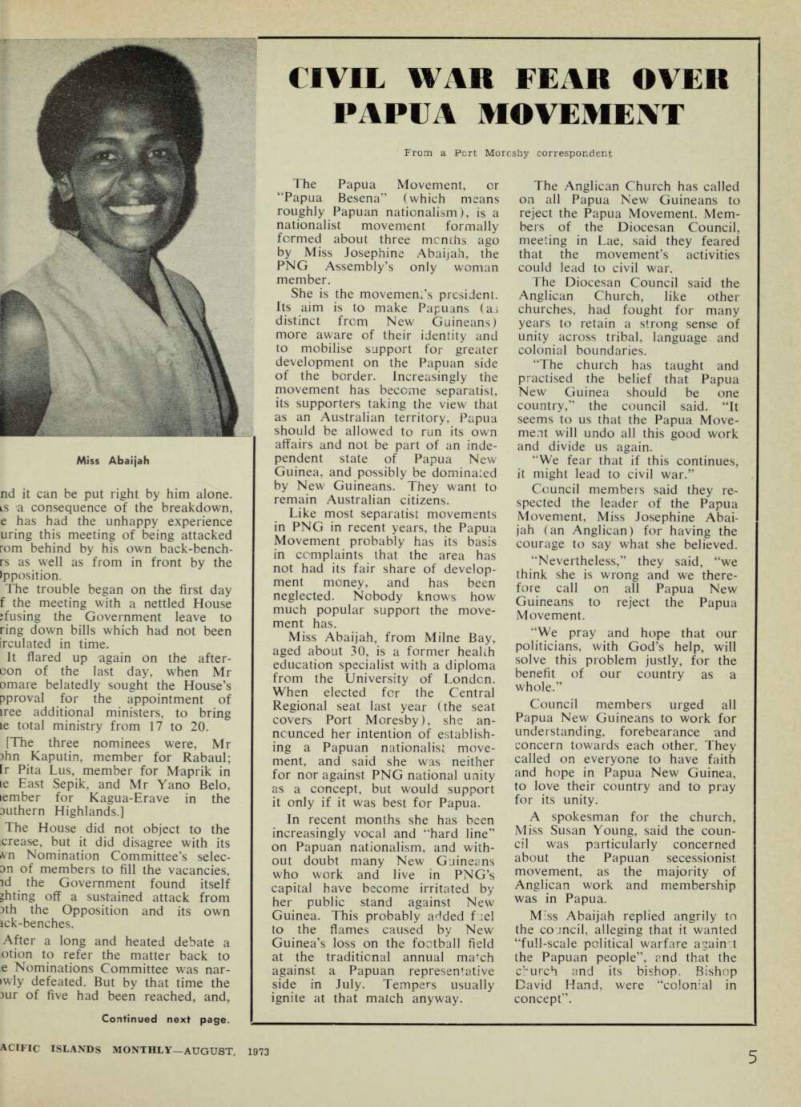
Miss Abaijah
'Rude words hurled^
in accordance with custom, Mr Speaker suspended the sitting till 8 pm. As so often happens on the last day of a meeting, the hour of eight found the House inoperative for lack of a quorum.
So it had to adjourn “to a date to be fixed” without the crucial motion to accept the nominations having been put, and the appointment of new ministers, along with other important business such as a bill to validate the transfer of control over the Public Service from Canberra to Port Moresby, have had to be stood over till the next meeting in August.
It is much to be hoped that Mr Somare can repair the weaknesses that this meeting has revealed.
While 1 have only a muted admiration for some members of his team, I consider Mr Somare himself is the man for the hour. I do not think that there is anyone else in sight who could do as good a job as Chief Minister as he has done, and it would be a tragedy if the coalition he heads were to collapse.
The most far-reaching piece of legislation enacted at this meeting was undoubtedly the bill to set up a National Broadcasting Commission, which as from December 1 next will take over the services at present operated by the Australian Broadcasting Commission at national level,
and by the Administration Depart ment of Information and Extension Services at local levels.
The commission is modelled fairly closely on ABC lines, but, in a fea ture no doubt borrowed from New Zealand, it is authorised to establish and supervise commercial broadcast ing. At another important point also it differs from the ABC model; the functions of chairman and manager will be carried out by one man.
The Opposition was not happy about this arrangement, more especi ally as the chairman/manager will hold office, in effect, at the pleasure of the cabinet. However, its attempt to amend the bill to separate the two jobs was unsuccessful.
Also unsuccessful was its attempt to add to the section dealing with “Function of the Commission” a sub-section requiring the commission to “ensure that the services it pro vides present a balanced outlook and allow for the presentation of views at variance with the mainstream of current political, religious and cultural thought”.
After a lengthy and sometimes heated debate, the bill was passed with only a couple of minor amend ments.
Time will show how justified or unjustified the Opposition’s reserva tions were. It is necessary not only that the commission should be im partial but also that the listening public should have confidence in its impartiality.
This will not happen if the job of chairman/manager is allowed to be come a political plum. It will only
happen if the Government has th( wisdom to appoint to the dual jol someone whose reputation fo integrity and impartiality is unshake able.
Emotion had full play in a “mat ter of public importance” debate oi our latest separatist movement, th Papua Movement, currently bein; spearheaded with truly feminin ferocity by Miss Josephine Abaijai
Mha.
Rude words were hurled, hot ai expelled, mixed metaphors were pei petrated, foes popped up wher friends might have been expectec and vice versa. But the net resu] seems to have been to provide on fiery Papuan nationalist with anothe tub to thump, which was not quit what the promoters of the debate ha planned.
Of the various papers tabled, tw were of special interest. One was a expansion, by Mines Minister Pai Lapun, of an earlier statement of hi on future mining policy. The paper i by way of being a blueprint for mining legislation to be brougl down later in the year.
One thing which seems clear : that never again will mining venture in Papua New Guinea get it as goo as Bougainville Copper Pty has ha it.
The other paper was the report c a committee set up to investigate la' and order problems in the Highland This report gives a quite horrif picture of a situation which is m so much a breakdown of law an order as a total rejection of wester concepts of law and order.
The committee’s recommendatior are drastic and include punishmei inflicted not only on individuals bi on communities, and, in certain ci cumstances, a reversal of the prii ciple that a man is innocent until I is proved guilty.
Finally, as a bonne bouche ar earnest of some good clean fun the August meeting, we have a< vance notice, from Oscar Tammu member for Kokopo and patron < the Mataungan Association, of motion to ban The Pill and disbar the Public Health Departmenl Family Planning Service.
And for good measure, Highlau member Sinake Giregire, who om wanted Papua New Guinea tak< away from Australia and given someone else to administer, now i tends to demand that Austral should pay New Guinea one tho sand million dollars as compensatic for having to take over responsib ity for “the uneconomic Territory Papua”.
A good time should be had by i in the August session.